
Legal Basis and State Standards for Electrical Code Compliance Inspection
Every electrical code compliance inspection rests on a defined legal foundation. State statutes, such as West Virginia Code §29-3C, establish statutory authority to mandate inspector qualifications, set conflict-of-interest prohibitions, and enforce safety rules. At the local level, municipalities derive power through building codes and safety regulations—such as Chapter 124: Electrical Inspections – City of Hudson, NY—which mandate that no new or altered electrical wiring for light, heat, or power be energized without an official certificate of compliance.
These regulations protect public health, safety, and property by ensuring that every connected building meets the strict safety benchmarks set by the National Electrical Code (NEC), state fire codes, and local building standards.
Certified Inspector Requirements and State Jurisdictional Differences
To perform an electrical code compliance inspection, individuals must meet rigorous credentialing prerequisites. Most states require certified inspectors to hold an active master electrician or journeyman license, demonstrate extensive field experience, and complete structured training. For instance, code enforcement officers often progress through a three-level training sequence:
- Level I (Basic): Focuses on single-family residential systems, basic circuiting, and foundational NEC rules.
- Level II (Intermediate): Covers complex multi-family and light commercial systems, plan reviews, and load calculations.
- Level III (Advanced): Focuses on high-voltage industrial installations, complex commercial distribution, and advanced hazardous location compliance.
Jurisdiction rules vary significantly across state lines. In Washington State, rules governed by WAC 296-46B-010 General. Adopted standards. dictate that the state will transition from the 2023 NEC to the 2026 NFPA 70 standard on December 31, 2026. Furthermore, states enforce strict statutory conflict-of-interest rules: an inspector is legally prohibited from inspecting or certifying work installed by themselves or a private contractor that employs them (outside of purely internal quality checks).
Virtual and Third-Party Electrical Code Compliance Inspection Protocols
To prevent construction bottlenecks, several states have modernized the verification process through third-party and virtual inspection frameworks. Under statutes like Florida Statute 553.791, property owners and contractors can engage state-licensed private providers as a direct alternative to local municipal building departments.
Virtual inspections operate via two primary formats:
- Live Video Walkthroughs: A contractor uses a mobile application to walk a licensed inspector through the installation in real time, receiving immediate verbal and digital sign-off.
- Offline Photo Submissions: High-resolution photographs showing panel interiors, wiring methods, grounding electrode connections, and service entrances are uploaded directly into an evaluation portal. Private providers frequently return photo evaluation results within 1 to 2 hours, compared to multi-week municipal turnaround lags.
Once approved, third-party providers issue formal certificates of compliance that hold full legal validity for utility connection and permit closure.
Key Stages of the NEC Inspection Process for New Construction

Navigating an electrical code compliance inspection for a new build or commercial build-out requires passing multiple sequential checkpoints. Inspectors must verify compliance at specific physical milestones before work proceeds:
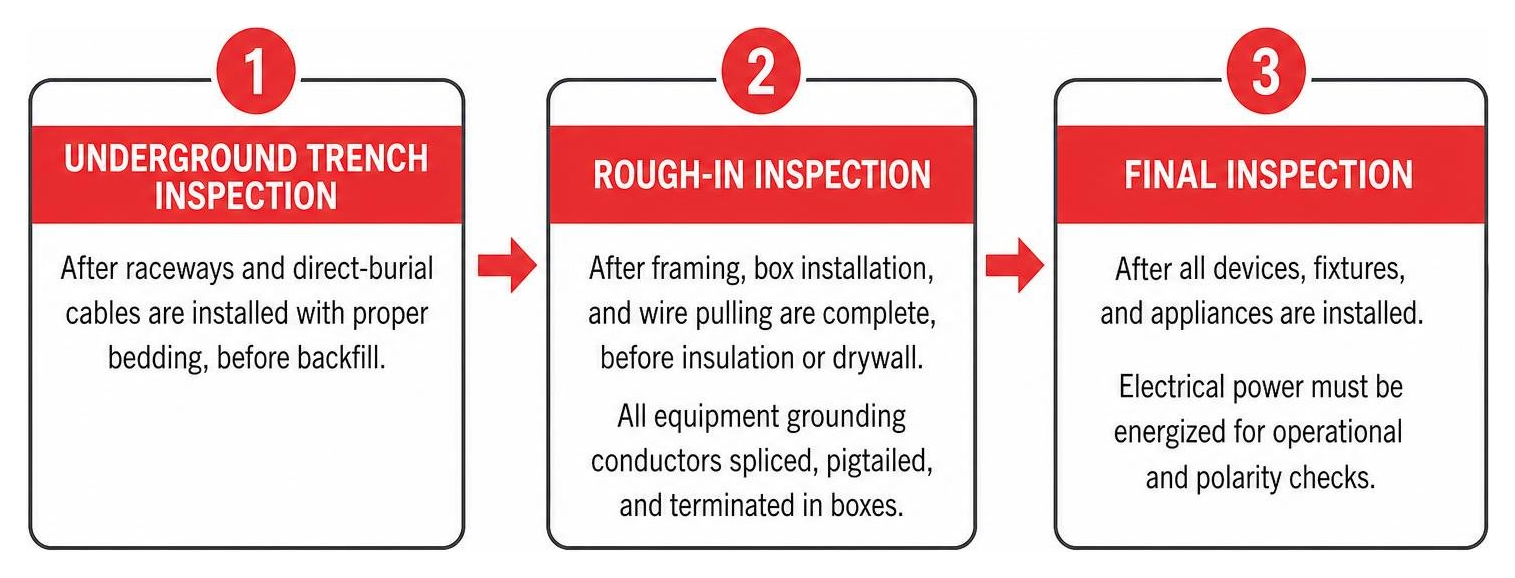
- Underground Trench Inspection: Occurs after raceways and direct-burial cables are laid in excavated trenches with proper bedding, but before backfill is placed. Under regulations like WAC 296-46B-010 General. Adopted standards., contractors must provide written notice a minimum of two working days prior to the requested trench inspection time.
- Rough-in Phase: Performed after framing, box installation, and wire pulling are complete, but before insulation, drywall, or ceiling membranes are installed. All equipment grounding conductors must be completely spliced, pigtailed, and terminated in boxes during this phase.
- Final Inspection: Conducted when all light fixtures, switches, receptacles, and appliances are installed. Under standards detailed in Tenn. Comp. R. & Regs. 0780-02-01-.04 – INSPECTIONS, electrical power must be actively energized to the structure so the inspector can perform operational and polarity checks.
Recognizing How to Tell When Your Home Needs an Electrical Safety Inspection ensures that existing properties receive these critical reviews whenever structural additions, panel changeouts, or service upgrades occur.
Preparing Your Job Site for an Electrical Code Compliance Inspection
Preparation is the single best way to pass an inspection on the first visit. To ensure a smooth review, contractors and property owners should maintain a clean, safe, and accessible jobsite.
Key preparation steps include:
- Posting Inspection Cards: Affix the official permit and jobsite inspection record card in a visible location near the main entry or electrical panel.
- Maintaining Panel Clearances: Clear working space around electrical distribution panels must be completely open. The NEC mandates a working space at least 3 feet deep in the direction of access, 30 inches wide (or the width of the equipment), and 6.5 feet high. This space cannot be used for storage.
- Calculating Box Volume: Ensure junction boxes are not overcrowded. A standard box volume calculation accounts for conductors, internal clamps, support fittings, switches, and receptacles. For example, a box housing four 14/2 cables with ground, a switch, and a receptacle requires a minimum volume of 28 cubic inches.
- Labeling Directories: Panel directories must be legibly printed with clear, specific circuit descriptions (e.g., “Kitchen Receptacles North Wall” rather than just “Plugs”).
- Exposing Box Leads: Ensure box conductor leads extend at least 6 inches in total length and at least 3 inches outside the box opening.
Grounding, Bonding, and Residential GFCI/AFCI Safety Mandates
Residential safety rules in the NEC emphasize shock prevention, arc-fault mitigation, and surge protection. When reviewing single-family or multi-family structures according to an official Electrical inspection checklist for one-family dwellings, inspectors enforce strict physical standards:
- Tamper-Resistant (TR) Receptacles: All 125-volt and 250-volt, 15- and 20-ampere receptacles installed or replaced in dwelling units must be listed as tamper-resistant, featuring internal shutters to protect children from electrical shock.
- Receptacle Spacing Rules: In habitable rooms, outlets must be installed so that no point measured horizontally along the floor line in any wall space is more than 6 feet from a receptacle. Kitchen countertops require receptacle placement so no point along the wall line is more than 24 inches horizontally from an outlet.
- AFCI Protection: All branch circuits supplying 125-volt, 15- and 20-amp outlets in dwelling kitchens, family rooms, bedrooms, hallways, and living spaces must be protected by a listed combination-type Arc-Fault Circuit Interrupter (AFCI).
- GFCI Mandates: Ground-Fault Circuit Interrupter (GFCI) protection is required for 125-volt through 250-volt receptacles in outdoors, bathrooms, kitchens, garages, crawl spaces, basements, and within 6 feet of sinks, bathtubs, or shower stalls.
- Emergency Disconnects & Surge Protection: Modern NEC editions mandate an outdoor emergency service disconnect located on or within sight of the dwelling, marked with high-visibility lettering. Furthermore, Type 1 or Type 2 Surge Protective Devices (SPD) with a minimum nominal discharge current rating of 10kA are required for all primary dwelling service equipment.
Understanding Why You Should Upgrade Old Electrical Outlets and Switches helps property owners modernize legacy systems to meet these lifesaving standards.
Common Violations and Legal Penalties for Unpermitted Electrical Work

Performing electrical work without permits or failing an electrical code compliance inspection carries significant financial and legal risks.
Common code violations include:
- Overcrowded junction boxes lacking required cubic-inch volume.
- Unsecured Nonmetallic-sheathed (NM) cable installed without staple support within 12 inches of entering an enclosure or every 4.5 feet along runs.
- Missing 1/16-inch protective steel nail plates where cables pass through wood framing members less than 1¼ inches from the edge.
- Inadequate working clearance surrounding panelboards.
- Improper grounding electrode conductor size or bonding connections.
The legal and financial liabilities for non-compliance are strict:
As detailed in statutory frameworks like View Full Table, municipal code officials possess complete authority to enter properties, demand proof of compliance, issue stop-work orders, and assess daily fines until non-compliant installations are corrected. Paying attention to 5 Warning Signs Your Commercial Electrical System Needs Immediate Attention can help commercial facility leaders resolve hazardous code defects before inspectors or fire marshals issue formal enforcement notices.
Frequently Asked Questions About Electrical Inspections
What happens if electrical wiring is covered before a rough-in inspection?
If wallboards, insulation, or backfill conceal electrical wiring before a rough-in inspection occurs, the permit holder bears full financial and legal responsibility for uncovering the installation. The inspector or local jurisdiction is not liable for costs associated with tearing out finished materials.
In select jurisdictions, if the concealment was completely inadvertent, state regulations (such as those in Tennessee) may allow the submission of a compliance letter signed by a registered professional engineer. However, this exception is strictly limited—often restricted to one occurrence per 12-month period per entity—and switch covers, light fixtures, and receptacle plates must still be removed for partial visual sampling.
Can a homeowner perform their own electrical work without a license?
In many jurisdictions, a homeowner is exempt from holding a personal electrical license to perform work on their primary single-family residence. To qualify, the homeowner must sign a permit affidavit declaring that they personally own and occupy the property and will perform all work themselves.
However, this licensing exemption has strict legal boundaries:
- It is illegal for unlicensed homeowners to install electrical wiring in two-family dwellings, apartment buildings, townhomes, condominiums, or commercial structures.
- Unlicensed homeowners cannot perform electrical installations on any rental property or building leased to or occupied by others.
How do virtual electrical inspections work?
Virtual electrical inspections leverage mobile digital technology to streamline the approval process without requiring an inspector on site:
- Live Video Streaming: The installer connects with a certified inspector via a secure video call app, moving through the job site to display specific panel interiors, bonding wires, circuit labels, and conduit runs as directed by the inspector.
- Offline Photo Submission: The installer captures high-resolution digital photographs of service equipment, grounding electrodes, box fill, and overcurrent devices, uploading them to an inspection portal.
- Rapid Verification: The certified inspector evaluates the visual evidence against NEC standards and issues an official sign-off or correction list—frequently within 1 to 2 hours of submission.
Conclusion
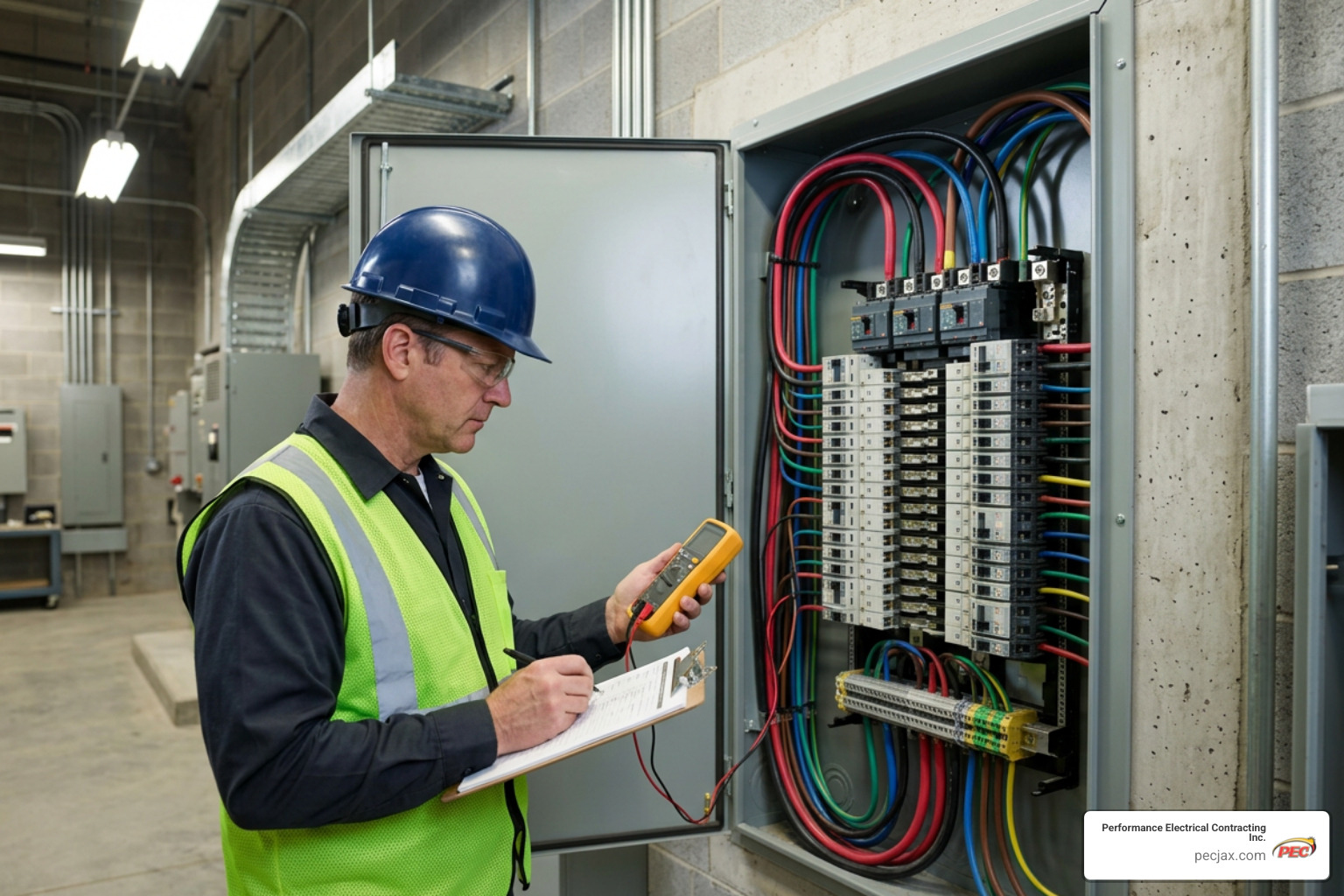
Navigating an electrical code compliance inspection requires attention to details—from initial permit filings and box volume calculations to grounding electrode bonding and GFCI/AFCI protection rules. While code enforcement can feel like a procedural hurdle, its real purpose is protecting lives, reducing property fire hazards, and ensuring electrical infrastructure operates safely for decades. Proactive planning, such as The Importance of Electrical Capacity Planning for Growing Homes and Businesses, sets a solid foundation for long-term power needs while helping ensure every inspection passes smoothly.
At Performance Electrical Contracting Inc., we bring a value-driven, partnership-focused approach to every project. Serving Jacksonville, FL, and the broader Southeast U.S., our pre-qualified team delivers full-service commercial, multi-family, hospitality, infrastructure, and residential electrical installations that meet strict local and national standards. Contact Performance Electrical Contracting Inc. today to discuss your next project, update legacy panels, or navigate your permitting and code compliance requirements on time and within budget.