Restaurant Electrical Service: Powering Safe, Reliable Operations
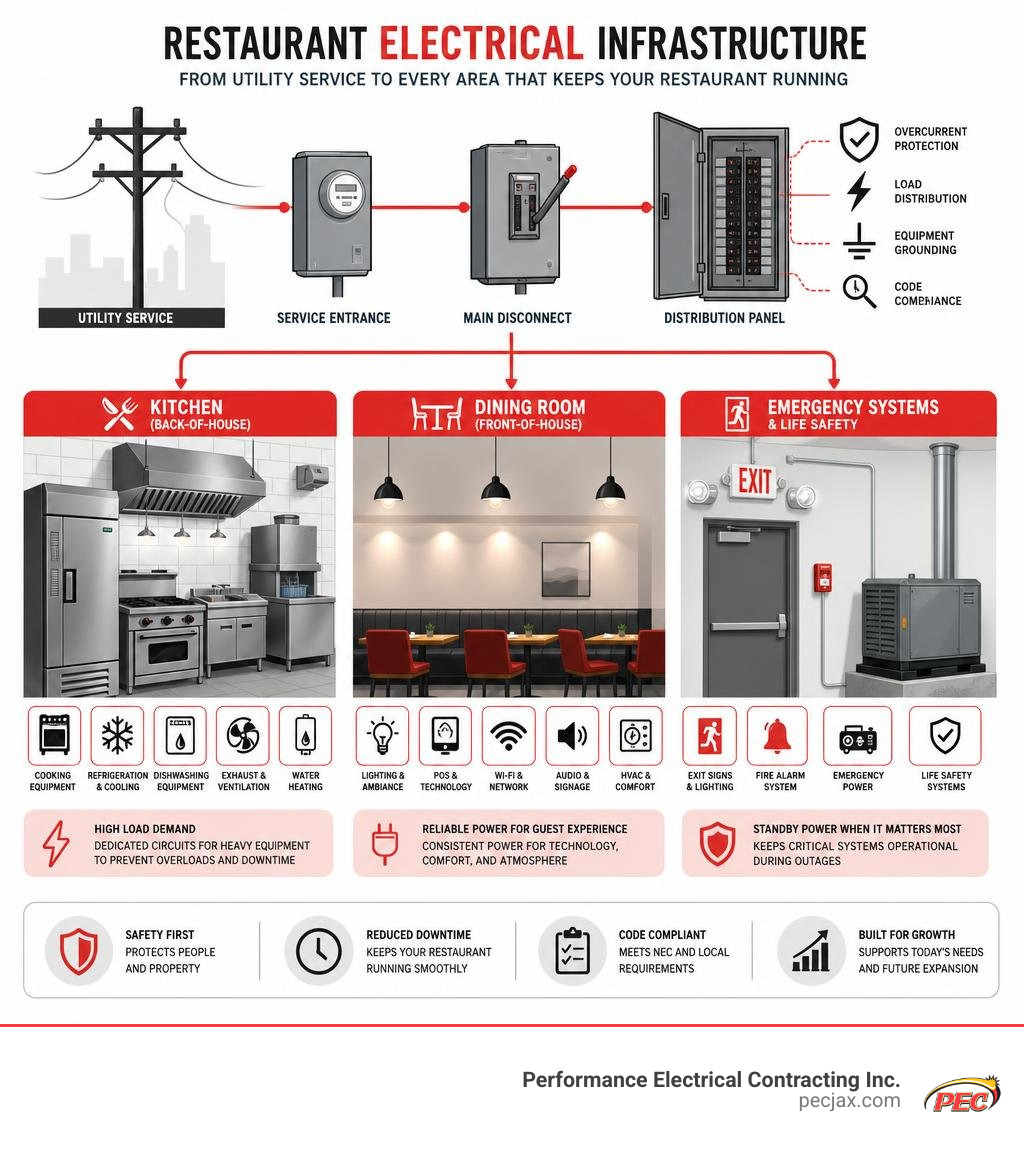
Restaurant electrical service covers the power systems that keep a restaurant or bar safe, open, and functional: kitchen equipment, refrigeration, HVAC, lighting, POS systems, emergency exits, and more. It must be sized for high-demand equipment, designed around wet-area safety rules, and maintained to prevent disruptive outages.
For property managers, the goal is simple: reliable, code-compliant electrical work that protects tenants, staff, guests, inventory, and operating hours.
Restaurants are especially demanding spaces because the back of house may run ovens, fryers, dishwashers, ice machines, walk-in coolers, and exhaust equipment at the same time. Meanwhile, the front of house needs dependable power for payment systems, lighting controls, signage, Wi-Fi, and the atmosphere guests expect.
A well-planned electrical system does more than keep the lights on. It helps avoid tripped breakers during service, supports future equipment additions, meets fire and health inspection requirements, and limits downtime when repairs or upgrades are needed.
Navigating Electrical Demands: Back-of-House vs. Front-of-House Requirements
Per square foot, food service establishments are among the most electrically demanding commercial spaces in existence. Balancing the extreme power draws of heavy equipment with the fine-tuned environmental needs of dining areas requires an understanding of how back-of-house (BOH) and front-of-house (FOH) electrical requirements differ.
Back-of-House Power Demands and Equipment Sizing
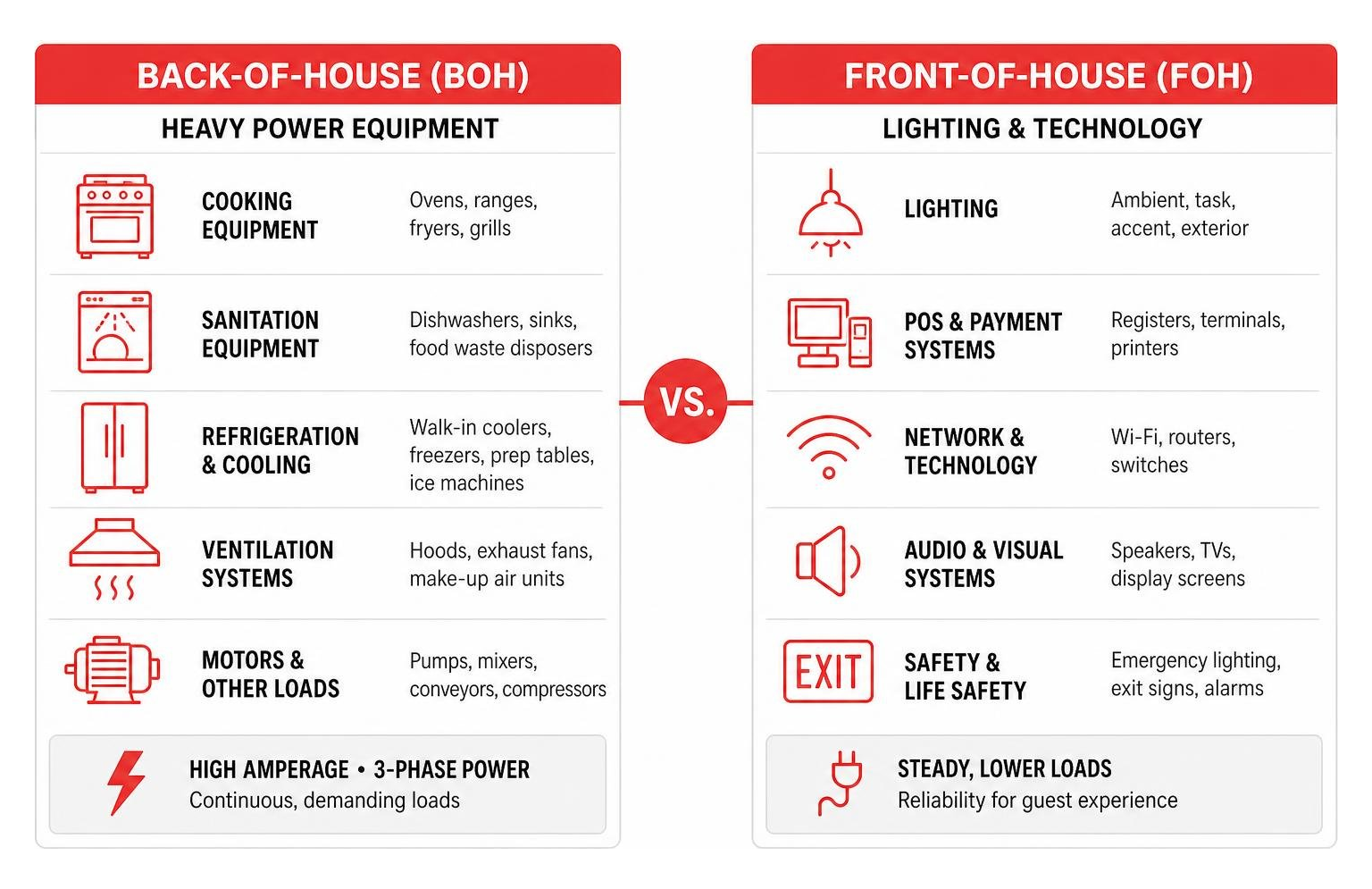
The back of house is an engine room. Heavy cooking equipment, sanitation gear, and continuous refrigeration draw massive electrical current, often requiring three-phase power distribution. Unlike standard single-phase residential or retail panels, three-phase power delivers electricity in three alternating waves, maximizing energy efficiency, reducing wire sizes, and providing smooth, reliable power to heavy motor loads.
When planning BOH electrical infrastructure, circuits must be sized directly from equipment nameplate specifications rather than general estimates. Essential kitchen equipment electrical draws include:
- Commercial Dishwashers: Typical commercial dishwashers pull between 30 and 50 amps on dedicated circuits to power internal water heaters and booster heaters.
- Walk-in Coolers and Freezers: Condenser units and evaporator fans generally require dedicated 20-amp circuits, with larger compressor racks needing heavy three-phase connections.
- Cooking Line Equipment: Commercial electric ranges, convection ovens, fryers, and steamers operate on dedicated 208V or 240V circuits, frequently drawing 30 to 50+ amps per unit.
- Ventilation Hoods and Makeup Air Units: Kitchen exhaust systems require interlocked motor control circuits to ensure air is actively exhausted whenever cooking appliances operate.
Separating these heavy motor and heat loads onto dedicated branch circuits prevents sudden voltage spikes or harmonic feedback from interfering with sensitive electronics elsewhere in the facility.
Front-of-House Ambiance and Essential Restaurant Electrical Service Design
While the kitchen relies on raw power, the front of house revolves around atmosphere and operational technology. Front-of-house restaurant electrical service design focuses on guest comfort, brand expression, and seamless transactions.
Key elements of FOH electrical design include:
- Dimmable Architectural & Accent Lighting: Dimming systems set the mood from morning breakfast to high-energy evening service. Using LED-rated dimmers matched precisely with dimmable LED fixtures prevents annoying flickering or buzzing.
- Point-of-Sale (POS) & Network Infrastructure: Handheld order terminals, digital menu boards, kitchen display systems (KDS), and customer Wi-Fi require isolated, clean power circuits to safeguard against power surges caused by kitchen equipment cycling on and off.
- Energy Code Compliance: In many regions, strict energy codes (such as California’s Title 24 or local energy conservation mandates) dictate automated lighting controls, daylight harvesting, and occupancy sensors in restrooms and office spaces.
- Bar Area & Patio Heating: Wet bar zones require isolated ground fault protection, while outdoor dining spaces often demand dedicated high-amperage circuits for electric patio heaters and landscape lighting.
Professional restaurant electrical services bridge these two environments, giving the kitchen room to roar while keeping the dining room cool, comfortable, and inviting.
How to Calculate Loads and Size Your Restaurant Electrical Service
Sizing a restaurant’s main electrical service panel isn’t a matter of guessing; it is a critical engineering calculation. Undersized panels lead to main breaker trips during peak dinner rushes, while oversized systems waste tens of thousands of dollars in unnecessary utility equipment fees.
To determine service amperage, electrical contractors perform detailed load calculations under the National Electrical Code (NEC). A small cafe or sandwich shop might operate comfortably on a 200-amp single-phase or three-phase service panel. However, full-service commercial kitchens running multiple ovens, fryers, dishwashers, and refrigeration units standardly require 400-amp, 600-amp, or even 800-amp three-phase panels.
Understanding The Industry Standards That Power Commercial Electrical Installation helps owners appreciate how demand factors work. Specifically, NEC Article 220.56 allows designers to apply a demand factor percentage to commercial kitchen equipment when calculating total service size. Because not every fryer, broiler, and oven operates at maximum draw simultaneously, having six or more pieces of kitchen equipment allows a qualified electrician to calculate the total load at 65% of the aggregate nameplate ratings, drastically saving on initial utility distribution costs.
| Restaurant Feature | Small Cafe / Coffee Shop | Full-Service Kitchen & Bar | Large Fine Dining / Banquet Facility |
|---|---|---|---|
| Typical Main Service Amperage | 200 Amps | 400 Amps – 600 Amps | 800+ Amps |
| Phase Requirement | Single-Phase or Light 3-Phase | Standard 3-Phase (208Y/120V) | High-Capacity 3-Phase (208V/480V) |
| Dedicated Appliance Circuits | 5 – 10 Circuits | 20 – 40+ Circuits | 50+ Circuits |
| Primary Lighting Strategy | Ambient LED + Low-Voltage Accent | Dimmable Multi-Zone Control | Automated Scene Control & Title 24 |
| Emergency Power Priorities | Point of Sale & Small Coolers | Walk-In Freezers & POS | Full Cold-Storage & Vent Hoods |
Essential Electrical Codes, Health Standards, and Compliance
Commercial food service operations are among the most heavily regulated business environments. Failing an electrical inspection can delay an opening date or cause an unexpected shut-down from local health authorities. For broader workplace safety context, restaurant owners and property managers can also review OSHA electrical safety guidance alongside local code requirements and licensed electrical contractor recommendations.
Fire Codes, Emergency Systems, and Restaurant Electrical Service Code Mandates
Fire safety and emergency egress mandates strictly govern restaurant build-outs. Standard regulations include:
- NEC 210.8(B) Commercial GFCI Mandates: Ground Fault Circuit Interrupter (GFCI) protection is mandatory for all 125V receptacles installed in commercial kitchens, behind bars, in dishwashing stations, and within 6 feet of any sink or water source.
- Emergency and Standby Lighting (NEC 700/701): Dining rooms, corridors, kitchens, and restrooms must feature battery-backed emergency fixtures and illuminated exit signage. In the event of a total power loss, these systems must maintain emergency illumination for a minimum of 90 minutes.
- Fire Suppression Interlocks: Under NFPA guidelines, kitchen exhaust hood fire suppression systems must be electrically interlocked with gas shut-off valves and high-draw electric cooking appliances beneath the hood. If the fire system triggers, electric power to equipment under the hood must instantly shut down.
- Health Department Documentation: Municipal health departments require documented sign-offs verifying that electrical connections, lighting levels in food prep zones (typically 50 foot-candles minimum), and refrigeration power feeds meet local sanitation standard specifications.
Commercial Kitchen Safety and Grounding Best Practices
Because commercial kitchens are wet, high-heat environments packed with stainless steel appliances, proper grounding and bonding are critical safety concerns. Non-current-carrying metal parts of equipment must be thoroughly bonded to the equipment grounding conductor to prevent accidental electrification of stainless steel prep tables or line equipment.
During installation and maintenance, our technicians implement torque-verified terminations on every circuit breaker and lug connection. High vibrational loads from nearby compressor motors and thermal cycling from high-draw appliances can loosen electrical connections over time, leading to electrical arcing, melted outlets, or panel fires. Periodic arc flash analysis and thermal imaging checks identify loose connections before they cause equipment damage or structural risk.
In-House Troubleshooting vs. Professional Emergency Electrical Repairs
When an outlet stops working or a light flickers during a busy Friday evening shift, manager panic sets in quickly. Knowing what can be safely tested in-house versus when to call a professional keeps staff safe and prevents costly unnecessary service dispatch fees.
Safe DIY Troubleshooting Steps Before Calling a Contractor
Before calling a licensed electrician, restaurant staff can perform several basic safety checks to isolate simple equipment bugs:
- Perform the “Phone Charger Test”: If a kitchen outlet stops powering a countertop blender, unplug the appliance and plug in a simple device like a phone charger. If the phone charges, the electrical outlet and circuit are working fine—the problem lies within the blender itself.
- Check Upstream GFCI Outlets: Commercial GFCI outlets are often wired in series. A tripped GFCI outlet near the prep sink may cut power to working outlets downstream. Inspect all GFCI buttons in the area and press “Reset.”
- Inspect and Toggle Panel Breakers: Open the breaker panel and look for switches resting between the “On” and “Off” positions. To reset a tripped commercial breaker, firmly push the switch all the way to the “Off” position first, wait 10 seconds, and then flip it back to “On.”
- Identify Equipment Overloads: If a breaker trips immediately after turning on two high-draw appliances (like a toaster and a soup warmer on the same line), unplug one device and move it to a different circuit line.
Warning: If a panel feels excessively hot to the touch, produces a strong burning plastic odor, or emits buzzing/crackling sounds, DO NOT attempt to reset breakers. Turn off main power if safe to do so and call an electrician immediately.
Managing Emergency Outages and Minimizing Downtime
When electrical issues extend beyond basic troubleshooting, expert emergency support is vital. Operating data shows that in 2022, restaurant owners spent an average of $496.56 per service call for emergency electrical repairs. Fortunately, professional emergency electric response proves highly effective, boasting a 93% first-time fix rate—meaning only 7% of emergency calls required a follow-up visit.
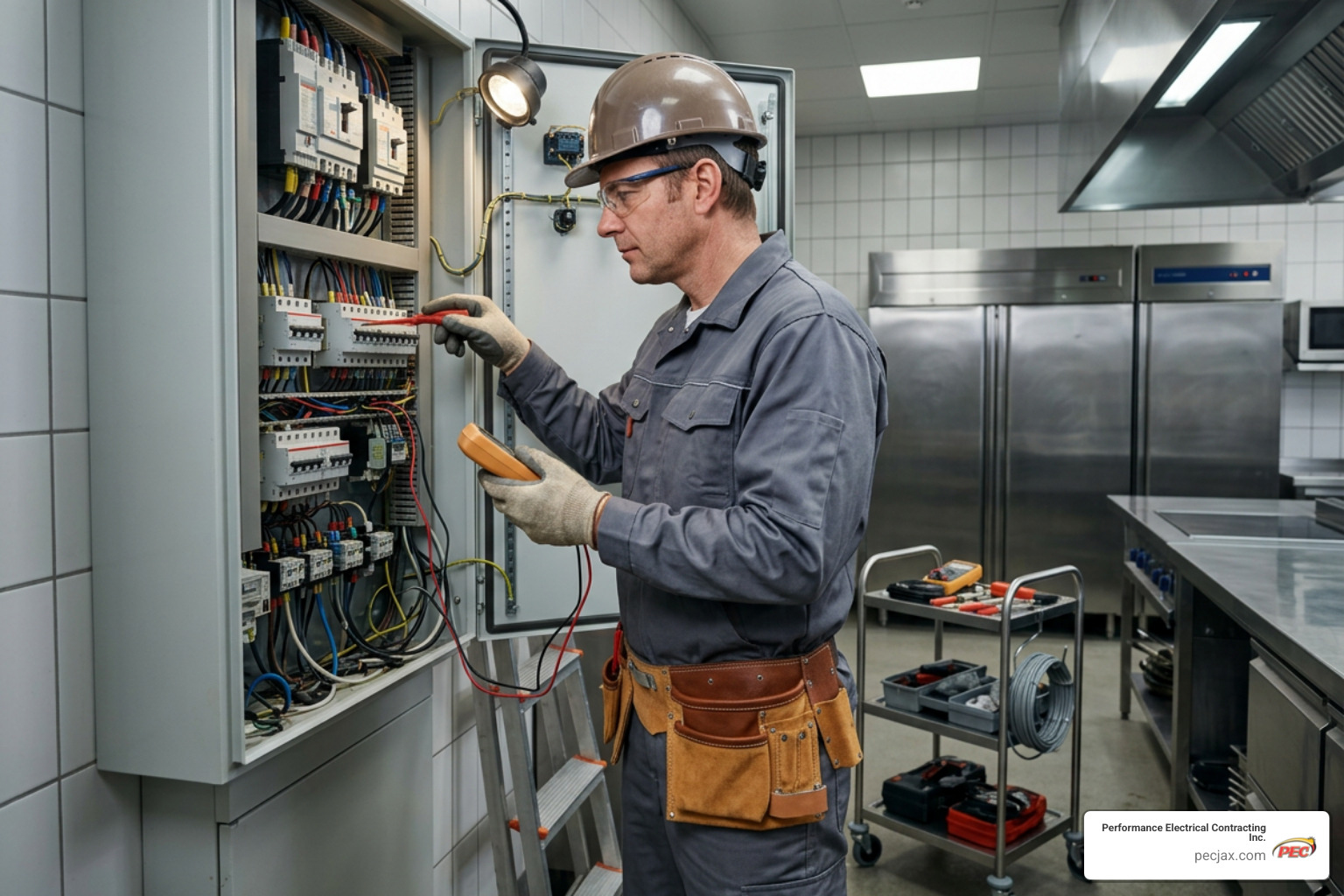
To minimize disruption during critical upgrades or urgent repairs, specialized commercial contractors offer off-hours scheduling between closing shifts and morning prep. Performing panel cutovers or major line replacements during overnight hours ensures your doors remain open during peak revenue shifts.
For specialized regional projects, partnering with an experienced restaurant electrician ensures full compliance with local utility standards and health board mandates.
What to Look For When Hiring a Commercial Electrical Contractor
Not every general electrical contractor is equipped for the intense demands of food service facilities. When evaluating contractors for a new restaurant build-out, renovation, or service contract, consider the following standards:
- Specialized Food Service & Design-Build Experience: Seek contractors with proven expertise coordinating with health inspectors, mechanical HVAC teams, and commercial kitchen equipment suppliers.
- Pre-Qualified Industry Credentials: Ensure the firm holds active state commercial licenses, master electrician certifications, comprehensive liability coverage, and solid community standing.
- Multi-Trade & Scope Coordination: A high-caliber contractor manages every detail from high-voltage main panels down to low-voltage network cabling, security cameras, background audio systems, and custom lighting controls.
- Thorough Panel Mapping & Documentation: At project completion, contractors should hand over clear panel schedules, torque logs, and load calculations so future equipment installations are straightforward.
At Performance Electrical Contracting Inc., we bring a partnership-focused approach to commercial, hospitality, and infrastructure installations across Jacksonville, FL and the Southeast U.S. Delivering projects on-time, on-budget, and strictly to code keeps your kitchen firing and your dining room full.
Frequently Asked Questions About Restaurant Electrical Systems
How do I know if my restaurant needs an electrical panel upgrade?
Common indicators include breaker switches tripping repeatedly during peak operational hours, dimming or flickering lights when heavy kitchen equipment kicks on, visible scorch marks around outlet receptacles, or an inability to add new kitchen appliances without overloading existing circuits. An electrician can evaluate your total nameplate load against existing panel bus bar ratings.
What is the NEC 220.56 kitchen equipment demand factor?
NEC Article 220.56 allows a calculated load reduction for commercial kitchen equipment when six or more electrically operated appliances (such as ovens, fryers, dishwashers, and booster heaters) are used in the facility. Because all appliances rarely run at maximum load simultaneously, the code allows engineers to size main utility feeders to a percentage of the total connected load, saving significant capital during construction.
How can energy-efficient lighting lower restaurant utility costs?
Upgrading to modern commercial LED fixtures coupled with automated smart controls reduces front-of-house lighting energy consumption by up to 75%. Additionally, because LED fixtures generate significantly less radiant heat than older incandescent or halogen lights, air conditioning loads in the dining room drop, lowering monthly electric utility bills year-round.
Conclusion
A successful restaurant requires harmony between culinary talent, warm hospitality, and robust infrastructure. From powering high-draw 3-phase commercial kitchen lines to crafting delicate dining room light settings, high-performing electrical systems form the backbone of your daily operations.
By prioritizing routine preventive maintenance, adhering strictly to NEC codes, and addressing red flags early, property managers and owners safeguard their operations against unexpected closures and costly downtime.
When you need dependable, value-driven execution for your next restaurant build-out, tenant improvement, or system upgrade, trust Performance Electrical Contracting Inc. to deliver exceptional commercial electrical services built for long-term success.