
Commercial Electrical Installation: What Property Managers Should Evaluate
A electrical installation is the complete system of wiring, distribution equipment, protective devices, and connected equipment that safely delivers power throughout a building. For a commercial or multifamily property, evaluating that system means looking beyond whether the lights turn on.
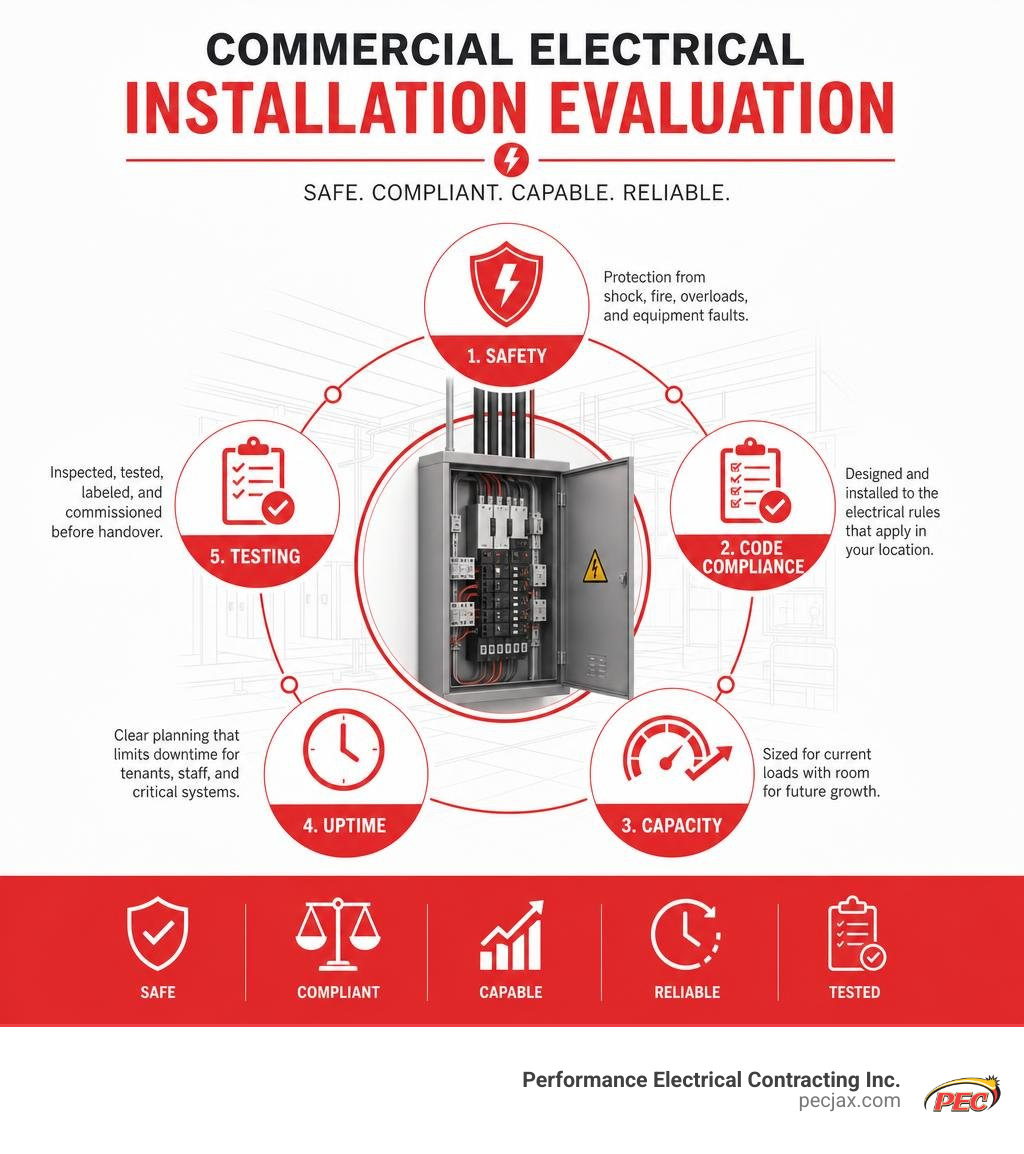
A reliable commercial installation should deliver:
- Safety: Protection from shock, fire, overloads, and equipment faults.
- Code alignment: Work designed and installed to the electrical rules that apply in the building’s location.
- Enough capacity: Service, panels, feeders, and circuits sized for current loads and realistic future growth.
- Minimal disruption: Clear planning that limits downtime for tenants, staff, and critical building systems.
- Testable quality: Documented inspection, testing, labeling, and commissioning before handover.
Commercial electrical work has a high cost of failure. A poorly planned upgrade can interrupt operations, create safety risks, and make future maintenance harder. The right installation approach connects design, safe workmanship, compliant protection, and long-term building performance.
This guide explains the industry standards and site-safety practices that help property managers evaluate electrical work with more confidence.
Navigating Electrical Installation Codes and Safety Frameworks
Operating a commercial facility means balancing rigorous legal mandates with technical technical specifications. When we execute an electrical installation, navigating the framework of statutory laws and non-statutory regulations ensures that every conduit, switchboard, and breaker protects both human life and physical property.
Key Legal Responsibilities Under the Health and Safety at Work Act 1974
At the foundation of modern workplace safety legislation sits the Health and Safety at Work Act 1974. This legislation establishes the legal responsibilities expected of both employers and employees on project sites.
For employers, the law requires creating a safe working environment, maintaining machinery and systems without risk, and providing the necessary instruction, training, and supervision. If a business employs five or more people, it must maintain a clear, written Health and Safety Policy statement. Employers must also post standard workplace posters (typically measuring 595 mm x 415 mm) detailing designated safety contacts and safety representatives.
Employees hold legal duties as well. Every team member must take reasonable care of their own safety and that of others who may be affected by their actions or omissions. Workers are required to cooperate fully with employers, use provided safety gear properly, and refrain from tampering with safety devices.
Enforcement falls to Health and Safety Executive (HSE) inspectors. HSE inspectors possess sweeping legal powers:
- They can enter any workplace unannounced to conduct investigations and inspect facilities.
- They can examine records, require statements, and dismantle or seize dangerous equipment.
- They can issue Improvement Notices (requiring compliance within a set timeframe) or Prohibition Notices (halting hazardous work immediately).
- In severe cases of negligence, inspectors can initiate criminal prosecution against non-compliant companies or individuals.
Statutory versus Non-Statutory Regulations in Practice
In the electrotechnical world, regulations fall into two main categories: statutory regulations (which carry full legal force) and non-statutory regulations (which provide technical benchmarks and codes of practice).
Statutory rules include legislation like the Electricity at Work Regulations 1989. Regulation 4 mandates that all electrical systems must be constructed, maintained, and operated in a manner that prevents danger. It specifically requires that conductors be made dead before work commences whenever feasible.
Non-statutory standards, such as the IEE Wiring Regulations (BS 7671), establish the technical baseline for safe wiring, equipment selection, and installation techniques. Adherence to standards detailed in Requirements for Electrical Installations provides legal defense demonstrating that a contractor exercised all due diligence under statutory law. Modern updates, such as Amendment 3:2024, address critical technologies including bidirectional protective devices—such as bidirectional RCBOs and circuit breakers designed for installations where power flows in both directions due to modern solar PV arrays or battery storage systems.
Furthermore, building infrastructure standards, such as those outlined in S T A T U T O R Y I N S T R U M E N T S 2019 No. 58., reinforce strict spatial layout rules, duct segregation, and switchboard construction standards for public and commercial structures. To keep existing properties safe, facility managers can learn how to tell when your home needs an electrical safety inspection to identify system degradation before it leads to serious non-compliance or failure.
Site Safety Protocols and Personal Protective Equipment
Working around commercial power distribution systems requires strict controls. Eliminating workplace hazards requires combining individual Personal Protective Equipment (PPE) with disciplined, step-by-step procedures.
Essential PPE for Commercial Electrical Installation Work
Personal Protective Equipment acts as the final defense against environmental and electrical hazards on active job sites. On an industrial or commercial electrical installation, standard PPE mandates include:
- Head Protection: Hard hats meeting safety ratings to protect against impact and falling objects.
- Eye and Face Protection: Impact-resistant safety glasses and full arc-flash face shields when working near exposed live components.
- Insulated Gloves and Sleeves: Dielectric rubber gloves rated for specific voltage thresholds, paired with outer leather protectors to resist mechanical punctures.
- Protective Footwear: Steel-toe or composite-toe boots with electrically insulated soles (dielectric rating) to guard against shock and impact.
- Arc Flash Clothing: Flame-resistant (FR) protective suits rated to withstand thermal calories per square centimeter ($cal/cm^2$) during potential arc flash incidents.
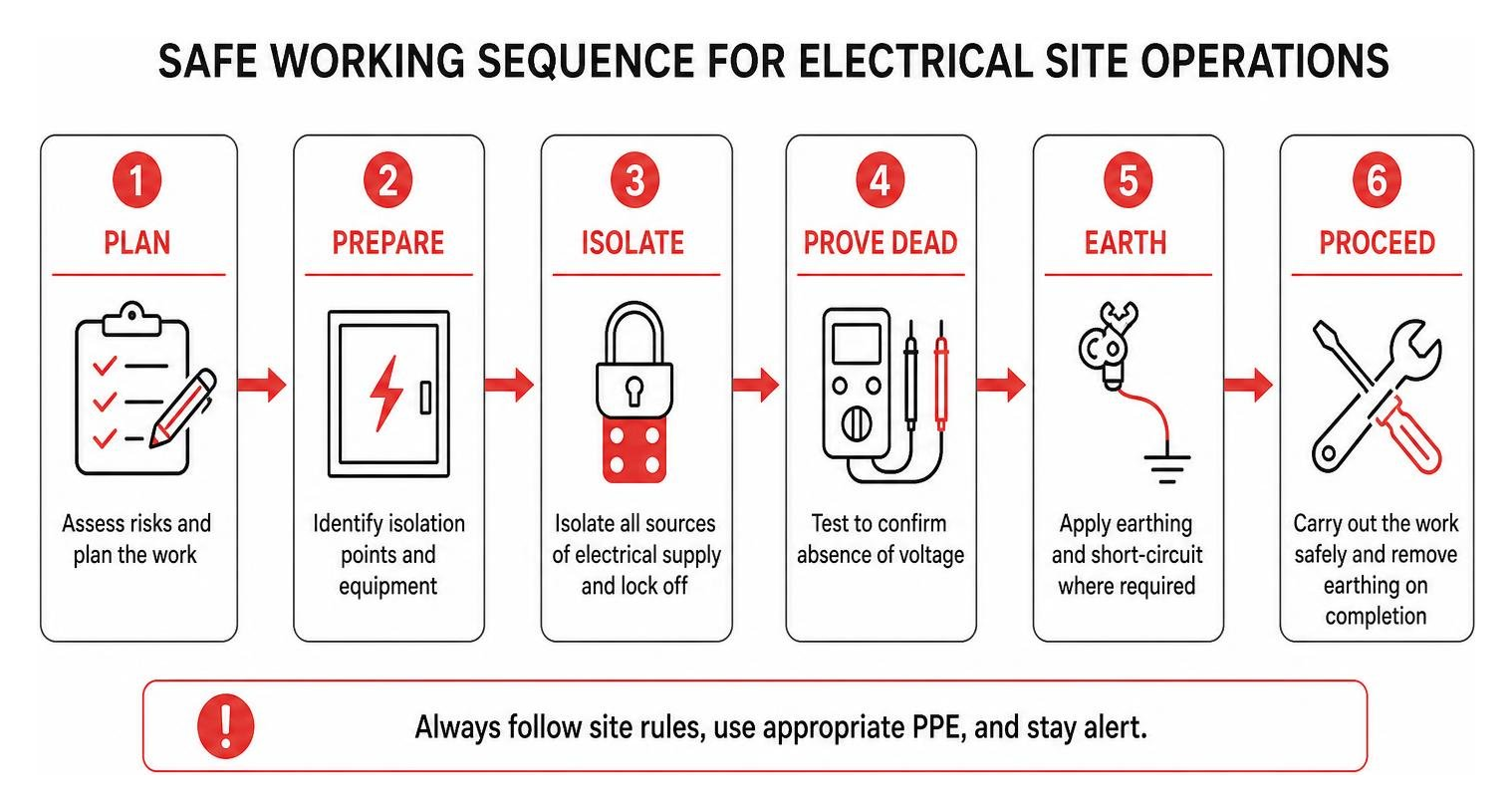
Safe Isolation Steps Before Electrical Installation Testing
Working on energized equipment poses severe risks. Proving a circuit dead through a rigorous safe isolation process is required before anyone touches a conductor.
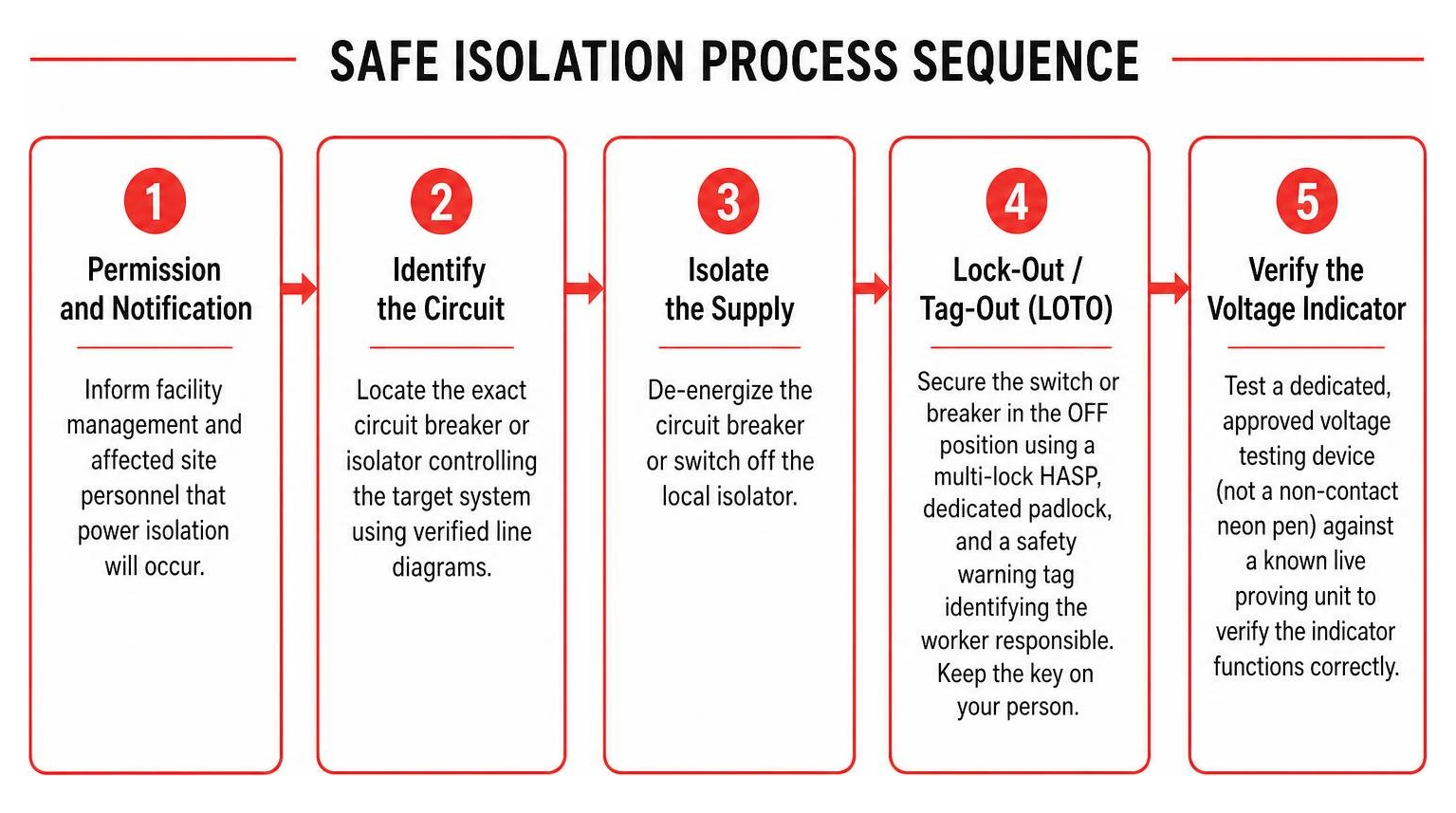
- Permission and Notification: Inform facility management and affected site personnel that power isolation will occur.
- Identify the Circuit: Locate the exact circuit breaker or isolator controlling the target system using verified line diagrams.
- Isolate the Supply: De-energize the circuit breaker or switch off the local isolator.
- Lock-Out / Tag-Out (LOTO): Secure the switch or breaker in the OFF position using a multi-lock HASP, dedicated padlock, and a safety warning tag identifying the worker responsible. Keep the key on your person.
- Verify the Voltage Indicator: Test a dedicated, approved voltage testing device (not a non-contact neon pen) against a known live proving unit to verify the indicator functions correctly.
- Test for Voltage (Proving Dead): Check phase-to-neutral, phase-to-phase, and phase-to-earth on the isolated circuit conductors to confirm zero voltage presence.
- Re-Verify the Indicator: Re-test the voltage indicator against the proving unit to confirm the instrument did not fail during testing.
Safety Signage and Temporary Site Power Standards
Safety signs communicate hazards clearly across complex construction sites. Standard categories include:
- Warning Signs: Triangular with a yellow background and black border/symbol (e.g., “Caution: Risk of Electric Shock”).
- Prohibition Signs: Circular with a red band and diagonal crossbar on a white background (e.g., “No Access for Unauthorized Personnel”).
- Mandatory Signs: Circular with a blue background and white symbol, indicating required actions (e.g., “Eye Protection Must Be Worn”).
- Safe Condition Signs: Square or rectangular with a green background and white text/symbol (e.g., “First Aid Station” or “Emergency Exit”).
For temporary power during active construction, strict voltage rules apply. Standard site supply systems use reduced low-voltage transformers (110 V center-tapped-to-earth), which caps any potential fault shock voltage to earth at just 55 V. To prevent accidental cross-connection, temporary electrical connectors utilize universal color coding:
- Yellow plugs/sockets: 110 V systems (standard temporary site tools and lighting).
- Blue plugs/sockets: 230 V single-phase supplies.
- Red plugs/sockets: 400 V three-phase equipment.
Risk Assessment, Hazardous Substances, and Emergency Response
Proactive hazard identification keeps commercial jobs safe. From hazardous material controls to sudden medical emergencies, clear guidelines ensure workers react properly under pressure.
COSHH 2002 Regulations and Asbestos Management
The Control of Substances Hazardous to Health Regulations (COSHH) 2002 mandates that employers assess and minimize risks associated with chemicals, dusts, solvents, and hazardous materials.
When conducting work on older buildings constructed between 1950 and 1980, asbestos presents a critical hazard. Electricians frequently drill into walls or drop ceiling panels containing asbestos insulators, flash guards, or fireproofing materials. Because asbestos-related illnesses can take up to 20 years to manifest, strict protocols exist:
- Never cut, drill, or disturb suspected Asbestos-Containing Materials (ACMs).
- If suspect insulation or structural paneling is encountered, stop work immediately and report the finding to a site supervisor.
- Formal site surveys must confirm safety before work can resume.
Recognized training programs, like those documented in the City & Guilds Level 1 Diploma in Electrical Installation (7202-01), emphasize these risk assessment procedures during basic trades training to protect young workers and apprentices.
Fire Extinguisher Selection and Electric Shock First Aid
Different fire types require specific extinguishing agents. Using the wrong fire extinguisher on live power distribution gear can result in fatal electrocution.
| Fire Class | Fuel Source | Recommended Extinguishing Agent |
|---|---|---|
| Class A | Wood, paper, trash, textiles | Water, Foam, Dry Powder |
| Class B | Flammable liquids (gasoline, oils) | Foam, $CO_2$, Dry Powder |
| Class C | Flammable gases | Dry Powder |
| Electrical | Energized switchgear, wiring | Carbon Dioxide ($CO_2$), Dry Powder (Water prohibited!) |
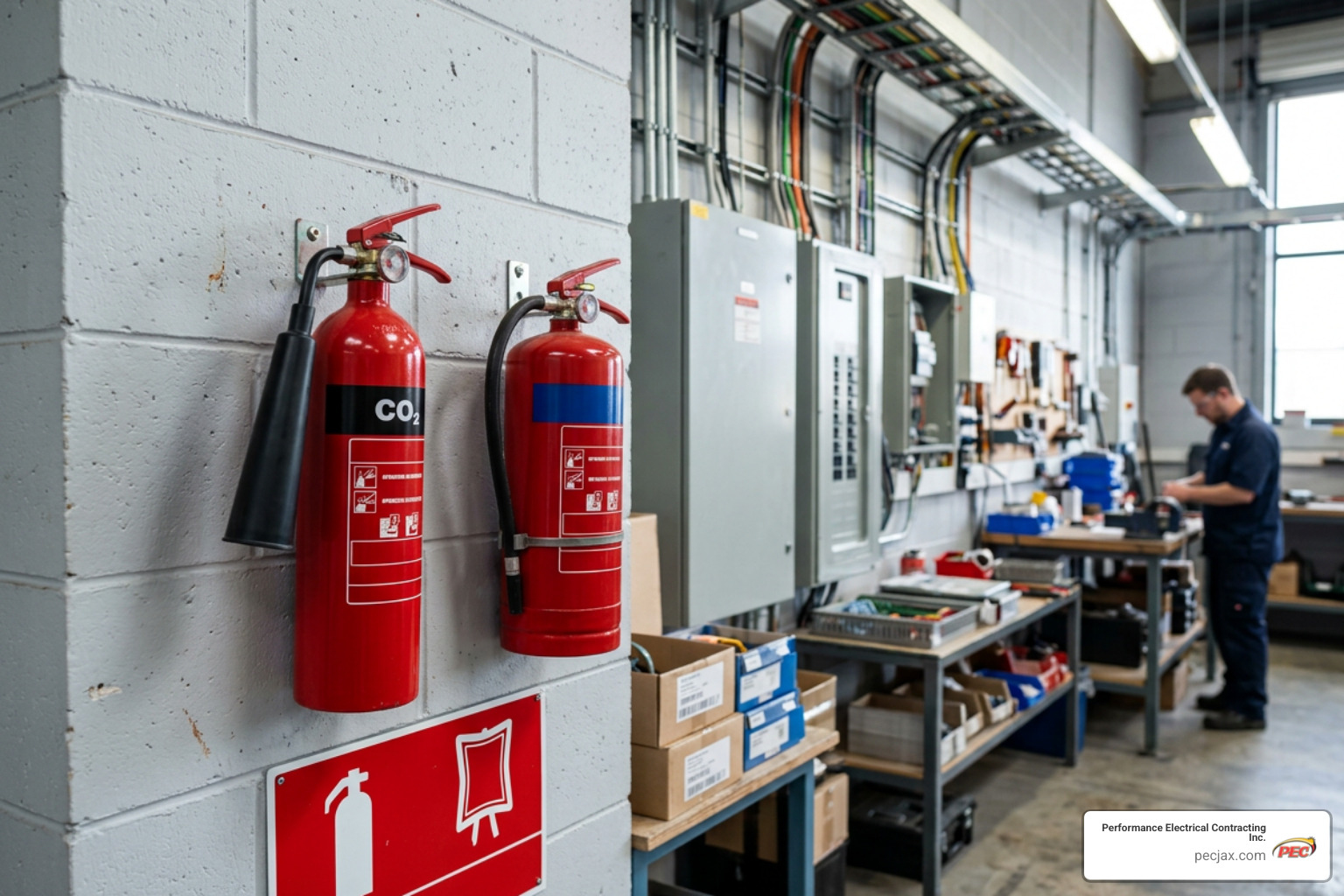
When an electric shock occurs, immediate action is vital. Electric current entering the human body above 50 mA can cause severe muscle contractions, respiratory failure, ventricular fibrillation, and death.
If a worker suffers an electric shock:
- Break the contact immediately: Switch off the main power supply. If unable to kill power, separate the victim from the live source using a dry, non-conductive object (such as a wooden broom handle or insulated hook). Never touch the victim directly with bare hands while they remain energized.
- Assess responsiveness: Check for breathing and a pulse.
- Call emergency services: Request medical personnel immediately.
- Initiate CPR: If the victim is unresponsive and not breathing normally, begin cardiopulmonary resuscitation (CPR)—30 chest compressions followed by 2 rescue breaths—until emergency responders or an AED arrives.
In commercial facilities, recognizing hardware warnings helps stop electrical hazards before fires or severe shock occur. Facility managers can review 5 warning signs your commercial electrical system needs immediate attention to spot burning odors, tripped main breakers, or panel heat buildup early.
Electrotechnical Specialisms and Building System Planning
Modern commercial buildings rely on sophisticated low-voltage distribution, HVAC power feeds, sub-metering, and emergency back-up integration. Completing these projects requires coordinated trade roles and accurate system capacity planning.
Electrotechnical Career Specialisms and Industry Roles
The electrotechnical industry incorporates distinct specialisms:
- Installation Electrician: Fits conduit, pulls cable, mounts panelboards, and connects devices on commercial and industrial sites.
- Maintenance Engineer: Diagnoses faults, performs routine thermal imaging, inspects switchgear, and repairs existing electrical infrastructure.
- Panel Builder: Fabricates control panels, wiring assemblies, and custom switchboard cubicles to precise technical drawings.
- Electrotechnical Designer / Engineer: Calculates circuit loads, designs distribution layouts, specifies protective device discrimination, and ensures code compliance.
Commercial System Capacity Planning and Switchboard Standards
Planning capacity for commercial buildings prevents nuisance trips, power quality degradation, and premature equipment failure. We calculate current demand and future expansions to ensure service panels handle all electrical loads safely. Reading our guide on the importance of electrical capacity planning for growing homes and businesses illustrates how balanced load calculations protect facility investments over time.
Additionally, component degradation in old switchgear creates unwanted high resistance and fire hazards. Facility owners can learn why you should upgrade old electrical outlets and switches to eliminate loose contacts and overheating connections.
When designing main switchboards and substations for commercial facilities, standards govern structural integrity and pest resistance:
- Load Center Placement: Transformer substations and switch rooms should be placed near the electrical load center (between the building’s geometric center and primary HVAC loads) to reduce long, expensive feeder runs.
- Enclosure Specifications: Main switchboard frameworks require steel sheet metal with a minimum thickness of 3 mm.
- Pest and Vermin Protection: Switchboard enclosure bases must be sealed against vermin, louvers backed by fine brass mesh gauze, and doors fitted with termite-resistant neoprene gaskets.
- Bus-Bar Sizing and Color Coding: Switchboard bus-bars must use electro-tinned copper. Earthing strips require electro-tinned copper measuring at least 25 mm x 3 mm running the full panel length. Standard phase bus-bar colors follow red/yellow/blue or brown/black/grey phase conventions with black or blue neutral bars depending on local jurisdiction.
Frequently Asked Questions About Commercial Electrical Compliance
What level of electric shock current is considered lethal?
An electric shock current as low as 50 mA (0.05 amperes) passing through the human body is considered potentially lethal. At this level, muscle contractions prevent the victim from letting go of the conductor, while the heart enters ventricular fibrillation (an uncoordinated fluttering) and breathing stops.
Why are temporary construction site supplies restricted to 110 volts?
Temporary construction site power systems are restricted to 110 V (fed via a 110 V center-tapped-to-earth transformer) to enhance worker safety in harsh conditions. Because the secondary winding is center-tapped to earth, the maximum voltage shock to ground from any phase wire is reduced to just 55 V, which is below the safe voltage threshold for human skin resistance under damp site conditions.
Do older commercial installations require immediate upgrades when codes update?
Not necessarily. Major safety codes like BS 7671 or national building codes operate under a principle where an existing installation, designed and commissioned in full compliance with earlier editions, does not automatically become non-compliant or illegal when a new edition is published. However, if the existing setup is altered, extended, or shows signs of severe deterioration, those modified sections must be upgraded to satisfy the current regulatory standards.
Partnering for Reliable Commercial Electrical Solutions
Executing a safe, compliant, and durable commercial installation requires technical knowledge, experienced personnel, and absolute adherence to safety protocols. At Performance Electrical Contracting Inc., we provide full-service electrical installation, maintenance, and repairs for commercial, multifamily, hospitality, infrastructure, and residential projects across Jacksonville, FL, and the Southeast U.S.
Our partnership-focused team delivers on-time, value-driven solutions that protect your physical infrastructure and keep your facilities running smoothly. Contact us today to discuss your upcoming project or request an expert facility safety review.