
What Code Violations Mean for Your Property
Code violations are conditions or work that do not meet local building, electrical, housing, zoning, fire, or property-maintenance rules. If you receive a notice, act quickly: read the cited code sections and deadline, stop any unsafe or unpermitted work, contact the assigned inspector, document existing conditions, and arrange the required repairs, permits, and reinspection.
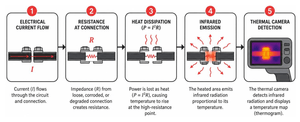
For property managers, an unresolved issue can mean more than a fine. It can delay tenant turnover, interrupt business operations, trigger a stop-work order, or create a serious life-safety risk. Electrical issues such as overloaded circuits, unsafe wiring, missing grounding, and work completed without permits often need prompt evaluation by a qualified electrical contractor.
Not every violation is the same. A housing violation may involve unsafe living conditions. A zoning violation may involve an improper use of the site or an addition that crosses setback rules. A nuisance violation may concern debris, tall grass, standing water, or other conditions that affect the neighborhood.
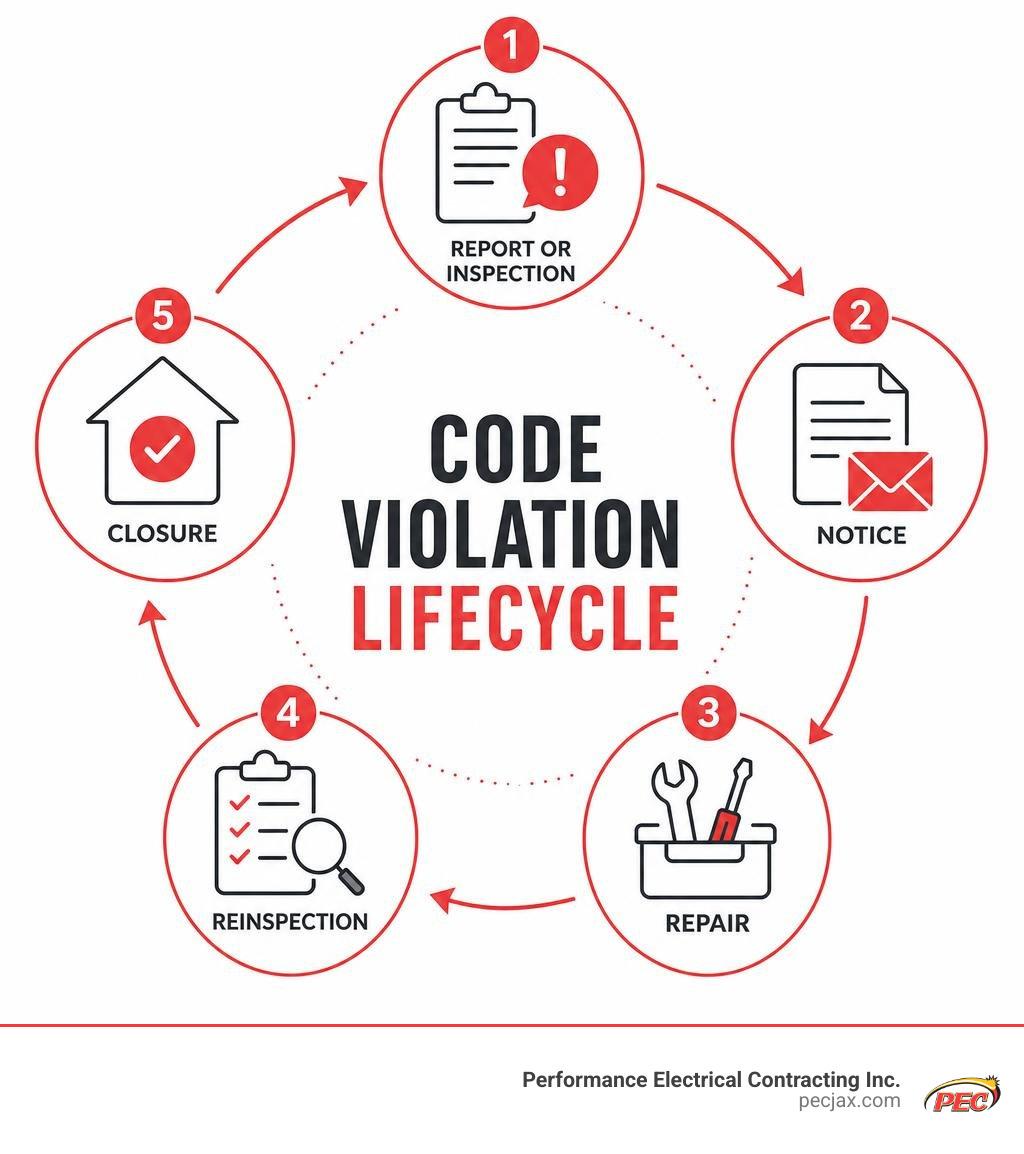
Cities also enforce differently. Some use 311 reports and online case portals, while others conduct proactive inspections. The path is usually similar: complaint or inspection, notice, correction period, reinspection, and case closure. Ignoring the notice can lead to escalating fines, municipal abatement costs, liens, court action, or utility shutoffs in severe safety cases.
Common Types of Property and Building Code Violations

Municipalities enforce local ordinances, standard building codes (such as the International Building Code), and life-safety standards to protect public health and welfare. Under local law, property compliance is generally a matter of strict liability: you are responsible for maintaining your property according to code regardless of whether you personally created the non-compliant condition or purchased the real estate with inherited defects.
Municipal citations fall across several key categories, ranging from neighborhood aesthetics to severe physical hazards.
Housing, Zoning, and Public Nuisance Distinctions
Understanding the exact legal nature of a citation determines which city department you will deal with, which appeals board holds jurisdiction, and how quickly you must respond.
| Violation Category | Primary Focus | Common Examples | Typical Responsible Agency |
|---|---|---|---|
| Housing Code | Habitability, tenant safety, interior building standards | Lack of hot water or heat, severe plumbing leaks, raw sewage, structural defects | Housing Department, Code Compliance |
| Zoning Ordinance | Land use, setbacks, property footprint, density | Converting a garage to a living unit without parking offsets, operating commercial business in residential zones | Planning & Zoning, Board of Zoning Adjustment |
| Public Nuisance | Exterior aesthetics, environmental sanitation, neighborhood impact | Grass or weeds exceeding 6 inches, accumulated trash, abandoned/inoperable vehicles | Environmental Services, Code Enforcement, Public Works |
Cities enforce strict rules regarding environmental upkeep. For example, many municipal ordinances mandate that non-ornamental weeds and grass higher than 6 inches constitute an actionable public nuisance, requiring property owners to cut or destroy nuisance vegetation on a regular seasonal basis.
Unpermitted Construction and Structural Alterations
Performing construction work without municipal review is among the most frequent citations issued to property owners. Common examples include:
- Finishing a basement or building an accessory dwelling unit (ADU) without building, plumbing, or electrical permits.
- Constructing an elevated deck over 12 inches above grade without setback review or footing inspections.
- Removing structural load-bearing walls during interior renovations.
- Replacing a residential garage door with a solid exterior wall without accounting for minimum required off-street parking.
Resolving these issues requires submitting as-built architectural plans, securing retroactive permits, and passing field inspections. When undertaking any major remodel or trade work, navigating electrical code compliance inspection rules and permits properly from day one ensures that you avoid stop-work orders, destructive inspections, and costly administrative penalties.
Resolving Electrical Code Violations and Safety Hazards
Electrical safety is governed by the National Electrical Code (NEC) along with local amendments. Because faulty electrical installations present immediate fire and shock hazards, inspectors treat trade non-compliance with elevated scrutiny. Common electrical infractions include:
- Inadequate Clearances: Blocking access to main electrical distribution panels with storage, machinery, or architectural framing.
- Overloaded Circuits: Exceeding branch circuit capacity demands or installing incorrect breaker sizes for wire gauges.
- Ungrounded Wiring and Missing GFCI/AFCI Protection: Operating ungrounded three-prong receptacles or omitting ground-fault/arc-fault circuit interrupter protection in required wet or habitable spaces.
- Open Junction Boxes and Exposed Splices: Leaving live conductor terminations uncontained outside approved electrical junction boxes.
- Unpermitted Service Upgrades: Upgrading electrical services, subpanels, or commercial machinery feeds without trade licenses and permits.
For commercial and industrial facilities, meeting the industry standards that power commercial electrical installation requires licensed professionals who calculate load demands, balance phases, and install listed equipment matching the exact engineered specifications.
How Municipalities Identify, Report, and Enforce Municipal Codes
Municipal code enforcement balances resident-driven complaints with targeted, proactive inspection initiatives.
Complaint Intake, 311 Reporting, and Response Tiers
The majority of property investigations originate from citizen inquiries submitted through municipal 311 call centers, online portals, or mobile apps. Most jurisdictions allow residents to submit reports entirely anonymously.
Once a complaint is logged, code compliance departments assign an inspector based on standardized service level agreement (SLA) response tiers. For example, municipal code compliance response tiers typically prioritize investigations according to the severity of the threat:
- Emergency (1-Hour Response): Imminent danger to life safety, open sewage leaks, or exposed live electrical infrastructure.
- Urgent (1-Day Response): Time-sensitive risks, severe structural hazards, or acute fire risks.
- Unsafe (3-Day Response): Land use violations, active unpermitted construction, or compromised building shells.
- Maintenance (4-Day Response): General property maintenance, exterior wall defects, or peeling paint.
- Nuisance (5-Day Response): Standing water, tall grass, nuisance weeds, or accumulated solid waste.
Administrative Hierarchy: Warnings, Notices of Violation, and Stop Work Orders
When an inspector confirms non-compliant conditions, enforcement follows a progressive hierarchy. Understanding official municipal violation and order types helps owners gauge their immediate risk and required response:
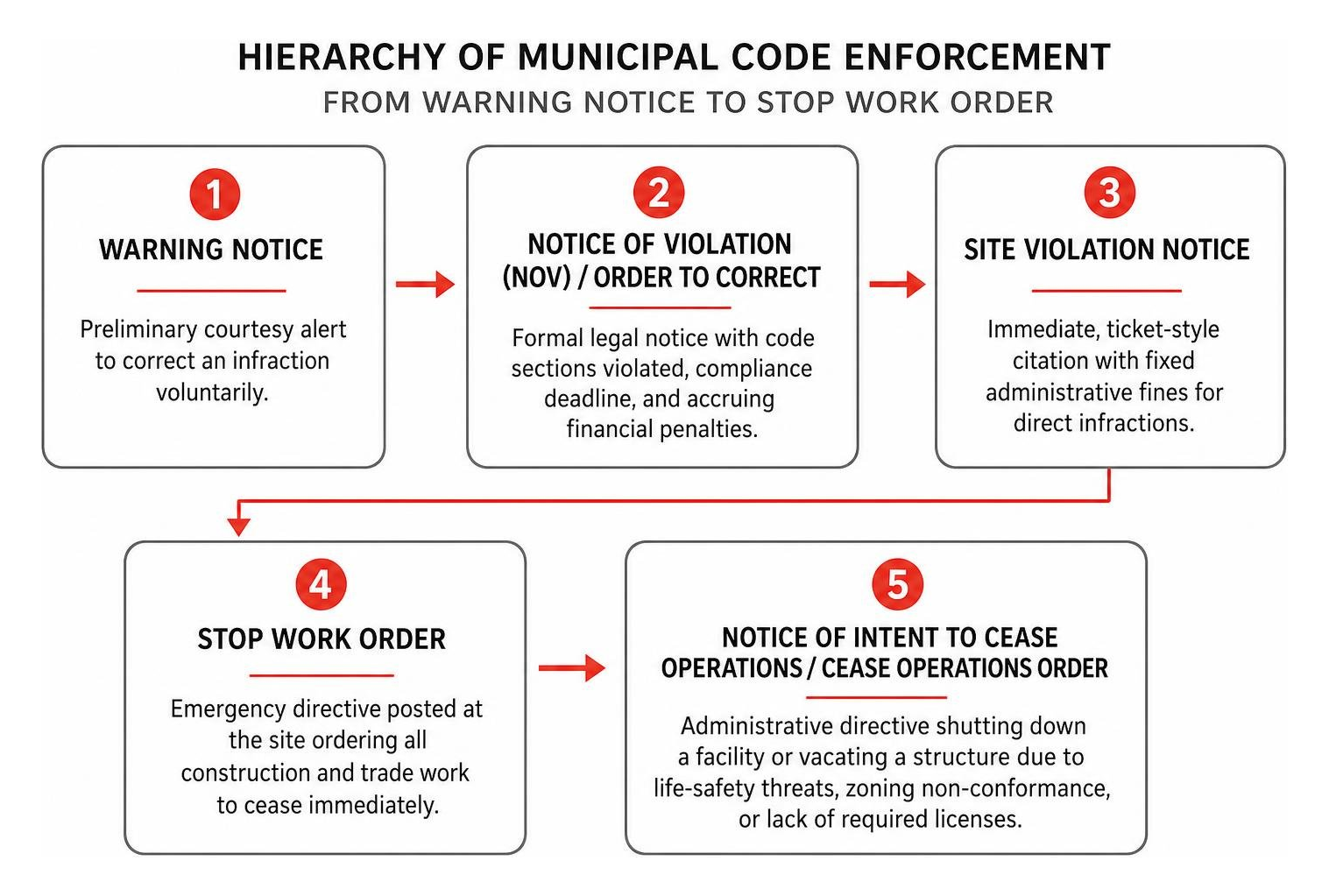
- Warning Notice: A preliminary courtesy alert issued to give the owner an opportunity to correct an infraction voluntarily without incurring immediate fines or formal court dockets.
- Notice of Violation (NOV) / Order to Correct: A formal legal notice establishing a case file, detailing specific municipal code sections violated, setting a compliance deadline (often 30 to 60 days, or as short as 5 days for public nuisances), and outlining accruing financial penalties.
- Site Violation Notice: Immediate, ticket-style citations carrying fixed administrative fines for direct infractions like improper trash disposal or minor trade infractions.
- Stop Work Order: An emergency directive posted at the job site ordering all construction and trade work to cease immediately due to unpermitted activity, dangerous conditions, or lack of site safety plans.
- Notice of Intent to Cease Operations / Cease Operations Order: An administrative directive shutting down a commercial facility or vacating a structure due to life-safety threats, zoning non-conformance, or operating without mandatory municipal licenses.
Jurisdictional Differences: Large Cities vs. Small Municipalities
Enforcement mechanisms vary significantly based on municipal size and administrative resources:
- Large Metropolitan Areas: Major cities deploy specialized departments. For example, building safety departments handle commercial construction, dedicated housing departments manage multi-family buildings (two or more dwelling units), and fire departments process exterior hoarding complaints. Large cities may also run fee-supported proactive programs, such as Annual Inspection Monitoring (AIM) divisions that inspect automotive repair garages, junk yards, and recycling facilities annually, alongside Pro-Active Code Enforcement (PACE) teams funded by Community Development Block Grants (CDBG).
- Smaller Municipalities and Rural Areas: Smaller townships often rely on a consolidated building department or part-time code officers who handle building, zoning, and nuisance complaints concurrently. Escalations often bypass complex administrative review boards and go directly before local town councils or local district judges.
Step-by-Step Response: What to Do After Receiving a Citation
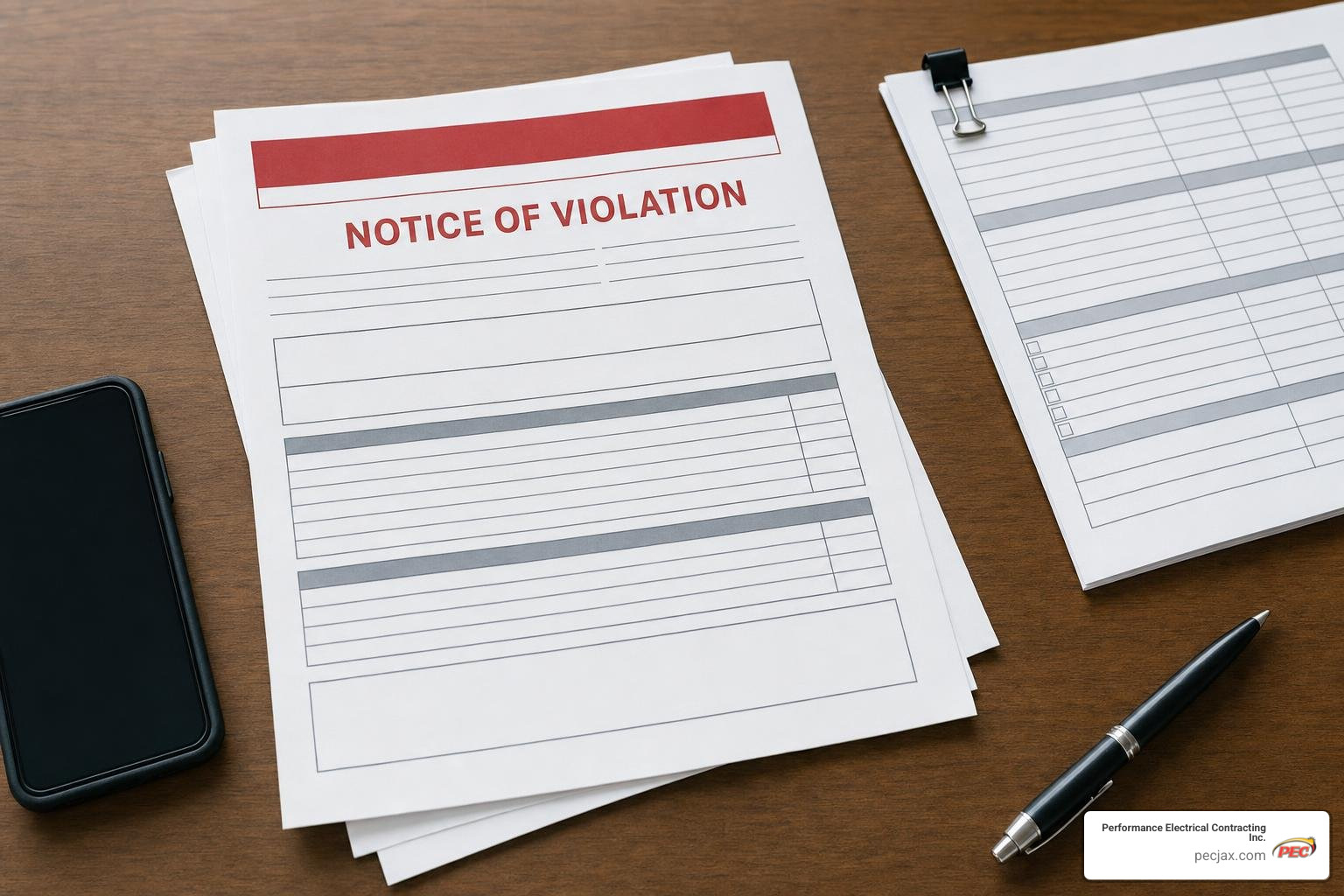
Receiving an official enforcement citation can be stressful, but taking structured, proactive measures will prevent financial penalties and legal action.
Searching Property History and Active Violation Databases
When addressing a violation—or conducting due diligence before acquiring a property—search the local municipality’s property records database. Most jurisdictions provide an online complaint and permit portal where you can query active cases using:
- The physical property address.
- The Assessor’s Parcel Number (APN), also known as the Map and Parcel number.
- The specific Request for Service (RFS) or municipal case tracking number.
Many municipal databases maintain public records going back at least two years. Reviewing this history reveals prior citations, recurring complaints, and unclosed permits that require resolution.
Retroactive Permitting, Design Approvals, and Compliance Inspections
If your citation involves unpermitted construction, structural work, or unpermitted trade additions, you must legalize the work through municipal channels. When remediating unpermitted construction violations, property owners must follow a standardized approval workflow:
- Hire Licensed Professionals: While owner-occupants may be allowed to pull permits for minor repairs on single-family homes, commercial properties and complex trade modifications (electrical, plumbing, HVAC) require licensed, insured contractors.
- Submit Sealed Architectural and Engineering Plans: If the work involved structural modifications or total project costs exceed municipal thresholds (often $25,000), a licensed design professional (architect or professional engineer) must prepare and seal as-built construction plans.
- Pay Penalty Permit Fees: Municipalities penalize unpermitted construction by doubling standard permit application fees when permits are pulled retroactively to resolve an active violation notice.
- Facilitate Destructive or Partial Exposure Inspections: City inspectors cannot approve concealed work they cannot see. If a deck, room addition, or electrical rough-in was completed without inspection, you may be required to open drywall, dig around footings, or expose framing attachments for field verification.
- Schedule and Pass Compliance Reinspections: Once work is permitted and adjusted to meet code, coordinate a final compliance inspection. Municipalities often charge rescheduling fees (such as $100) if an inspector arrives and the site is not ready or required trade certifications have not been submitted.
Navigating Administrative Appeals and Variance Requests
If you believe a violation notice was issued in error, or if you require an official variance from zoning setback rules, you have the right to file an administrative appeal.
That statutory appeal deadlines are strict and vary by violation type:
- Housing, Weed, and Solid Waste Violations: Typically require written appeals to be filed within 15 days of notice receipt.
- Zoning Violations: Generally provide a 20-day window to appeal to the Board of Zoning Adjustment.
- Uniform Construction Code / Building Code Citations: Typically allow up to 30 days to file before the Board of Appeals.
- Emergency, Unsafe, or Imminently Dangerous Orders: Carry expedited appeal windows, often requiring filings within 6 to 15 days.
Appeals must be submitted in writing, detailing the precise factual or legal grounds for contesting the citation, and accompanied by the required administrative filing fee.
Legal Consequences, Fines, and Enforcement Remedies
Ignoring a municipal code citation does not make it disappear. Code compliance processes escalate systematically from administrative notices to judicial proceedings.
Under governing frameworks like the San Diego Land Development Code enforcement remedies, cities possess expansive legal power to compel compliance, penalize non-compliance, and protect public safety.
Financial and Legal Penalties for Unresolved Code Violations
Continued failure to correct code citations triggers severe civil and criminal penalties:
- Criminal Misdemeanors: In many jurisdictions, willful violations of housing, zoning, environmental, or building codes are classified as Misdemeanors of the First Degree. These charges can carry statutory penalties of up to $1,000 in fines and up to 180 days in jail per violation.
- Accruing Civil Penalties: Civil fines accrue daily until the property is reinspected and cleared. Standard civil penalties can reach $250 per day for ongoing non-compliance.
- Double Permit and Administrative Fees: Retroactive permitting processes double administrative application fees, and repeated inspection failures incur compounding re-inspection charges.
- Court Judgments and Contempt: When local code officers file complaints with magisterial district judges or municipal courts, owners who fail to appear or refuse to obey judicial compliance orders face contempt of court citations.
Strict Liability, Utility Disconnections, and Abatement Liens
Municipalities do not need to prove fraudulent intent to enforce code requirements; property maintenance operates on strict liability. When safety hazards remain uncorrected, cities enforce several severe remedies:
- Emergency Utility Disconnections: Municipal building officials hold statutory authority to order electric and gas utilities to disconnect service immediately if an unoccupied or occupied structure is deemed substandard, hazardous, or unfit for human habitation.
- Municipal Abatement and Tax Liens: If a property owner fails to correct an environmental nuisance (such as overgrown weeds, hazardous dead trees, open dumping, or unsecured vacant structures), the city can dispatch municipal crews or third-party contractors to clear the violation. The full cost of abatement—often accompanied by administrative processing surcharges—is assessed directly against the property’s tax bill. For instance, municipal programs often mow and clean thousands of non-compliant properties annually, recouping costs by placing statutory liens on the real estate.
- Foreclosure and Property Loss: If municipal abatement costs, civil fines, and associated tax liens remain unpaid, the municipality can initiate tax lien foreclosure proceedings, forcing the sale of the real estate to satisfy outstanding municipal debts.
Frequently Asked Questions About Code Violations
How can I check if a property has active code violations before buying?
During real estate due diligence, look beyond standard home inspections. Access the municipal building safety or code compliance web portal and conduct a violation search using the property address and Assessor’s Parcel Number (APN). You can also submit an official public records request or dial 311 to ask the local code administration whether any open enforcement cases, unclosed permits, or unpaid abatement liens exist against the parcel.
What resources are available if I cannot afford to fix a cited violation?
Property owners experiencing financial hardship should contact their assigned code compliance officer immediately rather than ignoring notices. Many municipalities offer compliance extensions for owners demonstrating good faith. Additionally, local community development departments offer financial assistance through Community Development Block Grants (CDBG), municipal emergency home repair programs, and low-interest deferred rehabilitation loans specifically designed to help low-income seniors and property owners resolve health, safety, and code infractions.
Can a granted building permit still be cited for a code violation?
Yes. The issuance of a development permit, trade permit, or approved set of architectural plans does not authorize violations of municipal ordinances or national safety codes. If a permit was issued based on plan review errors or misrepresentations, the building official retains legal authority to halt construction, revoke the permit, and require site modifications to bring the installation into strict code compliance.
Conclusion
Navigating municipal property maintenance and building codes requires proactive oversight, clear communication with inspectors, and partnering with qualified trade professionals. Addressing minor maintenance items and trade defects early prevents them from escalating into administrative stop-work orders, compounding daily fines, or civil court litigation.
For commercial facilities, multifamily complexes, and industrial operations throughout Jacksonville, FL and across the Southeast U.S., our team at Performance Electrical Contracting Inc. delivers value-driven electrical installations, thorough compliance audits, and responsive maintenance. We partner closely with property managers, developers, and general contractors to ensure every installation meets the latest national and municipal codes safely, on schedule, and on budget.
If you are managing active renovations or looking to protect your facility from safety hazards, take time to review common electrical code violations in Florida and how to avoid them to keep your properties fully compliant and secure.