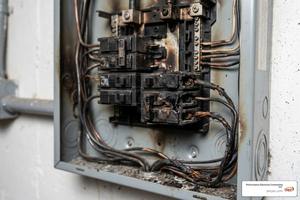

Safe Electrical Hand Gloves for 440V Work
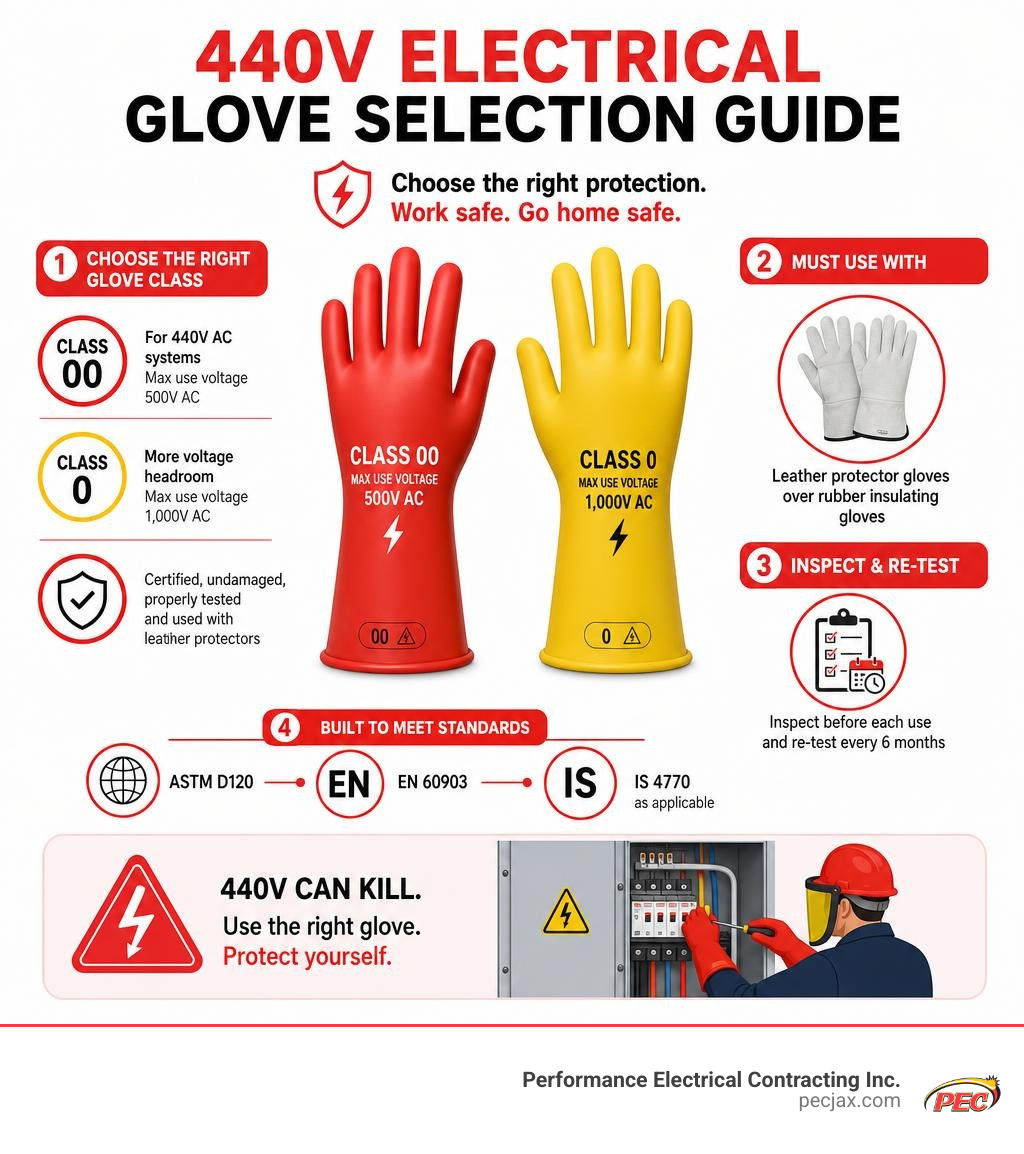
Electrical hand gloves 440v work should be voltage-rated rubber insulating gloves, not ordinary electrician gloves. For a 440V AC system, Class 00 gloves rated for a maximum use voltage of 500V AC can be suitable when they are certified, undamaged, properly tested, and used with leather protector gloves. Class 0 gloves, rated to 1,000V AC, provide a higher voltage rating for the same 440V task.
| Quick answer | What to look for |
|---|---|
| Minimum common glove class for 440V AC | Class 00, maximum use voltage 500V AC |
| More voltage headroom | Class 0, maximum use voltage 1,000V AC |
| Required construction standard | ASTM D120, EN 60903, or IS 4770, as applicable |
| Essential outer layer | Leather protector gloves over the rubber gloves |
| Ongoing safety check | Inspect before use and arrange electrical re-testing every 6 months |
A 440V panel may be called “low voltage” in electrical standards, but it can still cause fatal shock and serious arc flash injuries. For property managers, the key point is simple: live work should be avoided whenever possible, and when it is necessary, the technician needs PPE selected for the actual hazard – not just gloves labeled “electrician” or “insulated.”
This guide explains how glove classes, testing, materials, storage, and arc flash exposure affect safe work around 440V commercial electrical equipment.
Standards and Ratings for Electrical Hand Gloves 440V
When selecting insulating personal protective equipment (PPE) for commercial power distribution setups, relying on general work gloves or uncertified gear is a dangerous mistake. In live three-phase 440V systems, electrical current carries high energy capable of breaching non-dielectric barriers in milliseconds. That is why international manufacturing standards enforce rigorous engineering guidelines for dielectric hand protection.
Understanding The Industry Standards That Power Commercial Electrical Installation helps clarify how testing protocols keep workers safe. Three primary manufacturing standards dictate electrical insulating glove design globally:
- ASTM D120: Standard Specification for Rubber Insulating Gloves established by the American Society for Testing and Materials. It is explicitly mandated under OSHA 1910.137(a) in the United States.
- EN 60903: European standard governing live-working gloves made of insulating material for high and low voltages.
- IS 4770: Indian Standard for rubber gloves intended for electrical electrical protection up to high-voltage applications.
Every certified glove undergoes factory proof testing to guarantee it resists electrical breakdown well beyond its working limit. The fundamental voltage metrics include:
- Maximum Use Voltage: The absolute ceiling of AC or DC system voltage on which the glove can safely be used.
- Proof Test Voltage: The laboratory dielectric test potential applied during manufacturing and periodic re-testing (typically 5 to 10 times higher than working limits) to check for breakdown.
OSHA regulations mandate that any live electrical component operating above 50V AC presents an active shock hazard, requiring technicians to wear certified dielectric protection. On a 440V industrial line, using certified electrical hand gloves 440v rated gear ensures a massive safety cushion between operating conditions and dielectric breakdown thresholds.
Choosing Class 00 vs Class 0 Electrical Hand Gloves 440V
Choosing between Class 00 and Class 0 insulating gloves is a fundamental decision when outfitting technicians for 440V maintenance. Both options cover standard 440V three-phase equipment, but they offer distinct margins of safety, glove thickness, and physical feel.

Class 00 gloves carry an AC maximum use voltage of 500V AC (and 750V DC), backed by an AC proof test potential of 2,500V AC and a DC proof test potential of 10,000V DC. Because 440V AC falls under the 500V threshold, a Class 00 glove satisfies regulatory minimums. It provides maximum physical dexterity, making it popular for intricate panel wiring, metering, and small terminal connections. For instance, a complete kit like a Class 00 Electrical Glove Kit, 500V AC equips technicians with dielectric rubber gloves, leather protectors, and dedicated storage protection.
However, many electrical engineers and facility managers prefer Class 0 gloves for 440V circuits. Class 0 gloves feature a maximum AC use voltage ceiling of 1,000V AC (1,500V DC) and undergo factory AC proof testing at 5,000V AC. Choosing a Class 0 Electrical Glove Kit, 1000V AC provides extra safety headroom against standard utility voltage fluctuations, transient switching spikes, or unexpected system harmonics while still maintaining excellent hand dexterity.
| Feature / Spec | Class 00 Electrical Gloves | Class 0 Electrical Gloves |
|---|---|---|
| Max AC Working Voltage | 500V AC | 1,000V AC |
| Max DC Working Voltage | 750V DC | 1,500V DC |
| AC Proof Test Voltage | 2,500V AC | 5,000V AC |
| DC Proof Test Voltage | 10,000V DC | 10,000V DC |
| Color Tag Identifier | Beige / Tan | Red |
| Primary Advantage | Maximum flexibility and tactile feel | Higher dielectric safety margin for 440V |
| Typical 440V Application | Control circuits, tight panel wiring | Switchgear racking, main breakers, motor control |
Material Properties: Natural Rubber Latex and Flexibility
The raw material composition of insulating gloves determines their dielectric performance, chemical resistance, and physical longevity. Dielectric gloves are primarily dipped from natural rubber latex or specialized synthetic polymers.
Natural rubber latex provides incredible elasticity, tensile strength, and dielectric resistance. Because natural rubber allows precise hand movement with minimal hand fatigue, technicians working inside tight 440V enclosures can manipulate fine wire leads, test probes, and hardware with ease. Advanced manufacturing processes produce seamless rubber forms that eliminate mechanical seam weaknesses.
When choosing dielectric gloves, standard governing bodies categorize materials into two chemical resistance types:
- Type I (Non-Ozone Resistant): Crafted from pure 100% natural rubber latex. Type I gloves offer supreme flexibility, elasticity, and comfort. However, they are susceptible to environmental degradation caused by ozone, direct sunlight, ultraviolet radiation, and petroleum-based oils.
- Type II (Ozone Resistant): Synthetic rubber polymers (such as elastomeric compounds or synthetic blends) engineered specifically to resist atmospheric ozone breakdown, corona discharge effects, and aggressive industrial environments. While slightly stiffer than natural rubber, Type II gloves excel in outdoor utility and high-pollution commercial settings.
For specialized industrial environments where higher dielectric demands exist alongside heavy gear setups, technicians often work with heavy-duty gear like high voltage insulating gloves to protect against harsh physical wear.
Essential Layering: Why Leather Protector Gloves Are Required
A common rookie mistake in commercial electrical work is wearing dielectric rubber gloves alone without outer protective layers. Dielectric rubber is engineered exclusively to stop electrical current flow—it has minimal resistance against physical cuts, wire punctures, sharp sheet metal edges, or abrasive hardware.

A minor pinhole puncture from a sharp copper strand or a panel screw can completely neutralize a rubber glove’s dielectric strength. Under high electrical pressure, electric current will concentrate at the puncture point, causing a severe localized electrical arc and shock.
To safeguard against this, safety mandates such as NFPA 70E and OSHA regulations require rubber insulating gloves to be worn with fitted outer leather protector gloves.
Leather protectors act as a mechanical armor shield, offering key advantages:
- Puncture & Tear Resistance: Top-grain goatskin, cowhide, or pigskin leather shields the delicate natural rubber underneath from sharp enclosure edges, burrs, and abrasive mechanical tools.
- Cut Protection: Heavy-duty leather gauntlets minimize cut hazards during physical breaker manipulation and conduit pulls.
- Arc Flash Protection: Leather absorbs intense convective thermal heat generated during a localized arc flash event, preventing direct flame contact or thermal melting of the rubber layer.
- Secure Wrist Fit: Premium leather protectors incorporate a shirred elastic wrist or slip-on cuff design that holds the protector firmly over extended rubber cuffs (available in standard lengths ranging from 11 inches up to 16 or 20 inches).
For high-voltage environments requiring extended gauntlet coverage and robust physical shields, kits like the Class 2 Insulating Glove Kit demonstrate how extended cuffs protect the wrists and forearms alongside full mechanical hand armor.
Inspecting and Maintaining Electrical Hand Gloves 440V
Dielectric strength relies entirely on continuous material integrity. Even the best electrical hand gloves 440v selection will fail if stored improperly or placed into service with hidden damage. Establishing a strict inspection routine ensures that your safety gear remains reliable every time you open an energized panel.

Before starting live 440V work, every electrician must perform a mandatory two-step pre-use check:
Step 1: Detailed Visual Inspection
Examine both the inner rubber gloves and outer leather protectors under bright light. Look for signs of:
- Cuts, scratches, abrasive scuffs, or pinholes.
- Chemical swelling, soft spots, or tackiness caused by exposure to oils, solvents, or hydraulic fluids.
- Cracking, hardening, or “sun-checking” resulting from ozone or UV exposure.
- Embedded foreign metal particles or wood splinters.
Step 2: The Field Air Roll Test
The air roll test is a quick field method to locate invisible pinholes in rubber gloves.
- Grasp the glove cuff and roll it tightly inward toward the palm to trap air inside the hand section.
- Squeeze the trapped air bubble firmly into the fingers and thumb.
- Hold the glove up near your ear and face to listen for escaping air, or press the inflated glove against your cheek to feel for tiny air leaks. Never use compressed air lines to inflate gloves, as excessive pressure can rupture the dielectric rubber structure.
Beyond daily pre-use checks, OSHA Table I-5 mandates that rubber insulating gloves undergo certified laboratory electrical re-testing every 6 months (or every 12 months for gloves stored in original unopened packaging that have never been issued). Certified testing facilities submerge the gloves in specialized water baths and apply high dielectric proof voltages to verify zero leakage current. Gloves passing the test receive a stamped certification date before being cleared for field deployment.
Proper cleaning and storage further extend glove life:
- Cleaning: Wash dirty gloves with warm water and mild, non-bleaching soap. Rinse thoroughly with clean water to remove all film, then air-dry completely at room temperature away from artificial heaters.
- Storage: Store gloves flat inside a heavy-duty canvas protective storage bag—cuff facing down, natural shape preserved—away from direct sunlight, high heat, excess humidity, steam pipes, and ozone-generating equipment (such as electric motors or transformers). Never fold, roll, or cram rubber gloves into toolboxes.
Arc Flash Hazards and Voltage Limits on Live Circuits
When working around live 440V distribution gear, electric shock is only one of the hazards present. High-energy three-phase industrial systems carry significant arc flash potentials capable of releasing severe convective heat energy, shrapnel, and intense ultraviolet radiation.
Safety standards enforced by CSA, NEC, and OSHA dictate that any live circuit operating at or above 50V AC possesses arcing potential, making arc-rated gear and dielectric gloves mandatory. On a 440V circuit, short-circuit fault currents can spark violent thermal releases within milliseconds.
Physical working distance plays a critical role in arc flash hazard mitigation:
- The 18-Inch Baseline: Standard arc flash incident energy calculations assume a typical working distance of 18 inches between the technician’s chest/face and the exposed energized busbar.
- Exponential Energy Surge: Because a worker’s hands operate far closer than 18 inches during troubleshooting or breaker manipulation, the hands experience exponentially higher incident energy than the torso. Leather protectors over dielectric gloves are vital to absorb direct convective thermal pulses during unexpected arcing events.
Technicians frequently ask if low-voltage dielectric gloves are versatile across different line tasks. Standard Class 00 (500V max use) or Class 0 (1,000V max use) gloves cover low-voltage residential (120V/240V), single-phase commercial (208V/277V), and three-phase industrial (440V/480V) tasks seamlessly.
However, they must never be brought near medium-voltage or high-voltage equipment. Attempting to service 2,300V, 4,160V, or 11kV primary distribution systems with Class 00 or Class 0 gloves will cause immediate electrical puncture and severe injury. High-voltage applications require higher glove classes, such as Class 1 (7,500V max use), Class 2 (17,000V max use), Class 3 (26,500V max use), or Class 4 (36,000V max use). For medium-voltage commercial substations, specialized gear like 7500V Electrical Insulating Gloves provides the appropriate protection ceiling.
Frequently Asked Questions About 440V Electrical Gloves
Can Class 00 gloves be used safely on a 440V system?
Yes, Class 00 gloves can be used safely on a 440V AC electrical system. Under ASTM D120 and OSHA 1910.137, Class 00 rubber insulating gloves carry a maximum use voltage limit of 500V AC (and 750V DC). Since 440V is below the 500V threshold, Class 00 gloves provide legal and physical dielectric protection, provided they are undamaged, properly air-tested, and worn with leather protector gloves. However, many technicians choose Class 0 gloves (rated up to 1,000V AC) for additional safety headroom.
How often must electrical gloves for 440V be re-tested?
Rubber insulating gloves used on 440V systems must undergo field air tests and visual inspections before every single use. In addition, OSHA Table I-5 mandates that insulating gloves receive a certified laboratory electrical proof test at least once every 6 months. If a glove has been issued but unused, or if there is any suspicion of dielectric breakdown, puncture, or chemical contamination, it must be removed from service and re-tested immediately at an accredited testing facility before returning to active duty.
What color tags identify gloves rated for 440V applications?
Electrical insulating gloves feature color-coded tags vulcanized onto the cuff for instant visual identification of their voltage class:
- Class 00 (500V AC Max Use): Identified by a Beige / Tan label tag.
- Class 0 (1,000V AC Max Use): Identified by a Red label tag.
These standard color markings allow safety supervisors and technicians to verify that glove ratings match circuit requirements prior to opening energized enclosures.
Conclusion
Building a zero-incident electrical safety culture requires choosing the right gear, enforcing routine maintenance, and partnering with qualified experts. When working around live 440V commercial panels, using properly rated electrical hand gloves 440v setups—combining Class 00 or Class 0 rubber insulating gloves with rugged leather protectors—is your primary defense against shock and thermal hazards.
At Performance Electrical Contracting Inc., we prioritize uncompromising safety standards, regulatory compliance, and high-quality electrical installations across commercial, hospitality, multifamily, and industrial projects throughout Jacksonville, FL, and the Southeast U.S. Whether you need panel upgrades, facility maintenance, or comprehensive system installs, our team delivers on-time, value-driven solutions built on technical expertise. Reach out to us today to discuss your next electrical project!