
Signs Your Home Needs a Panel Upgrade and the Hidden Cost of Inefficiency
An electrical panel upgrade can unlock direct savings of 10% to 30% on utility bills through efficient electrification, up to $4,000 in HEAR and utility rebates, insurance premium discounts, and a 50% to 80% resale ROI. Most homeowners never think twice about the metal box tucked away in their garage, basement, or utility closet—until the power cuts out right in the middle of a movie or while dinner is in the oven. Running an outdated electrical panel is not just an inconvenience; it can silently drain your wallet through lost efficiency, damaged appliances, and severe safety risks.
Over half of the homes across the United States currently operate on electrical service ratings of 100 amps or less. When these panels were installed decades ago, they were designed to handle a refrigerator, a few lamps, a television, and perhaps a basic air conditioner. Today, modern homes run high-draw HVAC systems, computers, entertainment centers, dishwashers, and high-powered kitchen equipment simultaneously.
When your electrical system is consistently pushed to its maximum threshold, breakers trip, wiring overheats, and voltage fluctuations can degrade sensitive electronics. Understanding when to modernize your infrastructure is the first step toward safeguarding your home and uncovering long-term energy savings.
Warning Signs and Outdated Hazardous Panels
Your electrical panel gives clear clues when it is struggling to handle your household demand. Recognizing these symptoms early allows you to act before minor electrical issues turn into dangerous malfunctions.
Key warning signs include:
- Breakers that trip repeatedly under normal, everyday usage.
- Flickering, blinking, or dimming lights when major appliances like a vacuum or microwave kick on.
- Crackling, buzzing, or hissing sounds emanating from the panel interior.
- Discoloration, burn marks, or warmth on the panel door or individual breakers.
- Missing fuses, rust, or evidence of moisture intrusion.
Beyond everyday wear and tear, millions of older homes still contain obsolete and hazardous panel models that represent immediate fire hazards. Brands like Federal Pacific Electric (FPE) Stab-Lok, Zinsco, and Pushmatic have documented histories of catastrophic design failures.
Federal Pacific breakers, for example, have an alarming failure rate where they do not trip during a direct short circuit or severe electrical overload. Zinsco panels are notorious for breakers that melt directly onto the bus bars, effectively fusing in the “on” position and leaving branch circuits completely unprotected. Knowing how to tell when your home needs an electrical safety inspection can help you identify these obsolete panels before they fail. Upgrading to modern electrical safety solutions replaces these hazardous legacy components with reliable, code-compliant equipment.
Capacity Planning for Modern Electrification Demands
As homes transition from fossil fuels to clean electricity, total power demands increase dramatically. Running a fully electrified modern home—complete with a high-efficiency heat pump, induction range, heat pump water heater, electric dryer, and a Level-2 electric vehicle (EV) charger—typically requires an electrical load of approximately 121 amps. A standard 100-amp panel simply cannot support these modern additions safely.
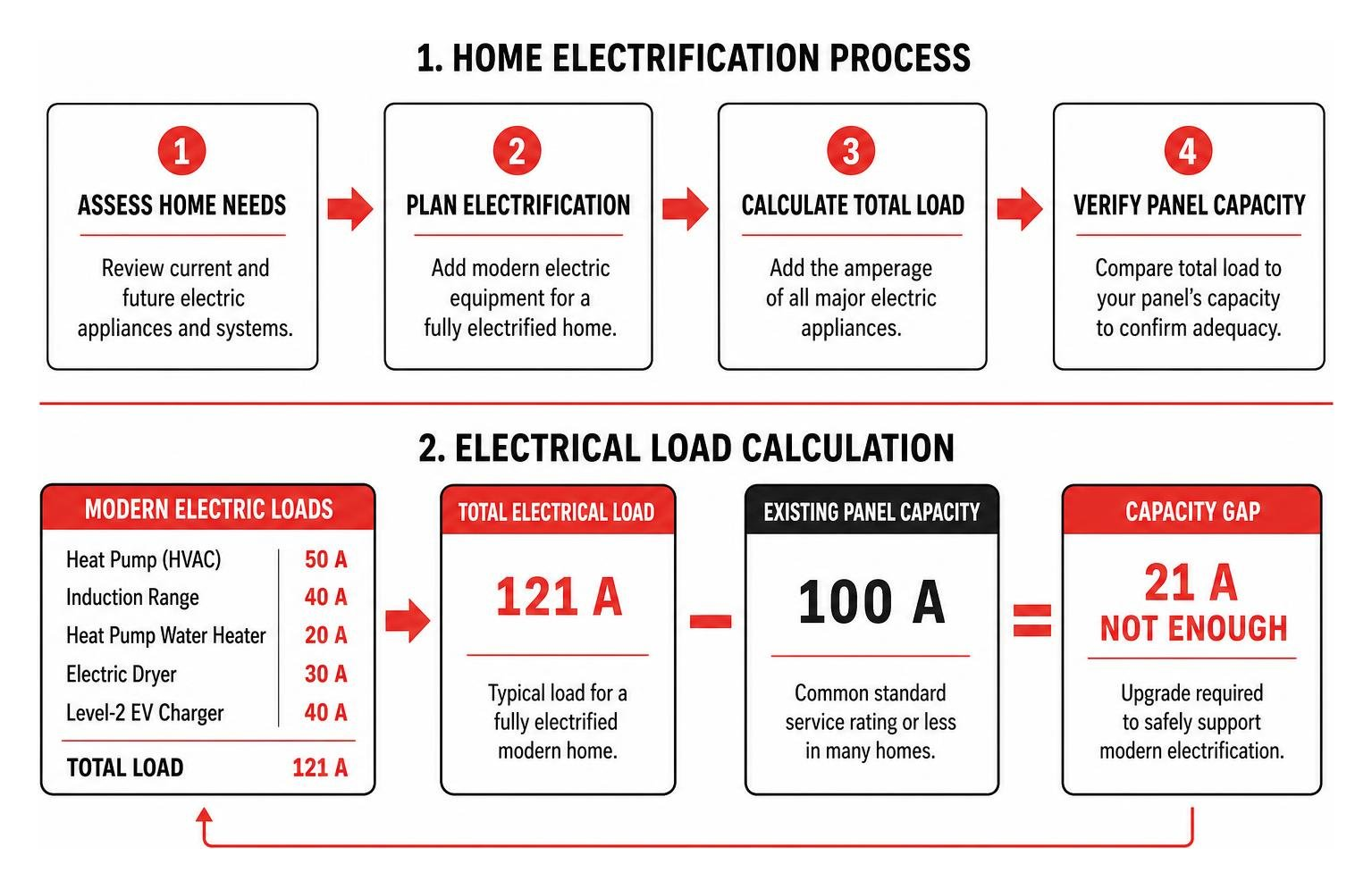
Without proper planning, adding even a single 40-amp or 50-amp Level-2 EV charger to a 100-amp service will exhaust available headroom and trigger chronic overloads. This is where the importance of electrical capacity planning for growing homes and businesses becomes essential.
Modern electrical systems also mandate contemporary safety devices, such as Arc-Fault Circuit Interrupters (AFCIs) and Ground-Fault Circuit Interrupters (GFCIs), to prevent electrical fires and electrocution. Coordinating a panel refresh is also the perfect time to evaluate why you should upgrade old electrical outlets and switches to ensure your entire distribution network operates smoothly.
2026 Panel Upgrade Costs, Pricing Drivers, and Smart Alternatives
Budgeting for an electrical service improvement requires understanding what drives project costs and knowing which technical solution matches your specific goals.
Typical Costs for 100A, 200A, and 400A Upgrades
The national average cost for a professional panel upgrade sits around $2,500, with typical installations ranging from $1,500 to $4,000 depending on location, existing hardware, and local utility requirements. Over the last five years, national pricing trends have climbed roughly +17.8%, up from $2,123 in 2022 to $2,500 in 2026 due to material costs and skilled trade labor adjustments.
To explore detailed itemized cost breakdowns by region and panel type, refer to this 2026 electrical panel upgrade cost guide.
| Upgrade Type | Average Cost Range | Power-Off Timeline | Total Project Turnaround | Best For |
|---|---|---|---|---|
| Panel-Only Replacement (200A swap) | $1,500 – $3,000 | 4 – 8 Hours | 3 – 7 Days | Replacing damaged, obsolete, or recalled panels without upsizing service |
| 100A to 200A Service Upgrade | $1,800 – $3,500 | 4 – 8 Hours | 1 – 3 Weeks | Standard single-family homes electrifying HVAC, water heating, and adding one EV charger |
| 200A to 400A Service Upgrade | $3,500 – $6,000+ | 1 – 2 Days | 2 – 6 Weeks | Large properties, multi-family units, workshops, or homes with dual EV charging and solar arrays |
Several key variables drive the final project price:
- Amperage Capacity: Higher-capacity panels (such as 400A split-bus systems) require larger enclosures, thicker copper service entrance conductors, and heavier main disconnects.
- Meter Base & Weatherhead: If upgrading total amperage, your local utility provider often requires replacing the exterior meter socket, service mast, and weatherhead to meet modern utility standards.
- Grounding and Bonding: Modern National Electrical Code (NEC) mandates two driven grounding rods placed at least six feet apart and continuous bonding to metal plumbing and gas lines.
- Permit and Inspection Fees: Municipal permitting fees range from $150 to over $1,000 depending on the local Authority Having Jurisdiction (AHJ).
- Utility Coordination Fees: Service disconnects and reconnects handled by utility crews can add administrative or line-drop adjustment charges.
Smart Panels vs. Traditional Service: Electrical Panel Upgrade Savings Compared
Homeowners do not always need a full utility service upgrade to accommodate new high-demand electric appliances. Modern smart panels and intelligent load-management systems offer an innovative alternative.
Under NEC Article 750, energy management systems are legally permitted to dynamically monitor and control branch circuits. Because most homes utilize only about 30% of their theoretical electrical capacity even during peak evening hours, a smart load-management device ($500 to $1,500 installed) can automatically pause non-critical loads (like an EV charger or electric water heater) for a few minutes while higher-priority devices (like an electric range or central heat pump) are active.
Evaluating smart load control against full panel upsizing provides a direct look at your potential electrical panel upgrade savings and lets you choose the most cost-effective path. For detailed planning insights, check out this comprehensive 2026 panel upgrade and load management guide.
Real-World Electrical Panel Upgrade Savings: ROI, Bills, and Home Value
While a new panel functions behind the scenes, its financial return extends well beyond simply keeping the power running.
Lower Utility Bills, Efficiency Gains, and Insurance Premium Discounts

An electrical panel does not generate electricity, but modernizing it helps reduce wasted power and unlocks systemic efficiency. Older panels with loose connections, undersized aluminum wiring, or corroded bus bars create high electrical resistance. This resistance dissipates energy as wasted heat rather than powering your home, driving up utility bills. In one documented real-world case, a family in Tulsa experienced a 10% reduction in overall energy costs after upgrading their overloaded 60-amp panel to a balanced, modern 200-amp distribution system.
Furthermore, a properly sized panel allows you to take advantage of electrical upgrades that can help lower energy costs, such as replacing an old 10-SEER air conditioner with an ultra-efficient 20+ SEER heat pump or switching from a gas water heater to a hybrid heat pump unit. Ongoing protection through 4 major benefits of having a residential electrical service plan ensures your newly installed panel remains clean, tight, and code-compliant for its entire lifespan.
Insurance savings provide another direct financial return. Many homeowner insurance carriers refuse coverage or charge higher premiums for properties containing Federal Pacific, Zinsco, or fuse-based panels. Replacing these fire hazards with a modern, permitted breaker box can result in insurance premium discounts and eliminates the risk of dropped coverage.
Resale Value Boost and EV-Ready Buyer Demand
Modern homebuyers prioritize move-in-ready, electrified properties. A 200-amp panel upgrade delivers an impressive Return on Investment (ROI), often recouping 50% to 80% of its initial cost directly in home resale equity.
Surveys from the National Association of Realtors highlight that roughly 63% of younger home buyers actively seek homes ready for Level-2 EV charging. Having a modern 200-amp panel eliminates a costly post-purchase obstacle for prospective buyers. Additionally, in hurricane-prone regions across the Southeast, a new panel allows for seamless integration of interlock kits and manual transfer switches. To keep your property secure against severe storms, verify is your electrical system ready for hurricane season.
How to Fund Your Upgrade and Avoid Costly Budgeting Pitfalls
Strategic planning allows homeowners to capture lucrative incentives, lower upfront costs, and prevent common budgeting oversights.
Maximizing Electrical Panel Upgrade Savings Through Rebates and Tax Credits
Numerous federal, state, and utility programs help offset the cost of panel modernization:
- HEAR Program (Home Electrification and Appliance Rebates): Offers up to $4,000 in direct point-of-sale rebates for electrical panel upgrades when completed as part of a qualified home electrification project for eligible households.
- Utility Rebates: Regional utilities offer substantial rebates for panel upsizing. For example, Xcel Energy provides rebates up to $1,500 for qualifying amperage increases, while municipal programs in cities like Minneapolis add bonuses ranging from $1,500 to $3,000 when paired with heat pump installations.
- State-Specific Programs: Initiatives like California’s TECH Clean California cover 100% of panel upgrade costs (up to $4,000) when transitioning to heat pump systems.
- Renewable Tax Credits: Federal tax credits covering up to 26% of qualifying expenditures apply when panel work directly facilitates rooftop solar and battery storage systems.
To review current incentive structures and regional qualification standards, refer to this panel upgrade cost breakdown and incentive analysis.
Strategic Financing and Cost-Saving Best Practices
If upfront capital is tight, several low-friction financing avenues exist:
- Home Equity Lines of Credit (HELOCs): Offer competitive, lower-interest borrowing secured against home equity.
- Specialized Green Energy Loans: Many states and credit unions provide low-interest financing specifically designated for home electrification and safety improvements.
- Contractor Financing: Reputable electrical contractors frequently partner with lending institutions to offer 0% promotional interest terms.
To cut costs without sacrificing quality or safety:
- Bundle Electrical Projects: Combine your panel replacement with other scheduled electrical projects—such as EV charger installation, lighting retrofits, or generator subpanel wiring—to minimize repeat permit and labor dispatch fees.
- Avoid Off-Brand Panels: Stick with established, industry-standard manufacturers (such as Square D, Eaton, or Siemens) that offer lifetime parts availability and robust warranties.
- Never Attempt DIY Installation: Panel replacements involve direct, unfused contact with utility grid voltage. Unpermitted DIY work voids homeowner insurance policies, fails municipal safety inspections, and risks fatal electrical shock.
Frequently Asked Questions About Electrical Panel Upgrades
How much can an upgraded electrical panel lower electric bills?
While a new breaker box does not alter utility rate structures, it reduces wasted energy caused by internal circuit resistance and overheating bus bars. More importantly, upgrading unlocks the electrical capacity required to install ultra-efficient heat pumps, hybrid water heaters, and smart energy monitors, which together can reduce household energy consumption by 10% to 30%.
What rebates and incentives are available for panel upgrades in 2026?
The primary federal incentive is the Home Electrification and Appliance Rebates (HEAR) program, which provides up to $4,000 for qualifying households upgrading panels alongside heat pumps or other electric appliances. Local utility rebates (such as Xcel Energy’s $1,500 rebate) and state initiatives like TECH Clean California offer additional layered incentives that can cover up to 100% of out-of-pocket expenses.
Can smart load management replace a full 200-amp service upgrade?
Yes. If your current 100-amp or 125-amp service is physically sound and you only need to add an EV charger or electric range, installing an NEC Article 750-compliant smart energy management system ($500 to $1,500) can dynamically manage electrical draw. By automatically pausing non-essential loads when high-draw appliances run, you can safely avoid a full $3,000 to $6,000 utility service upgrade.
Conclusion: Maximizing Long-Term Value and Safety
Upgrading your electrical panel is one of the highest-leverage investments you can make in your home. With a standard operational lifespan of 25 to 40 years, a modern 200-amp service panel provides decades of reliable operation, lowers household fire risk, and ensures your property is fully prepared for clean energy technologies like heat pumps, EV chargers, and solar arrays.
At Performance Electrical Contracting Inc., we specialize in delivering safe, fully permitted, and high-efficiency residential electrical services across Jacksonville, FL, and throughout the Southeast U.S. Our team handles every stage of your project—from detailed load calculations and utility coordination to permit filing and rebate verification—delivering value-driven electrical solutions on time and on budget. Reach out to our team today to evaluate your panel’s capacity and start planning your upgrade.