
Why You Need a Licensed Low Voltage Cabling Contractor
Many business owners and facility managers assume that because low voltage systems operate under 50 to 60 volts, anyone with a wire stripper and a ladder can install them. However, high-performing communications cabling relies on strict adherence to building codes, electrical standards, and physics.
Hiring a fully licensed low voltage cabling contractor ensures your property complies with NEC Article 800, which regulates communications circuits within the National Electrical Code (NFPA 70). One crucial rule is maintaining at least a 2-inch physical separation between unshielded data lines and high-voltage power lines. Crossing or running data cabling parallel to line-voltage electrical lines introduces electromagnetic interference (EMI), leading to packet loss, slow data transfers, and intermittent connection drops.
Furthermore, improper penetrations through fire-rated walls without certified firestopping materials create significant life-safety hazards during a fire. Just as upgrading old electrical outlets and switches is necessary for line-voltage safety, installing certified low voltage pathways protects your building’s physical integrity and security.
Certifications to Demand from Your Low Voltage Cabling Contractor
When evaluating cabling specialists, verify their trade certifications and credentials before signing a contract:
- BICSI (Building Industry Consulting Service International): Technicians with BICSI credentials demonstrate mastery of Information and Communications Technology (ICT) design and installation guidelines.
- RCDD (Registered Communications Distribution Designer): An RCDD designation proves a project designer can engineer complex telecommunications infrastructure for multi-story buildings and enterprise campuses.
- NICET (National Institute for Certification in Engineering Technologies): Essential for specialized low voltage sub-systems such as commercial fire alarms and integrated security systems.
- State Licensing & Liability Insurance: A reputable contractor must hold proper state specialty licenses and carry general liability and worker’s compensation insurance to protect your property during construction.
Dangers of DIY and Handyman Cabling
Relying on handymen or undertaking a DIY wiring project introduces hidden risks to your physical infrastructure. Did you know that many network outages trace back to physical layer problems rather than software glitches? A single loose connector behind a server rack can cost a company thousands of dollars in an afternoon.
Sloppy punch-down terminations on keystone jacks remain the single most common cause of post-installation intermittent network failures. Additionally, improper cable routing can violate bend radius limits, causing internal copper strain and signal attenuation.
Thermal management is another critical risk when deploying modern high-power Power over Ethernet (PoE++ 802.3bt), which delivers up to 90 watts per port. Running high-wattage PoE across lower-grade Cat5e cables tightly bundled in unconditioned attics creates severe cable heating that degrades data signals and can even melt outer jacketing. If your property displays broader physical layer flaws, review these 5 warning signs your commercial electrical system needs immediate attention.
Essential Low Voltage Systems and Cabling Architecture
The medium you select determines how fast your business can communicate, expand, and adopt new technologies over the next 15 to 20 years.
| Cable Category | Max Speed at 100m | Max Speed at Shorter Distances | Primary Use Case |
|---|---|---|---|
| Cat5e | 1 Gbps | 1 Gbps | Legacy installations, basic VoIP phones |
| Cat6 | 1 Gbps | 10 Gbps (up to 55m) | Standard commercial drops, light PoE, enterprise WiFi |
| Cat6a | 10 Gbps | 10 Gbps (full 100m) | High-density data centers, PoE++, 10G networks |
| Fiber Optic | 10G to 100G+ | 100G+ (up to 40km+) | Backbone inter-closet links, building-to-building, high EMI zones |
Selecting the Right Medium: Cat6, Cat6a, or Fiber Optics
Choosing between twisted-pair copper and fiber optics depends on your bandwidth demands, distance requirements, and physical environment:
- Cat6: The standard workhorse for general office drops. It cleanly delivers Gigabit network speeds up to 100 meters (328 feet, per TIA-568 standards) and supports 10 Gigabit speeds at shorter distances up to 55 meters.
- Cat6a: Engineered with augmented shielding and tighter wire twists to eliminate alien crosstalk. It supports full 10 Gigabit performance over the maximum 100-meter channel length and handles thermal buildup from high-wattage PoE++ devices with ease.
- Fiber Optics (Single-mode vs. Multi-mode): Copper ethernet maxes out at 100 meters per channel (including patch cords). For distances exceeding 100 meters—such as connecting detached outbuildings, warehouse distribution centers, or linking telecom closets across multiple floors—fiber optic cabling is mandatory. Multi-mode fiber works exceptionally well for high-speed indoor backbones, while single-mode fiber handles long-haul multi-kilometer runs.
For specialized guidance on tailoring ethernet and fiber pathways to your facility, understanding standard low voltage cabling deployment options helps ensure optimal network performance.
Structured Cabling vs. Point-to-Point Connections
Point-to-point cabling connects individual devices directly to a switch port or recorder with a single continuous cable. While this works in a home office, deploying point-to-point wiring across an enterprise environment quickly leads to an unmaintainable “spaghetti rack.”
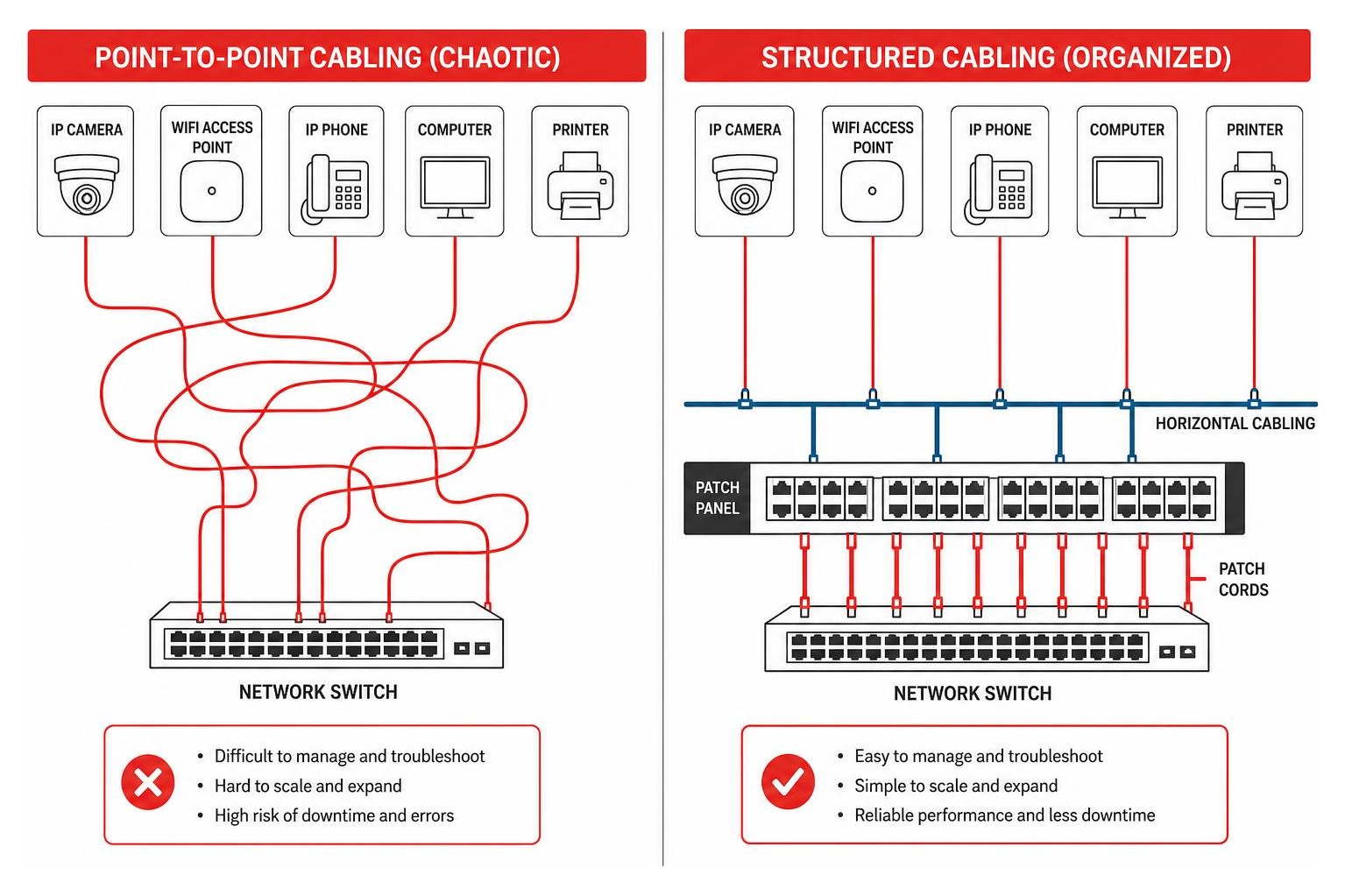
A professional low voltage cabling contractor implements structured cabling, built upon a standardized star topology:
- Horizontal Cabling: Runs from wall jacks (keystone outlets) inside individual offices through ceiling pathways back to the telecommunications room.
- Patch Panels: Horizontal cables terminate permanently into patch panels inside an equipment rack.
- Patch Cords: Short, easily replaceable patch cords bridge the gap between patch panels and active network switches.
Structured cabling creates an organized, scalable layout that lasts 15 to 20 years. When an employee moves desks or a device fails, IT personnel simply move a small patch cord rather than pulling new wire through walls.
Power over Ethernet (PoE) and Integrated Building Systems
Modern commercial buildings rely on low voltage infrastructure to power and manage connected hardware. Through Power over Ethernet (PoE), network cables carry both high-speed data and DC electrical power over a single run, eliminating the need for dedicated AC electrical outlets at every device location.
A skilled contractor can design and install cabling for a wide array of integrated systems:
- IP Security Camera Systems (CCTV): Delivering high-definition video feeds while drawing PoE power directly from the central switch. Modern surveillance systems allow owners to monitor live camera footage remotely from anywhere.
- Access Control Systems: Connecting biometric scanners, card readers, door strikes, and electronic keypads.
- Enterprise WiFi 6/6E Access Points: Pre-wiring ceiling locations with dual Cat6a drops for high-bandwidth wireless coverage.
- VoIP Phone Systems & Audio/Visual: Supporting crystal-clear IP telecommunications and conference room display setups.
What to Expect During a Professional Cabling Project
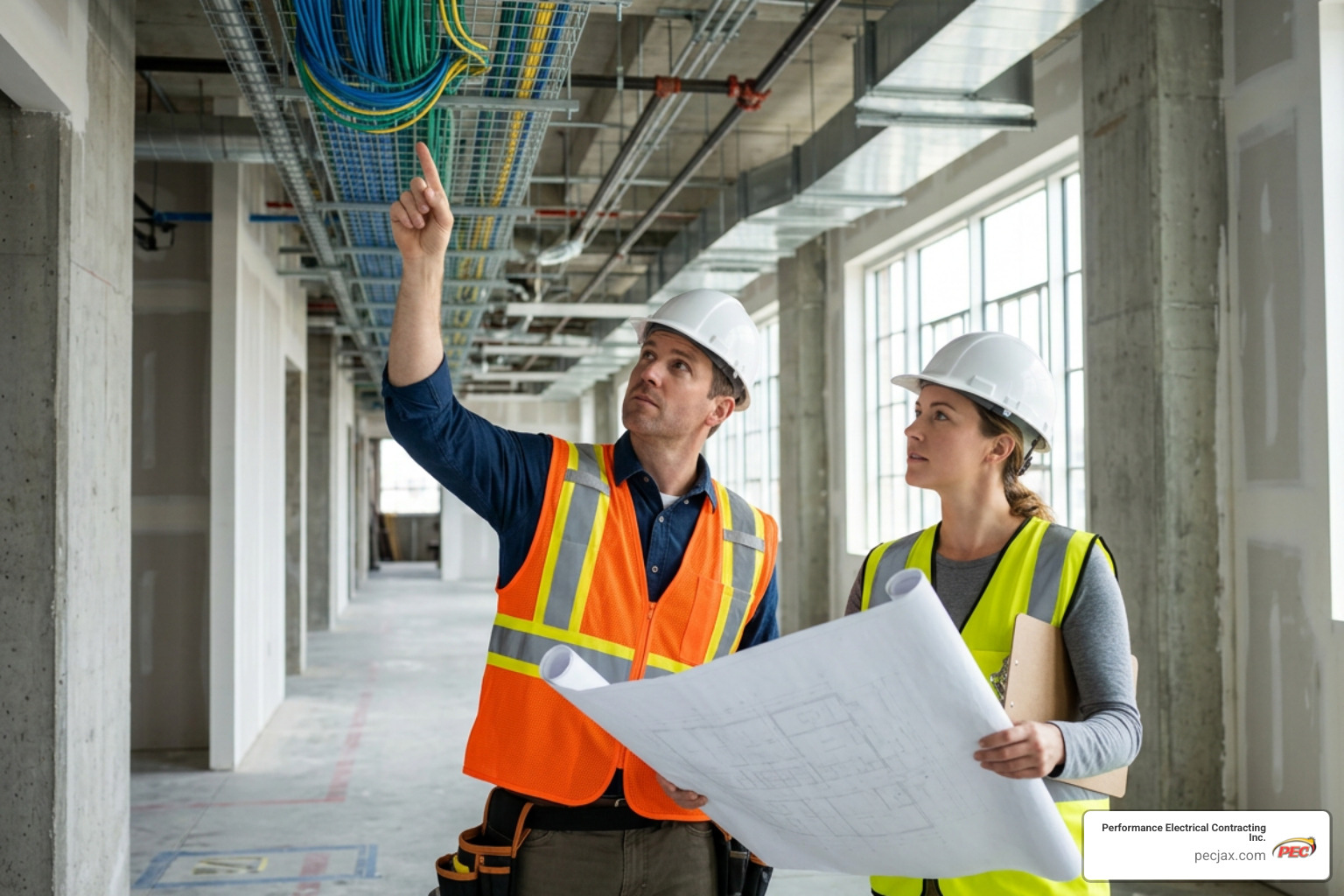
A structured cabling installation should never begin with immediate cable pulling. Proper planning ensures that every run is organized, compliant, and completed within established budget and time constraints.
The Importance of a Professional Site Survey
Before submitting an official estimate, we conduct a detailed on-site survey to evaluate your facility’s physical constraints. During this walkthrough, our team evaluates:
- Existing cable pathways, conduit capacity, and ceiling plenum spaces (requiring fire-resistant CMP-rated cabling).
- Physical wall structures and fish-tape routing opportunities for retrofits in finished spaces.
- Distances from the central equipment rack to the furthest device to ensure runs stay well under the TIA-568 100-meter limit.
- Wireless access point placement using WiFi heat mapping tools to eliminate dead zones.
When investing in tailored commercial network wiring services, a site survey ensures that drop lists, pathways, and hardware lists accurately reflect your building’s layout.
Project Timelines, Staging, and Warranties
How long does installation take? Timelines depend on drop counts and building accessibility. A small office needing 15 to 30 cable drops can usually be completed in two to three business days. A multi-story commercial building requiring hundreds of drops, telecom closets, and fiber backbones may take several weeks.
To prevent operational disruptions, we stage installations in phases or schedule high-noise ceiling work during off-hours and weekends. This allows your personnel to maintain regular daily activities without downtime.
Once installation is complete, every copper and fiber drop is certified using advanced Fluke Networks cable testers. We test for continuity, channel length, wiremap, and near-end crosstalk (NEXT) to guarantee full performance. Standard installations backed by accredited certification qualify for 25-year manufacturer system warranties, offering long-term protection that uncertified handymen cannot match.
Proper planning extends beyond network cabling. As your infrastructure expands, consider the importance of electrical capacity planning for growing homes and businesses to ensure your main power panels handle expanding hardware racks.
Frequently Asked Questions About Low Voltage Cabling
How long does a typical low voltage cabling installation take?
Project duration varies according to facility size, drop counts, ceiling height, and accessibility:
- Small Office (10–30 drops): 1 to 3 days.
- Medium Commercial Space (50–150 drops): 1 to 2 weeks.
- Large Enterprise / Warehouse (200+ drops & Fiber Backbone): 3 to 6+ weeks in structured phases.
Can cabling work be completed without shutting down business operations?
Yes. Experienced low voltage contractors regularly perform retrofits in active business environments. By staging work room-by-room, utilizing quiet fish-tape techniques, and scheduling core cutting or loud ladder work after hours or on weekends, your business remains fully operational throughout the project.
How a Low Voltage Cabling Contractor Handles Office Relocations
During an office relocation, a contractor coordinates with your IT department and Internet Service Provider (ISP) to ensure seamless migration:
- Decommissioning: Safely removing legacy patch cables and labeling existing equipment for transit.
- New Site Pre-wiring: Installing patch panels, racks, and wall outlets at the target facility prior to moving day.
- ISP Relocation: Running dedicated Cat6 drops from the ISP demarcation point to your server rack so internet connectivity is active immediately upon arrival.
- Testing & Certification: Validating all drops so your team connects seamlessly on day one.
Conclusion
Your physical cabling layer is the unheralded backbone of your organization’s digital operations. Skimping on low voltage installation leads to network bottlenecks, security vulnerabilities, and costly unexpected downtime. By partnering with a certified, licensed, and insured low voltage cabling contractor, you ensure your network infrastructure remains reliable, secure, and ready for future technological demands.
If you suspect your building’s wiring infrastructure needs professional attention or want to assess your property’s safety, review our guide on how to tell when your home needs an electrical safety inspection.
At Performance Electrical Contracting Inc., we provide value-driven, partnership-focused electrical and low voltage solutions tailored to your unique commercial, hospitality, or residential goals. Contact our team today to schedule your comprehensive site survey and build a foundation engineered for success.