
What Is Low Voltage Cabling for Office Networks?
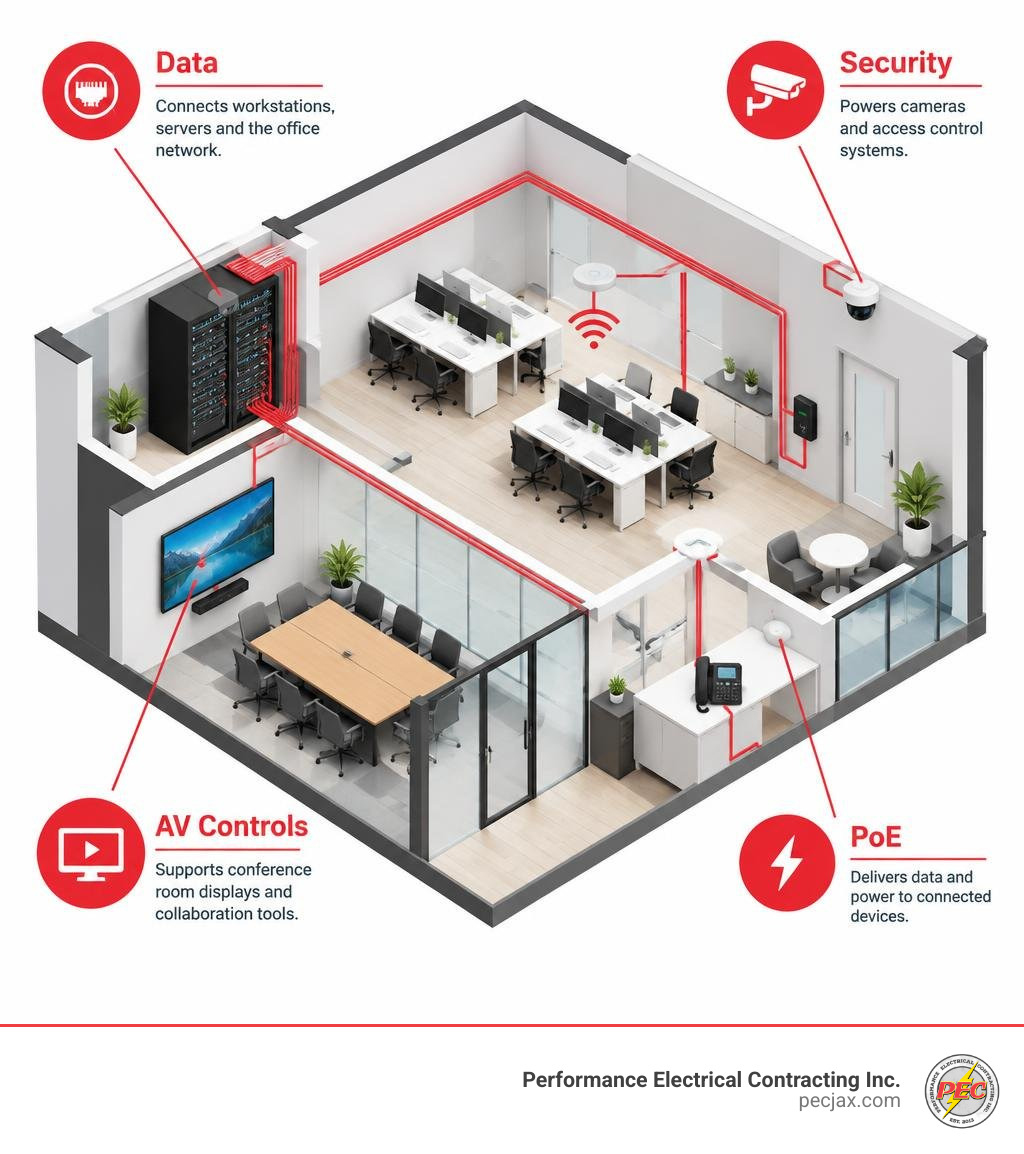
Low voltage cabling is the wiring that carries data, voice, video, security signals, and limited power for building technology systems. In most office and property-management settings, it operates at 50 volts or less, far below the 120-volt circuits that power outlets, lighting, and major equipment.
It is the physical backbone behind Ethernet networks, Wi-Fi access points, VoIP phones, IP cameras, access-control readers, conference-room AV, and building controls. A single properly selected cable can also deliver both data and power through Power over Ethernet (PoE).
For property managers, the key point is simple: low voltage cabling is not “just IT wiring.” Its design and installation affect network speed, security-system reliability, tenant operations, inspection outcomes, and the cost of future upgrades. Well-organized, tested cabling can support dependable operations for years, while poorly routed or mislabeled cable often creates expensive troubleshooting and downtime.
This guide explains the cable types, safety rules, NEC considerations, planning decisions, and installation practices that help create fast, reliable office networks.
What Is Low Voltage Cabling and How Does It Differ From High-Voltage Wiring?
When planning modern facility infrastructure, answering the foundational question—what is low voltage cabling—is critical to designing a safe, high-performance workspace. Low voltage wiring forms the physical network layer responsible for moving sensitive digital signals, voice packets, and low-level control currents across modern buildings.
Because these circuits operate with strictly limited electrical energy, they present minimal risk of electrical shock or arc flash compared to main power distribution lines. However, that does not mean they are simple. High-speed signals require rigorous routing, shielding, and termination to protect against electromagnetic interference (EMI) and packet loss.
Core Definitions: What Is Low Voltage Cabling?
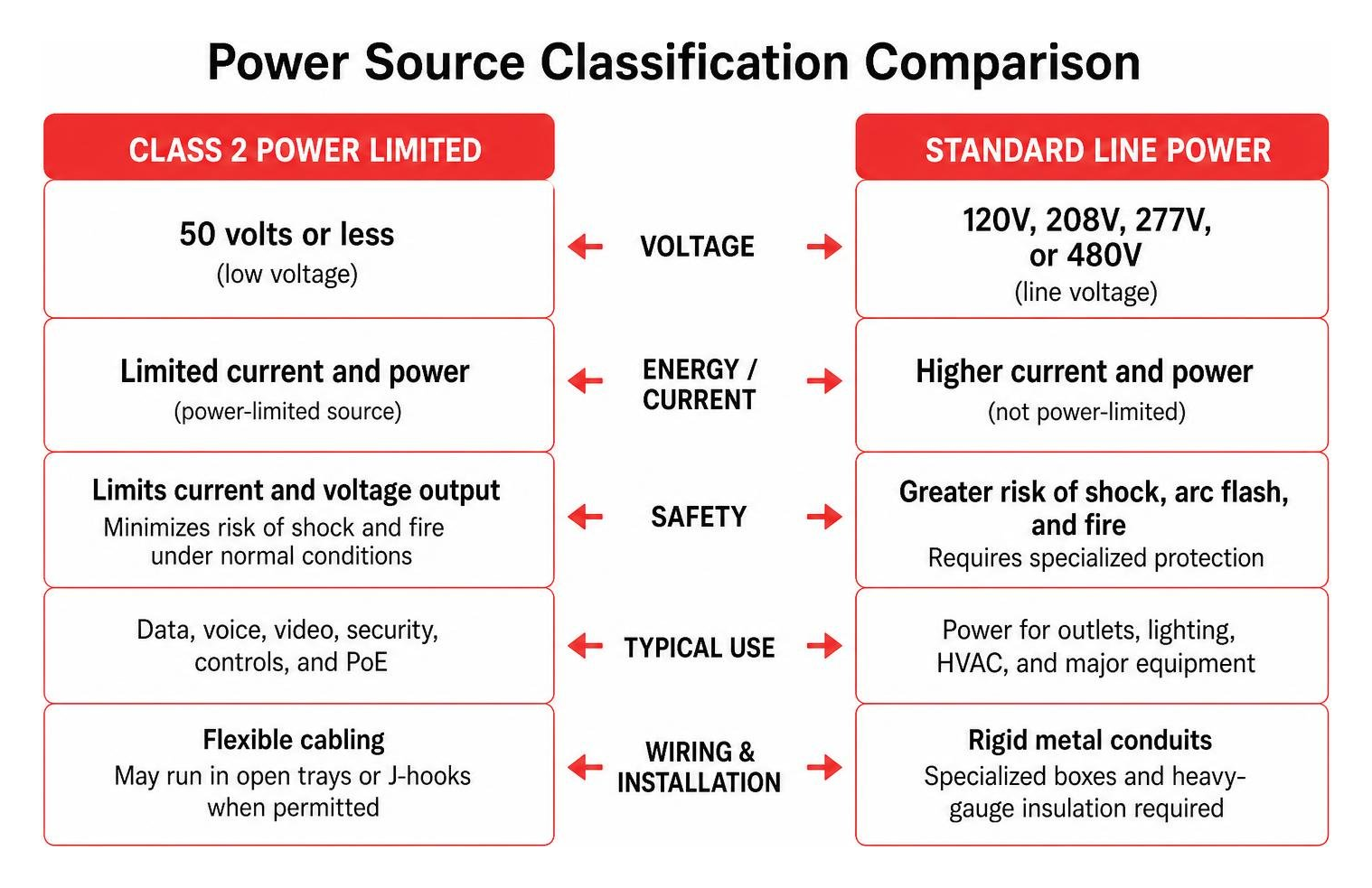
In practice across North American commercial construction, low voltage cabling refers to circuits operating at 50 volts (V) or less. The National Electrical Code (NEC) primarily groups these under Class 2 and Class 3 power-limited circuits.
A listed Class 2 power source limits both current and voltage output, preventing fire initiation even under short-circuit conditions and eliminating electrocution hazards under normal handling. Internationally, the scope can look slightly different; broader international standards on low voltage from organizations like the IEC classify low voltage as up to 1,000V AC for general electrical distribution. In building communications and telecommunications, however, the sub-50V definition remains the benchmark.
Line Voltage vs. Low Voltage Infrastructure
Standard line-voltage electrical distribution in commercial buildings runs at 120V, 208V, 277V, or 480V. These heavy conductors power HVAC chillers, commercial lighting panels, and breakroom appliances. Line voltage requires rigid metal conduits, specialized junction boxes, and heavy-gauge wire insulation to contain thermal energy and shock hazards.
Low voltage cabling focuses on signal integrity rather than raw power delivery. Because these cables carry low voltages and currents, they are more flexible and can be routed in open cable trays or J-hooks when code permits.
| Feature | Low Voltage Cabling | Standard Line Voltage Wiring |
|---|---|---|
| Typical Operating Voltage | ≤ 50V DC / AC (commonly 12V, 24V, 48V) | 120V to 480V AC |
| Primary Function | Data, communication, control, low-wattage power | Power distribution, machinery, appliances |
| Conductor Types | 22–24 AWG twisted copper, fiber optics | 10–14 AWG solid/stranded copper, aluminum |
| Pathway Requirements | Open J-hooks, cable trays, light conduit | Rigid conduit, EMT, armored MC cable |
| Shock Hazard | Extremely low / touch-safe under normal use | High shock and arc flash danger |
| Primary Code Focus | Signal bandwidth, flame spread, separation | Overcurrent protection, grounding, fire prevention |
Primary Types of Low Voltage Cables and Network Applications
Selecting the correct medium ensures your building systems perform at peak capacity without bottlenecking data throughput.
Copper Twisted-Pair and Power over Ethernet (PoE)
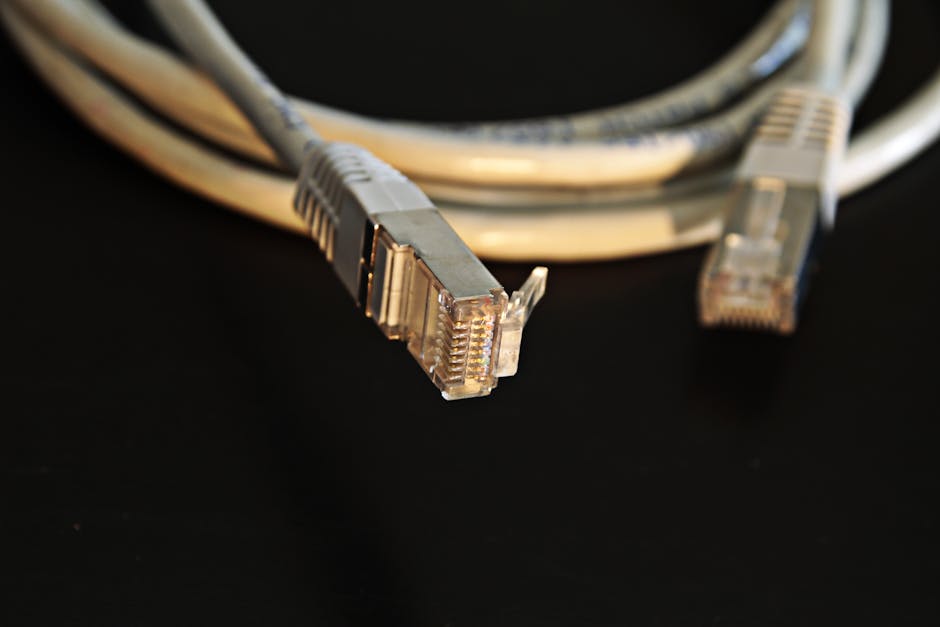
Category-rated twisted-pair copper cable remains the workhorse of structured communications. The pairs are twisted at specific rates per inch to cancel out cross-talk and external noise:
- Cat5e: Rated for up to 1 Gbps at 100 MHz bandwidth over 100 meters. Suitable for basic voice lines and legacy systems, though rarely specified for new enterprise builds.
- Cat6: Delivers 1 Gbps up to 100 meters and up to 10 Gbps across shorter runs of up to 55 meters at 250 MHz.
- Cat6a: Features tighter twists, thicker insulation, and improved alien cross-talk reduction to deliver a full 10 Gbps transmission speed over the complete 100-meter channel at 500 MHz.
Modern copper twisted-pair installations also support Power over Ethernet (PoE) under IEEE standards (802.3af, 802.3at, and 802.3bt). PoE Type 4 (IEEE 802.3bt) delivers up to 90–100 watts of DC power alongside multi-gigabit data over a single cable run. This eliminates the need for separate electrical outlets at device endpoints like Wi-Fi 6/7 access points, pan-tilt-zoom IP security cameras, and intelligent LED lighting fixtures.
Fiber Optics and Specialty Cabling Lines
When distance, bandwidth, or electrical interference exceeds the limits of copper, optical cabling is the standard choice:
- Single-Mode Fiber (OS2): Uses a narrow 9-micron glass core to carry laser signals over long distances (often tens of kilometers), making it ideal for campus backbones and data-center uplinks.
- Multi-Mode Fiber (OM3/OM4/OM5): Utilizes a 50-micron core with LED or VCSEL light sources, serving high-throughput connections up to 100 Gbps within server rooms over distances up to 300–550 meters.
Specialized copper configurations serve non-data applications:
- Coaxial (RG-6 / RG-11): Carries high-frequency radio and video signals for broadband cable distribution, satellite feeds, and legacy CCTV.
- Multi-Conductor Shielded Wire: Used for access control door strikes, card readers, and motion sensors (often bundled in composite “banana” jackets).
- CL2/CL3 Speaker Wire: Low-resistance multi-conductor copper engineered for clear audio distribution and paging.
- Thermostat / Control Wire: Typically 18 AWG solid conductors linking HVAC control boards, relays, and smart thermostats.
Critical Business Systems Powered by Low Voltage Cabling
The modern office relies entirely on low voltage infrastructure to keep teams connected, facilities secure, and operations automated:
- Enterprise Data & Wi-Fi: High-density Wi-Fi access points and workstation drops rely on Cat6a pathways for fast cloud connectivity.
- IP Surveillance & Access Control: Real-time video streams and card readers tie directly into central monitoring panels via PoE infrastructure.
- VoIP Telephony & Unified Communications: Digital desk phones and conferencing units receive power and voice-over-IP streams through structured drops.
- Conference Room AV: 4K video matrices, motorized projection screens, and ceiling microphones depend on shielded twisted-pair and optical HDMI runs.
- Building Automation & Energy Management: Smart sensors, automated window shades, and HVAC controllers tie back to building management systems (BMS) to optimize energy use.
For businesses looking to integrate or scale these networks, pairing your structured layout with expert commercial electrical services ensures both primary line power and communication subsystems work together smoothly.
Essential NEC Codes, Fire Ratings, and Safety Standards
Even though low voltage systems operate with limited energy, the cables themselves travel through plenums, drop ceilings, wall chases, and vertical building shafts. Because cable jackets are made of plastics and polymers, improper installations create real fire-propagation and smoke hazards.
Flame Spread Ratings and Air Handling Spaces
The National Electrical Code and NFPA mandate specific fire ratings based on where a cable is installed:
- Plenum (CMP / CL2P / CL3P): Designed for installation in environmental air-handling spaces, such as the open drop-ceiling space above office cubicles. Plenum cables use specialized fluoropolymer jackets (like Teflon/FEP) that resist high temperatures, self-extinguish quickly, and produce minimal toxic smoke.
- Riser (CMR / CL2R / CL3R): Rated for vertical runs between floors through dedicated riser shafts. They prevent flames from traveling vertically from floor to floor, though they produce more smoke than plenum cables and cannot be placed inside air-handling spaces.
- General-Purpose (CM / CMG / CL2 / CL3): Standard commercial rating for horizontal runs inside walls or open conduit where no vertical risers or air plenums exist.
Whenever low voltage cables penetrate fire-rated walls or floor assemblies, installers must restore the fire barrier. Using listed firestop sleeves, intumescent pillows, or firestop sealants prevents fire and toxic gases from traveling along cable pathways during an emergency.
Key NEC Classifications and Grounding Protocols
Low voltage installations are governed by several key NEC articles:
- NEC Article 725: Governs Class 1, Class 2, and Class 3 remote-control, signaling, and power-limited circuits. It defines power source limits, wiring methods, and separation distances.
- NEC Article 770: Governs the installation of optical fiber cables and raceways.
- NEC Article 800 / 805: Covers general communications circuits and telecommunications pathways.
- NEC Article 750 (NEC 2026): Updates have consolidated and clarified grounding and bonding mandates for limited-energy systems, requiring structured communication racks, shielded patch panels, and surge protection devices to bond directly back to the building’s primary grounding electrode system.
Maintaining clean electrical isolation is a core safety standard. Low voltage cables must never share a conduit, junction box, or raceway with 120V+ power conductors. In open pathways, installers must maintain physical separation—typically at least 2 to 12 inches depending on whether the high-voltage lines are shielded—to prevent dangerous line-voltage crossover and electromagnetic noise.
When your facility demands comprehensive compliance, deploying certified electrical safety solutions guarantees your infrastructure passes municipal inspections on the first run.
Planning, Structured Installation, and Avoiding Costly Mistakes
High-performing low voltage networks don’t happen by accident. They are designed as cohesive structured systems rather than ad-hoc wire pulls.
Structured Cabling Architecture vs. Point-to-Point Wiring
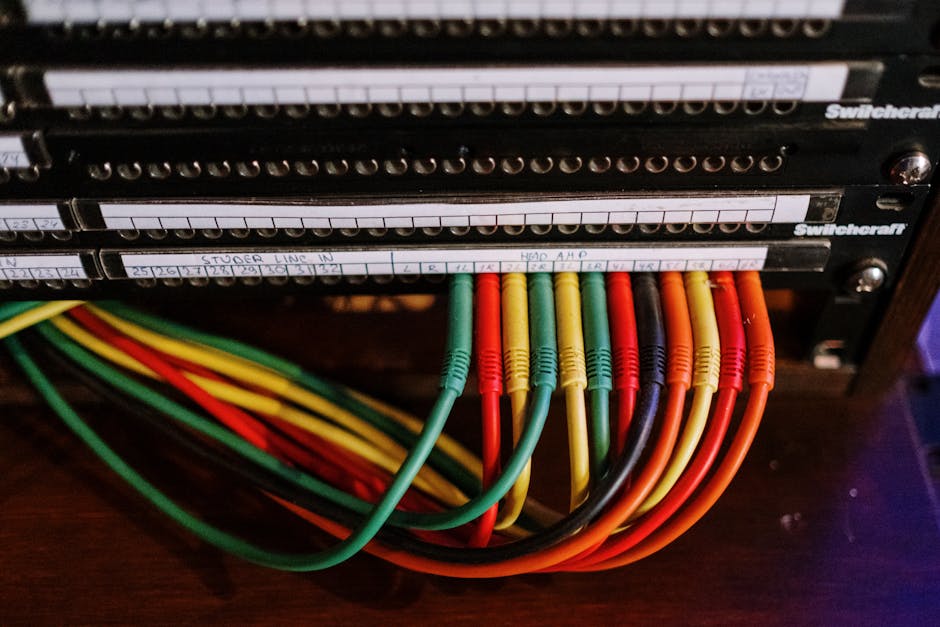
In a point-to-point setup, a technician runs an uninterrupted cable directly from a server or switch port straight to an end device. While point-to-point works for small home offices, it becomes an unmanageable mess in commercial settings.
Structured cabling replaces this chaos with a standardized, modular topology governed by ANSI/TIA-568 standards:
- Entrance Facility (EF): The demarcation point where external service providers (ISPs, telcos) enter the facility.
- Main Telecommunications Room (MTR/MDF): The central hub housing core routers, PBX switches, and primary patch panels.
- Backbone Cabling: High-bandwidth fiber optic or multi-pair copper trunk lines connecting the MDF to secondary closets across multiple floors.
- Intermediate Distribution Frames (IDF): Satellite closets that serve localized floor zones.
- Horizontal Cabling: Individual Cat6 or Cat6a runs spanning from patch panels inside the IDF out to workstation wall outlets or ceiling devices (limited to a maximum permanent link distance of 90 meters, with 10 meters of total patch cord allowance).
- Work Area: Wall plates, surface-mount boxes, and short patch cords connecting laptops, VoIP hardware, or printers.

This structured layout allows network administrators to make moves, additions, and changes (MACs) at the patch panel in seconds without pulling new cable through finished walls. Investing in dedicated infrastructure electrical services provides the necessary cable trays, dedicated circuits, and cooling frameworks to support this architecture long-term.
Critical Installation Pitfalls and Quality Assurance
Poor installation practices can downgrade expensive Cat6a or fiber infrastructure to subpar speeds. Here are the most common field pitfalls and how to avoid them:
- Exceeding Maximum Pull Tension: Four-pair UTP copper cable has a maximum pulling tension of 25 pounds of force (lbf). Yanking cables around tight corners stretches copper pairs and alters internal twist rates, causing permanent return-loss failures.
- Violating Minimum Bend Radii: Copper data cables require a minimum bend radius of at least 4 times the cable’s outside diameter (roughly 1 inch), while armored or fiber optic lines require 10 to 20 times the diameter under tension. Kinking a cable destroys its high-frequency transmission capability.
- Using Copper-Clad Aluminum (CCA): Some low-cost cables use aluminum conductors with a thin copper plating. CCA is not approved by the NEC for structured data cabling, has high electrical resistance, snaps easily, and poses serious fire risks when used for PoE applications. Always specify 100% pure solid bare copper conductors.
- Over-Tightening Cable Ties: Crushing bundles with plastic zip ties pinches internal conductors and alters pair geometry. Installers should use hook-and-loop (Velcro) straps tightened by hand to secure bundles neatly without deforming the jackets.
- Inadequate Labeling: Failing to follow ANSI/TIA-606 labeling standards turns troubleshooting into a nightmare. Every run should be labeled at both termination ends and mapped on architectural schematics.
- Skipping Certification Testing: Simple wire-map continuity testers only prove pins are wired in order. Professional installers use Fluke-grade certification analyzers to test for near-end cross-talk (NEXT), return loss, attenuation, and length before project handover, ensuring the installation meets 99.9% operational uptime standards.
Frequently Asked Questions About Low Voltage Wiring
Do commercial low voltage cabling installations require permits?
In most commercial jurisdictions, yes. While residential low voltage work (like replacing a doorbell) rarely requires local permits, commercial installations typically do. Municipal building departments mandate permits to verify that cables installed in return-air plenums have the proper CMP flame ratings and that firestop systems are correctly installed where pathways breach fire-rated barriers.
What is the expected lifespan of a low voltage cabling system?
A properly designed and installed structured cabling system has a physical lifespan of 15 to 20 years. However, because technology and network bandwidth requirements advance rapidly, most enterprise organizations evaluate their cabling infrastructure every 5 to 7 years. Installing higher-spec cabling (such as Cat6a instead of Cat6, or deploying spare dark fiber strands during initial construction) ensures the physical layer can support future multi-gigabit hardware without requiring costly wall retrofits.
Can low voltage and high voltage electrical cables share the same conduit?
No. NEC Article 725 and Article 800 strictly prohibit Class 2 and Class 3 low voltage communication cables from occupying the same conduit, raceway, or junction box as line-voltage conductors (unless separated by an approved permanent barrier). Mixing them poses a life-safety hazard if high voltage arcs across damaged insulation, and the strong electromagnetic fields generated by 60Hz alternating power lines will introduce severe electrical noise and data packet loss into communication lines. Installers must maintain at least a 2-inch separation even in open ceiling runs.
Conclusion
Low voltage cabling is the unsung backbone of every high-performing office, modern hospitality venue, and commercial enterprise. From delivering multi-gigabit data streams and clear video conferencing to powering smart access controls through PoE, a well-engineered cabling plant ensures dependable operational uptime, easy maintenance, and simple future expansion.
Cutting corners with inferior materials, uncertified wire pulls, or code-violating routing leads to intermittent network drops, costly troubleshooting, and failed building inspections. Building it right the first time protects your budget and your business.
Ready to plan your next commercial build or retrofit? Discover how to partner with certified, experienced professionals by exploring The Ultimate Guide to Hiring Low Voltage Cabling Contractors.
At Performance Electrical Contracting Inc., we deliver top-tier commercial electrical, infrastructure, and low voltage solutions throughout Jacksonville, FL, and across the Southeast. Whether you need a ground-up structured cabling deployment, data closet buildouts, or integrated security pathways, our certified team delivers on-time, code-compliant, and value-driven results. Explore our full range of services or contact us today to schedule a consultation with our experienced project team.