
How to Choose a Recessed Lighting Contractor
Start with a licensed, insured electrical contractor. Ask for an itemized quote, a lighting layout, a project schedule, and a clear answer on who will handle permits and inspections. For a multifamily or commercial property, also ask how the crew will keep spaces safe and limit disruption to tenants or business operations.
The right specialist should check ceiling access, existing wiring, and circuit capacity before promising a price or timeline. This guide covers the questions that help you compare contractors and avoid costly surprises. For additional guidance on lighting design and installation standards, the U.S. Department of Energy offers a helpful overview of LED lighting.
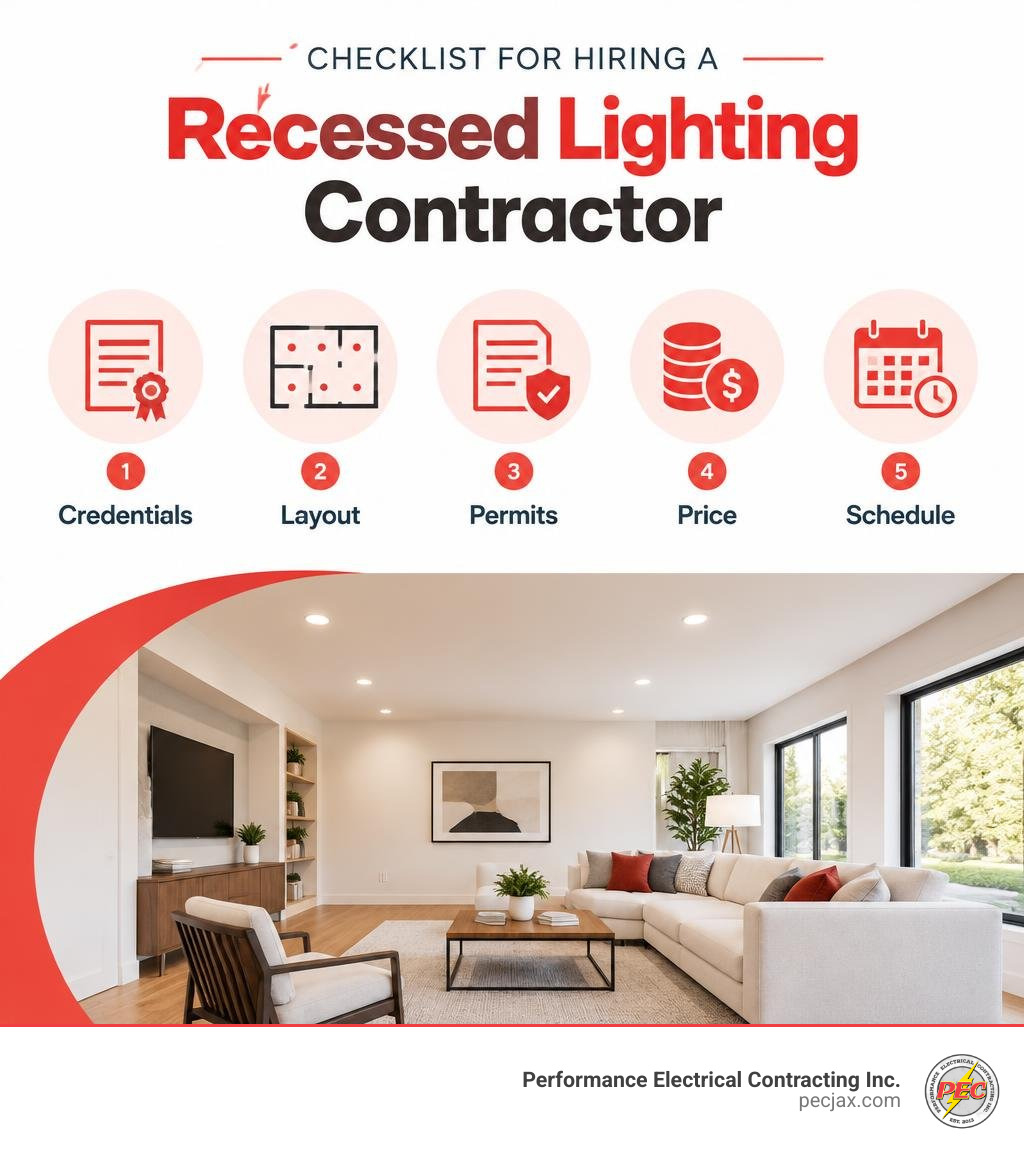
What to Look for When Hiring a Recessed Lighting Contractor

Hiring the right indoor lighting expert is about far more than finding someone who knows how to use a drywall saw. Cutting into ceilings and tying new fixtures into your primary electrical distribution system introduces distinct safety, structural, and fire-hazard considerations. When selecting a recessed lighting contractor, you want an experienced partner who can guarantee clean lines, perfectly balanced illumination, and total code compliance.
Our comprehensive residential electrical services prioritize home safety by conducting thorough panel load calculations, testing existing copper wiring, and evaluating overhead clearance before making a single cut.
| Feature / Consideration | Qualified Licensed Electrician | Uncertified Handyman |
|---|---|---|
| Licensing & Code Compliance | Verified state-issued master/journeyman electrical license; pulls official permits | Unlicensed for primary circuit expansion; skips local code filings |
| Insurance Coverage | Comprehensive general liability and workers’ compensation coverage | Minimal or nonexistent; puts homeowner at financial risk |
| Load & Safety Calculations | Performs precise panel capacity checks and load calculations | Guesses circuit capacity; risks breaker trips and overheating |
| Structural Knowledge | Maps joists, plumbing, and HVAC lines using precision scanning | Prone to cutting joists, ceiling drywall damage, or hitting hidden pipes |
| Workmanship Warranty | Dedicated warranty backing labor, fixtures, and control integration | Rarely offers written guarantees; difficult to reach for callbacks |
Credentials and Insurance Every Recessed Lighting Contractor Must Have
Before signing a contract or letting a technician drill into your ceiling, ask for documented proof of credentials. Any reputable electrical professional must maintain:
- State-Issued Electrical Contractor License: Proves technical mastery of the National Electrical Code (NEC) and regional building regulations.
- General Liability Insurance: Protects your property against structural damage or fire hazards during installation.
- Workers’ Compensation Insurance: Covers on-site technicians, shielding you from liability if someone gets injured.
- Background Checks & Safety Adherence: Ensures vetted, drug-tested professionals enter your home or business.
Evaluating Past Experience and Project Portfolios
Never hesitate to ask to see a specialist’s recent work. Reviewing an established portfolio allows you to examine beam consistency, trim alignment, and the absence of drywall blowout.
Look for verified customer reviews that highlight punctuality, tidy workspaces, and clear communication. Seasoned residential lighting crews complete most standard residential recessed lighting installations in a single day, leaving no mess or patching headaches behind.
Core Design and Technical Questions for Your Lighting Specialist

A high-quality lighting specialist does not just ask, “Where do you want the switches?” They evaluate how you actually use the room. Whether you are illuminating a single kitchen or outfitting large living areas across multifamily electrical services, design precision prevents awkward shadows, harsh glare, and unbalanced dark spots.
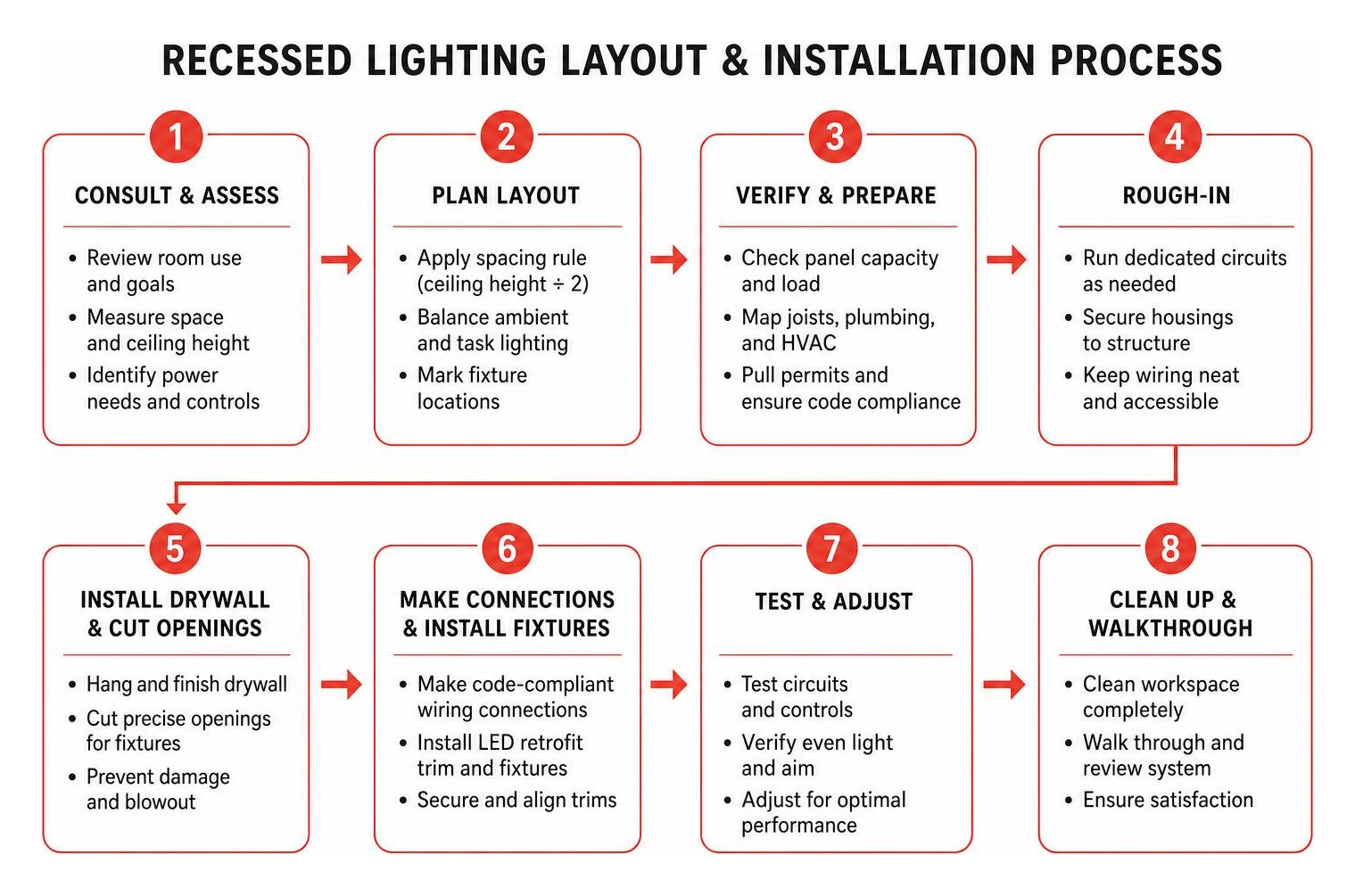
How Will You Determine Fixture Placement and Spacing?
Proper placement balances ambient illumination with focal task lighting:
- Ceiling Height Rule of Thumb: A reliable standard spacing formula is dividing your ceiling height by two to determine the distance between fixtures (for an 8-foot ceiling, space fixtures roughly 4 feet apart; for a 10-foot ceiling, roughly 5 feet apart).
- Wall Washing Distance: For illuminating artwork or accent walls, fixtures should generally be placed 2 to 3 feet away from the wall to create a smooth, flattering wash of light without glaring hot spots.
- Countertop Task Lighting: In kitchens, fixtures should align directly above the counter edges rather than behind the cook’s shoulders, preventing frustrating workspace shadows.
- Beam Angle Selection: Narrower beam spreads (25 to 30 degrees) accentuate specific art or architectural features, while wider spreads (40 to 60 degrees) deliver seamless ambient coverage.
Choosing Between New Construction, Remodel, and Retrofit Fixtures
The physical structure above your ceiling dictates the exact housing required.
| Fixture Type | Best Used For | Installation Requirements | Key Advantages |
|---|---|---|---|
| New Construction Housing | Open framing during builds or major gut renovations | Mounted directly to ceiling joists using adjustable hanger bars | Maximum sturdiness; unrestricted positioning between studs |
| Remodel (Canless / Ultra-Thin) Kits | Existing finished drywall, plaster, or drop ceilings | Cut directly into drywall; secured via spring-loaded tension clips | Minimal drywall disruption; fits ceiling voids that are less than 2 inches deep |
| Retrofit Downlight Inserts | Upgrading older incandescent/halogen “tin cans” | Screws directly into existing E26 sockets or clips into housing | Inexpensive, ultra-fast upgrade to modern LED efficiency |
When working around insulation in finished ceilings, your installer must use IC-rated (Insulation Contact) fixtures. These prevent excess heat buildup when the unit touches attic insulation. For sloped or vaulted ceilings, specialized angled trims and gimbal fixtures keep the light projecting straight downward instead of glaring sideways.
Energy Efficiency, Smart Controls, and System Compatibility
Upgrading from dated incandescent lighting to modern solid-state LEDs is an exceptional efficiency investment. Quality LED downlights operate for 25,000 to 50,000+ hours (lasting well over a decade under standard use) compared to just 1,000 hours for traditional incandescent bulbs.
In commercial offices and large facilities managed under our commercial electrical services, switching to LED can reduce lighting electricity consumption by up to 75% to 85%. Because modern LEDs emit minimal ambient heat, they also lower cooling loads and ease air conditioning strain during hot summer months.
Which Dimmer Switches and Smart Lighting Controls Are Compatible?
One of the most common complaints after DIY lighting jobs is flickering, buzzing, or an inability to dim smoothly. This happens when the LED driver does not match the wall dimmer’s internal design.
- TRIAC (Forward-Phase) Dimmers: Traditional dimmers; often require specific LED compatibility to prevent low-end hum.
- ELV (Electronic Low Voltage / Reverse-Phase) Dimmers: Deliver ultra-smooth, flicker-free dimming for high-end architectural LED arrays.
- 0-10V Dimming: Common in commercial settings for precise low-voltage array control.
- Smart Home Hubs & No-Neutral Setups: Many wireless smart switches (such as Lutron Caseta, Philips Hue, or Zigbee-compatible systems) require specific wiring configurations. Your contractor will confirm whether your switch boxes have neutral wires or need specialized no-neutral smart dimmers.
How Does LED Recessed Lighting Impact Long-Term Energy Costs?
LED fixtures offer outstanding luminous efficacy, generating maximum lumens with very low wattage. For instance, five traditional 75-watt incandescent bulbs consume 375 watts of power. Replacing them with five modern LED fixtures producing the same light output requires only about 50 to 60 watts total.
This drop in power demand delivers measurable utility bill savings every month while virtually eliminating ongoing bulb replacement costs.
Understanding Costs, Permits, and Project Timelines
Clear budgeting and realistic timelines are critical for any electrical project.
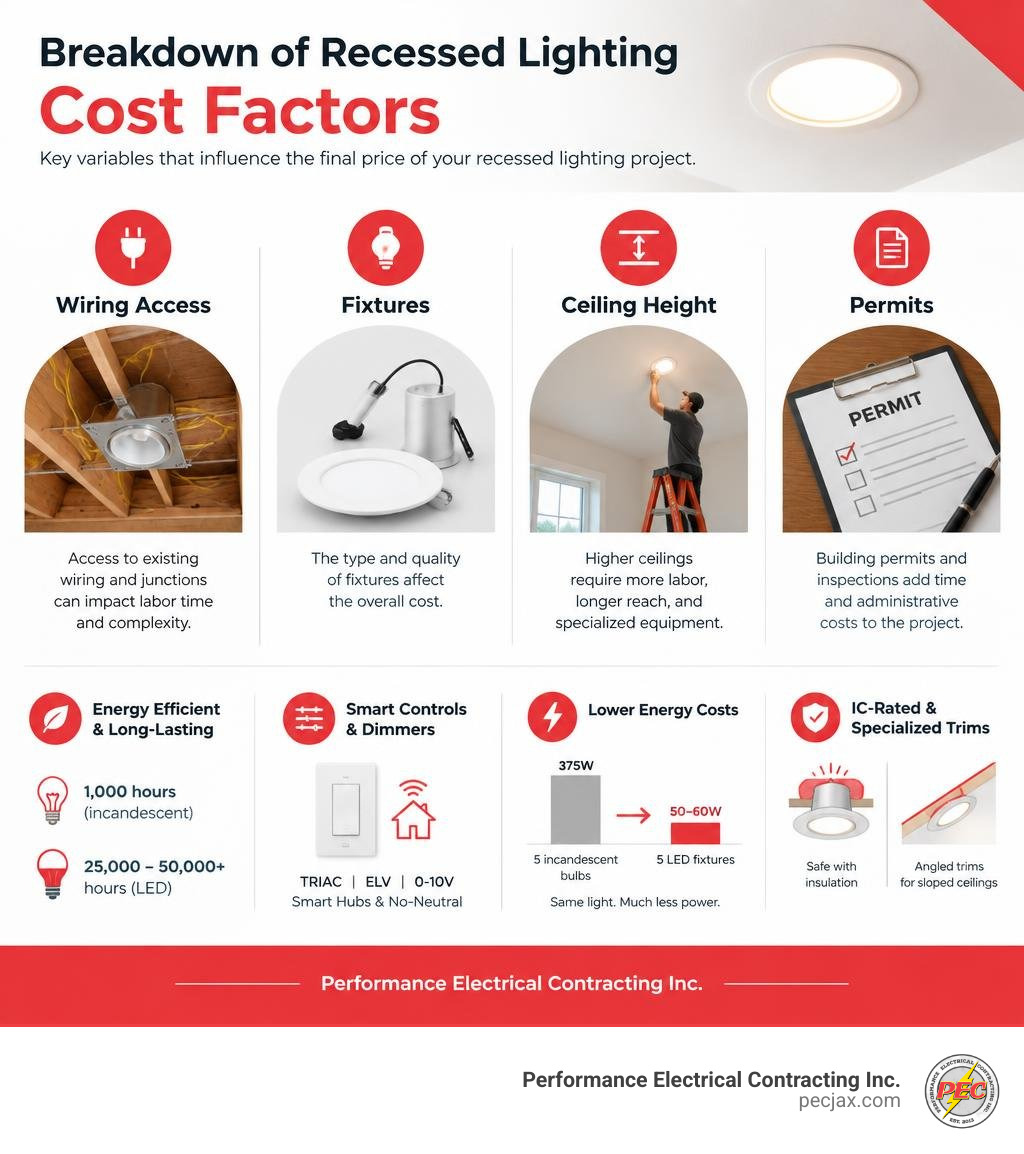
Professional installation costs generally range from $150 to $350 per fixture, including labor, rough-in wiring, fixture housing, and trim. If your project requires running brand-new circuits through finished drywall, upgrading an older panel, or navigating dense attic insulation, costs will adjust accordingly.
Are Building Permits and Inspections Required for the Project?
Yes, in most jurisdictions, adding new branch circuits, running new Romex/NM-B wiring, or modifying your main service panel requires an electrical permit for residential work. A licensed contractor pulls these permits, schedules municipal rough-in and final inspections, and ensures everything complies with the latest National Electrical Code standards.
Simple, direct 1-to-1 retrofit bulb swaps in existing cans do not typically require a permit, but adding new lighting arrays to an unlit ceiling almost always does.
What Is the Typical Cost and What Factors Cause Price Variations?
A reliable electrical contractor provides an itemized proposal detailing:
- Number of fixture units and chosen trim finishes (e.g., baffle, gimbal, flangeless)
- Ceiling material complexity (drywall is straightforward; plaster and lath, tongue-and-groove wood, or concrete require specialized cutting tools)
- Wiring accessibility (open attic crawlspaces allow faster wiring than two-story flat ceilings)
- Electrical panel upgrades (if your breaker panel is at full capacity, adding a new 15-amp or 20-amp lighting circuit requires a subpanel or service panel upgrade)
To see how professional installation keeps timelines sharp and spaces clean across real properties, explore our featured projects.
Frequently Asked Questions About Hiring a Recessed Lighting Contractor
How Many Recessed Lights Do I Need for a Standard Room?
To determine the ideal baseline, calculate the room’s square footage (length × width) and multiply by the recommended foot-candles or lumens needed for that space:
- Living rooms and bedrooms: Require roughly 10 to 20 lumens per square foot.
- Kitchens, home offices, and workspaces: Require roughly 30 to 50 lumens per square foot for clear visibility.
For example, a 200-square-foot living room requires approximately 3,000 total lumens (200 sq ft × 15 lumens/sq ft). If you choose 4-inch LED recessed fixtures that emit 750 lumens each, you will need 4 evenly spaced fixtures to light the room evenly.
Can Recessed Lights Be Installed in Any Ceiling Type?
Yes. Modern canless LED downlights, which measure less than an inch thick with remote junction boxes, install easily in drywall, plaster and lath, tongue-and-groove wood, drop ceilings, and shallow joist cavities. In insulated ceilings, always verify that your installer uses IC-rated (Insulation Contact) and airtight (AT) fixtures to maintain home efficiency and prevent fire risks.
Does Installing Recessed Lighting Increase Home Value?
Yes. Upgrading to a clean, flush recessed lighting layout provides an immediate return on investment. It eliminates dated, bulky hanging fixtures, makes low ceilings feel visibly taller, opens up narrow hallways, and creates a bright, modern visual appeal that immediately attracts prospective buyers and appraisers.
Conclusion
Recessed lighting is an effective, elegant way to modernize your property, make rooms feel more spacious, and cut monthly energy bills. However, ensuring clean spacing, safe circuit loading, and reliable smart controls requires the expertise of a qualified professional.
At Performance Electrical Contracting Inc., we deliver turnkey indoor lighting solutions backed by decades of commercial, multifamily, and residential experience across Jacksonville and the Southeast. From custom design layouts to clean single-day installations and code-compliant sign-offs, our team provides on-time, on-budget results.
Discover our full line of electrical services or contact us today to schedule your lighting consultation and receive a detailed project quote!