The Purpose and Structure of the National Electrical Code
At its core, the National Electrical Code establishes the absolute minimum safety benchmark for electrical installations across the United States. Sponsored by the National Fire Protection Association (NFPA) since 1911 and approved by the American National Standards Institute (ANSI), NFPA 70 is recognized worldwide as the definitive standard for safeguarding people and property from electrical hazards.
When the NFPA first began sponsoring the standard over a century ago, roughly 25% of American homes had electricity. Today, modern homes and commercial facilities carry massive electrical demands, powering everything from complex building management automation to banks of electric vehicle chargers.
To keep pace with this rapid evolution, the standard operates on a strict three-year revision cycle. The development process relies on an open, consensus-driven framework overseen by a Technical Correlating Committee and 18 specialized Code-Making Panels (historically 19 panels). During the 2014 development cycle alone, technical committees acted on 3,745 code change proposals and 1,625 public comments, proving how active and democratic this safety process is. For an in-depth breakdown of these evolving standards, the NFPA 70, National Electrical Code (NEC) Handbook (2026) provides complete commentary and practical guidance alongside the regulatory language.
Core Chapters and Structure of the Electrical Code
The NEC is systematically arranged into an introduction, nine core chapters, and several informative annexes. Understanding this roadmap makes finding specific compliance requirements straightforward:
- Article 90 (Introduction): Outlines the purpose, scope, and enforcement principles of the code, emphasizing that it is designed for safety rather than as a design manual for untrained individuals.
- Chapter 1 (General): Covers broad foundational rules, including definitions (Article 100) and general requirements for electrical installations, working spaces, and equipment examination (Article 110).
- Chapter 2 (Wiring and Protection): Details requirements for grounded conductors, branch circuits, feeders, service entrance equipment, overcurrent protection, surge protection, and grounding and bonding (Article 250).
- Chapter 3 (Wiring Methods and Materials): Regulates physical wiring, conductor types, cable assemblies (such as NM, MC, and TC cables), raceways, conduit bodies, and junction boxes.
- Chapter 4 (Equipment for General Use): Governs everyday equipment, including switches, receptacles, panelboards, luminaires, motors, air conditioning equipment, transformers, and stationary battery banks.
- Chapter 5 (Special Occupancies): Focuses on hazardous (classified) areas where flammable gases or dust exist, health care facilities, commercial garages, marinas, and agricultural buildings.
- Chapter 6 (Special Equipment): Addresses specialized installations such as electric signs, elevators, electric vehicle power transfer systems, solar photovoltaic (PV) arrays, and energy storage systems.
- Chapter 7 (Special Conditions): Covers emergency systems, legally required standby systems, critical operations power systems (COPS), and Class 1, 2, 3, and 4 power-limited circuits.
- Chapter 8 (Communications Systems): Independent requirements for radio, television, telephone, broadband, and network cabling systems.
- Chapter 9 (Tables): Practical mathematical tables for conductor dimensions, conduit fill percentages, and cable properties.
- Informative Annexes (A through K): Reference materials providing application formulas, conduit fill tables, torque specifications (UL 486A-486B), administrative enforcement guidelines, and ADA accessibility metrics.
The standard also establishes clear dividing lines for operating voltages, creating distinct rules for low-voltage systems, systems under 1,000 volts nominal, and high-voltage systems exceeding 1,000 volts AC or 1,500 volts DC.
Application Across Residential, Commercial, and Industrial Occupancies
The scope of the code covers diverse building environments, adapting safety rules to match specific operational risks:
- Residential Dwellings: Focuses heavily on personal life safety through child protection, ground-fault reduction in wet areas, arc-fault fire mitigation in living spaces, and exterior emergency service disconnects.
- Commercial Facilities: Emphasizes continuous power reliability, emergency egress lighting, robust branch-circuit sizing, dedicated equipment working clearances, and selective coordination for overcurrent protective devices.
- Industrial Infrastructure: Addresses high-load motor circuits, variable frequency drives, heavy machinery transformers, classified hazardous dust or chemical areas, and large-scale power distribution systems.
- Agricultural and Specialized Occupancies: Addresses unique environmental challenges, such as corrosive livestock confinement spaces, stray voltage mitigation, and equipotential planes around livestock waterers.
Essential Safety Technologies Mandated by Standardized Rules
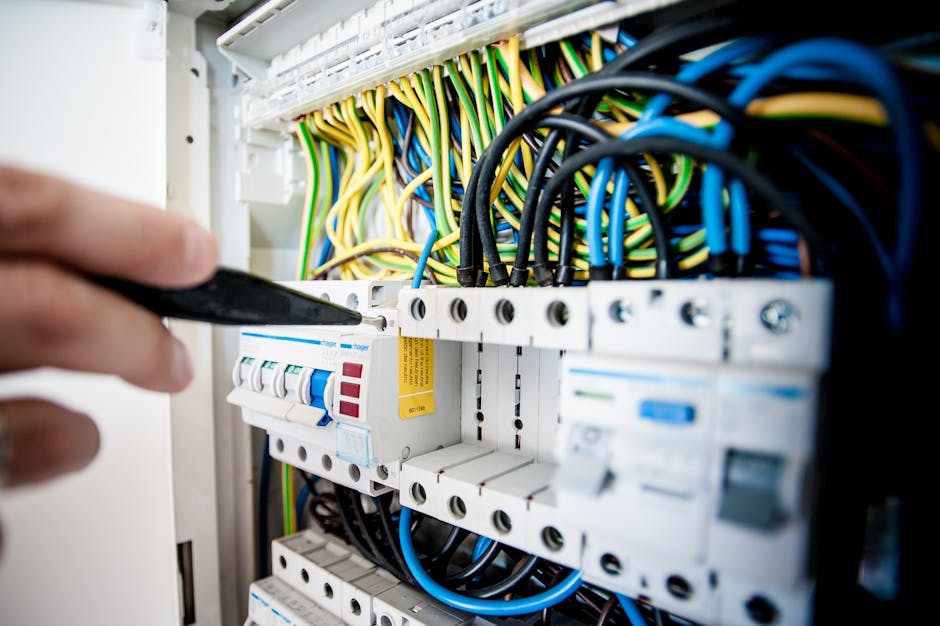
Over several decades, safety data has driven the inclusion of automatic protective technologies. Rather than relying solely on human behavior to avoid hazards, the code mandates built-in safety devices that continuously monitor circuits and interrupt dangerous faults automatically.
| Technology | Primary Hazard Mitigated | Operational Mechanism | NEC Baseline Requirement |
|---|---|---|---|
| Tamper-Resistant Receptacles (TRRs) | Pediatric electrical burns and foreign object insertion shock | Internal spring-loaded shutters that open only when equal pressure is applied simultaneously to both slots | Mandatory across all 15A and 20A, 125V and 250V dwelling unit receptacles, child care facilities, and hotel guest rooms |
| Arc-Fault Circuit Interrupters (AFCIs) | Electrical fires caused by arcing, frayed cords, and damaged building wire | Microprocessors analyze electrical waveforms to detect erratic arcing signatures and cut power | Required on branch circuits supplying family rooms, bedrooms, dining rooms, hallways, and similar residential living areas |
| Ground-Fault Circuit Interrupters (GFCIs) | Severe electric shock and fatal electrocution from current leakage | Senses microscopic current imbalances (4–6 mA) between hot and neutral conductors, cutting power in milliseconds | Required in kitchens, bathrooms, garages, outdoors, basements, within 6 feet of sinks, and for major appliances |
Tamper-Resistant Receptacles (TRRs)
Standard electrical outlets present a severe risk to young children. More than 2,400 children—nearly 7 children each day in the United States—are treated in hospital emergency rooms for electrical injuries caused by inserting everyday objects such as keys, paperclips, or hairpins into electrical outlets.
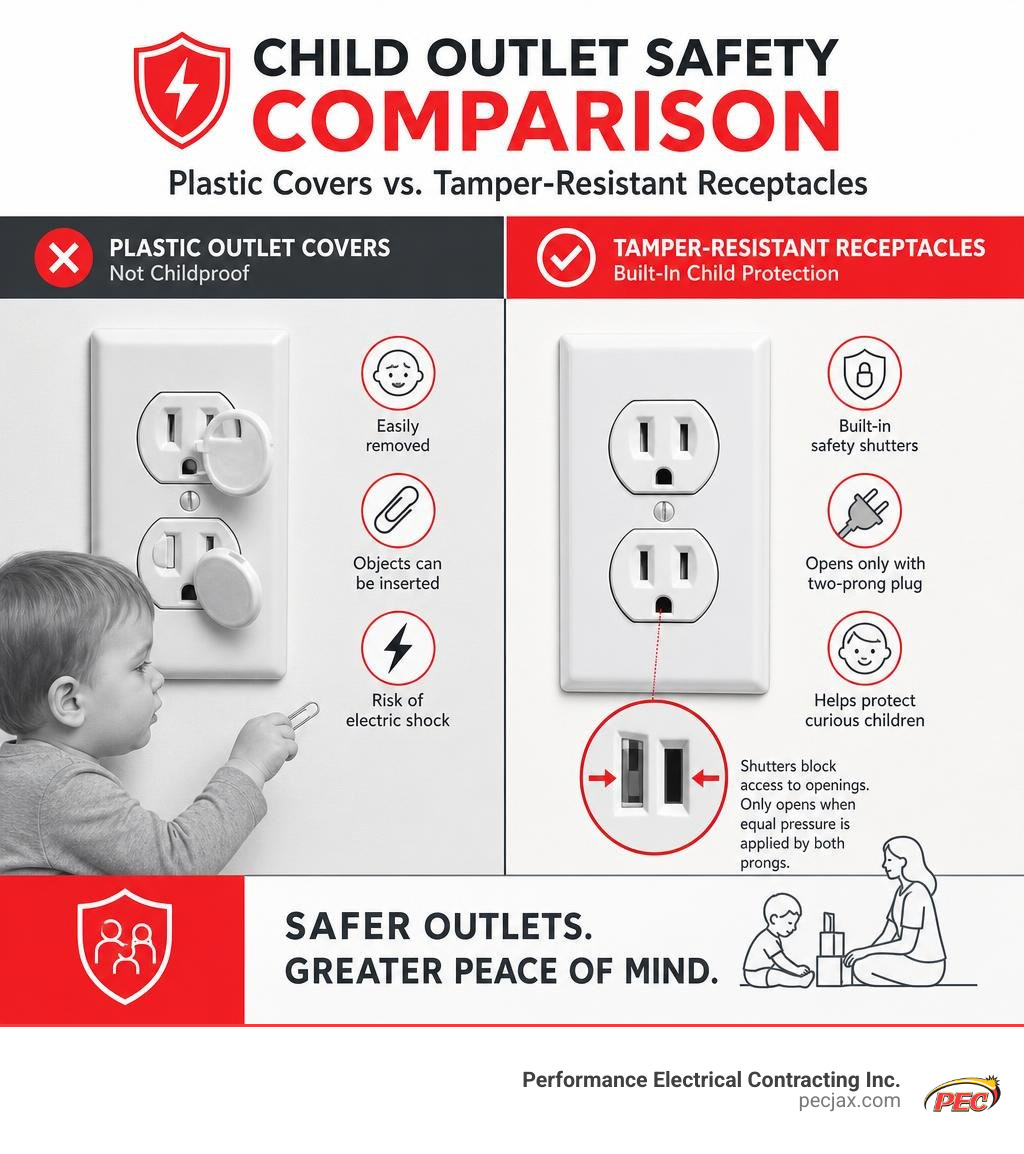
A landmark study by Temple University’s Biokinetics Laboratory revealed that 100% of children aged 2 to 4 years were able to remove conventional plastic outlet caps in less than ten seconds. In contrast, Tamper-Resistant Receptacles feature built-in, spring-loaded safety shutters. These shutters block foreign objects from contacting live components unless two identical prongs are inserted simultaneously with equal pressure. Installing TRRs throughout a newly built single-family home adds less than $50 to total construction costs while offering permanent, passive protection.
Arc-Fault and Ground-Fault Circuit Interrupters (AFCIs and GFCIs)
AFCIs and GFCIs address two fundamentally different electrical hazards:
- AFCIs Protect Against Fire: Damaged wiring inside walls, pinched cords behind furniture, and loose screw terminals can generate high-temperature electrical arcing capable of igniting nearby wood framing or drywall insulation. The U.S. Consumer Product Safety Commission (CPSC) estimates that AFCIs could prevent roughly 50% of the electrical fires that occur every year.
- GFCIs Protect Against Electrocution: When electricity strays from its normal conductor path—such as through water or a human body to ground—GFCIs cut power in a fraction of a second. Since their introduction to the NEC in the early 1970s, GFCIs have helped cut the number of residential electrocutions in half.
Recent code cycles have continuously expanded GFCI protection beyond standard bathroom and kitchen receptacles to include hardwired and cord-and-plug-connected residential appliances, including dishwashers, electric ranges, microwave ovens, clothes dryers, and outdoor HVAC condenser units.
How States Adopt and Enforce Electrical Safety Standards

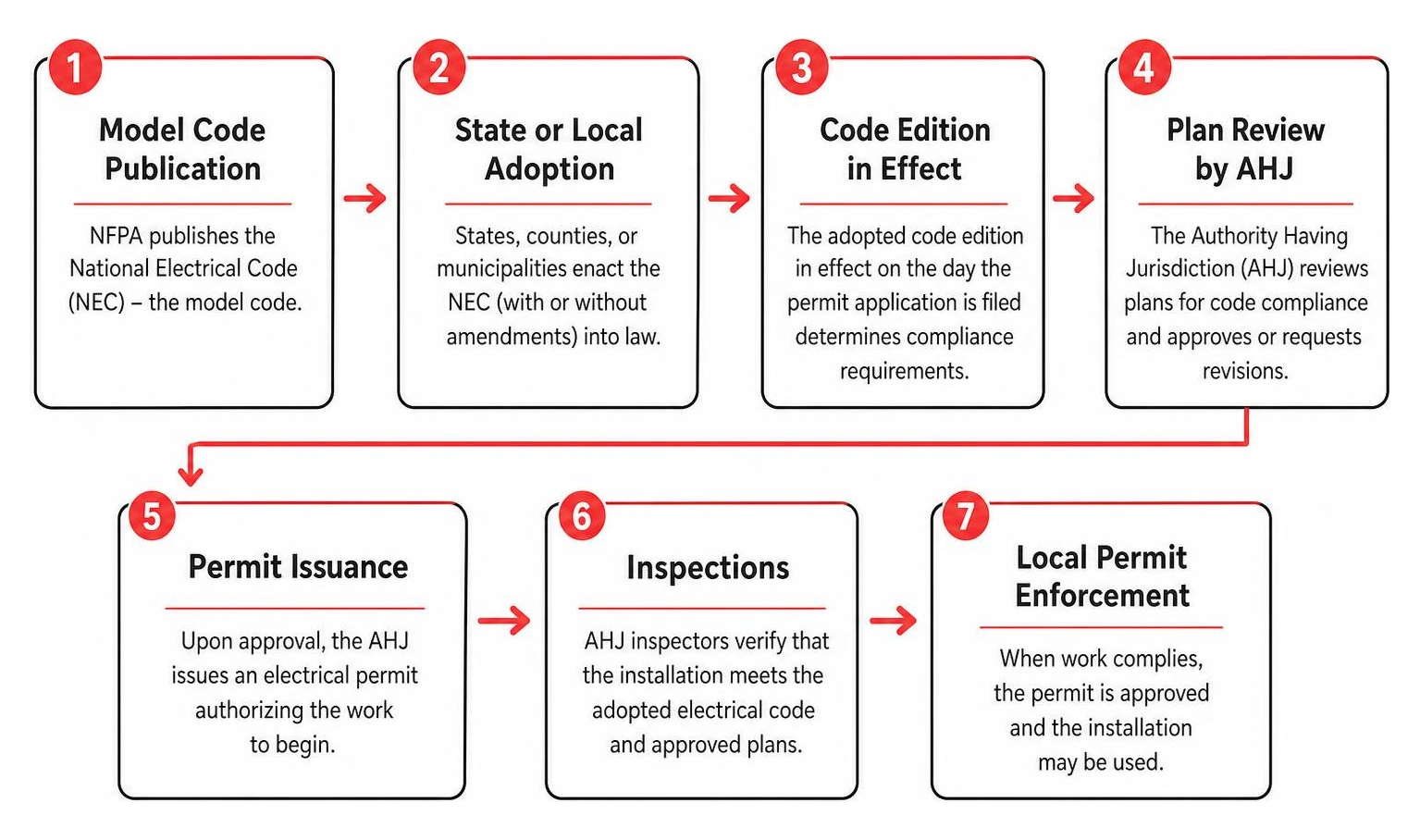
The NEC does not automatically become legally binding nationwide upon publication. Instead, it must be enacted into law by state legislatures, county commissions, or municipal city councils. The local regulatory body—typically led by a designated building official known as the Authority Having Jurisdiction (AHJ)—is responsible for reviewing plans, issuing permits, and carrying out field inspections.
When projects involve complex installations or modern upgrades, navigating electrical code compliance inspection rules and permits requires understanding which specific code edition is in effect on the exact day the permit application is filed. AHJs have the authority to interpret rules, approve specialized equipment, and issue stop-work orders if work diverges from approved plans or mandated safety codes.
State-Specific Adoptions: California and Minnesota Case Studies
Because states maintain sovereignty over building safety laws, code adoption cycles and local amendments vary widely across jurisdictions:
- California: California integrates electrical standards into Title 24, Part 3 of the California Code of Regulations, known as the California Electrical Code (CEC). The 2025 CEC uses the 2023 edition of NFPA 70 as its base model code, layering on extensive state-specific amendments for energy efficiency, electric vehicle charging infrastructure, and seismic bracing.
- Minnesota: Minnesota adopts national safety standards through Chapter 1315 of the Minnesota State Building Code. Demonstrating one of the most proactive adoption timelines in the country, the Minnesota Board of Electricity adopted the 2026 National Electrical Code with a mandatory effective date of August 17, 2026. Under Minnesota administrative rules, any electrical permit filed on or after August 17, 2026, must strictly comply with the 2026 NEC, and state licensing examinations transition to the 2026 curriculum starting September 8, 2026.
Key Updates Across Recent Three-Year Revision Cycles
The continuous revision of the NEC ensures electrical design requirements reflect modern construction methods, renewable power generation, and distributed energy systems. Comparing historical editions highlights how rapidly these standards evolve.
Professionals referencing prior revision benchmarks can consult the National Electrical Code, 2023 Edition, Spiralbound with Tabs (September 27, 2022) or the historic baseline in the NFPA 70, National Electrical Code (NEC) (2020). Between the 2023 and 2029 cycles, Code-Making Panels are completing a multi-edition restructuring that systematically relocates medium- and high-voltage standards into dedicated, unified sections.
Modern Power Systems, Energy Storage, and Emerging Technology
Recent NEC updates actively accommodate new electrical technologies and power distribution models:
- Class 4 Fault-Managed Power Systems (Article 726): Known commercially as “digital electricity,” Class 4 systems transmit high-voltage power over small-gauge conductors by breaking electricity into discrete, monitored energy packets. If the system detects a human touch or a short circuit, it halts power delivery in milliseconds, preventing shock and fire hazards.
- Energy Storage Systems (Article 706): Clear distinctions now separate simple stationary battery banks (Article 480) from complete, integrated Energy Storage Systems (ESS), mandating factory listings, emergency shutdown controls, and spatial separation from egress corridors.
- Bidirectional EV Charging (Article 625): Standardizes vehicle-to-home (V2H) and vehicle-to-grid (V2G) systems, allowing electric vehicles to export power directly to building electrical panels during utility blackouts without backfeeding into dangerous grid faults.
- Commercial Extraction Facilities (Article 512): Provides dedicated safety rules for commercial cannabis oil extraction equipment operating with volatile, flammable chemical solvents.
Tools and Resources for Electrical Code Compliance
Staying current with shifting regional and national mandates requires specialized professional resources. Electrical contractors, engineers, and facility managers rely on tools such as the NFPA 70, National Electrical Code (NEC) Handbook (2023), which incorporates full-color diagrams, practical engineering calculations, and code commentary.
In addition to physical handbooks, digital reference suites like NFPA LiNK give field electricians immediate mobile access to cross-referenced code articles, historical errata sheets, and Tentative Interim Amendments (TIAs). Continuous professional education through industry trade associations ensures installation crews apply current standards accurately on every job site.
Frequently Asked Questions About Electrical Safety Standards
Is the NEC a Federal Law in the United States?
No. The National Electrical Code is not a direct federal statute. The federal government does not enforce building electrical codes across private residential or commercial properties. Instead, the NEC serves as a model code developed by private industry consensus under the NFPA and ANSI. It acquires full legal force only after a state legislature, county commission, or city council formally votes to adopt it into statutory law. Once incorporated, local electrical inspectors and AHJs possess the legal authority to enforce its rules and mandate full compliance before issuing Certificates of Occupancy.
Why Is the Code Revised Every Three Years?
The three-year revision cadence balances regulatory consistency with the need to address emerging electrical technologies and safety discoveries. Consumer electronics, renewable generation, energy storage systems, and industrial automation evolve far faster than traditional ten-year legislative update cycles. The triennial revision process gives electrical contractors, product manufacturers, fire marshals, and testing laboratories a regular forum to propose data-backed updates, eliminate newly identified hazards, and ensure electrical installations remain safe as power requirements change.
What Is the Difference Between an AFCI and a GFCI?
While both are automated circuit interrupters, they monitor entirely different electrical phenomena to protect against distinct hazards:
- AFCI (Arc-Fault Circuit Interrupter): Built to prevent structural fires. It uses internal digital signal processors to constantly monitor the alternating current waveform for the unique electrical “noise” caused by erratic arcing across cracked, pinched, or deteriorated insulation.
- GFCI (Ground-Fault Circuit Interrupter): Built to protect people from fatal electric shocks. It measures the balance of current moving out on the hot wire and returning on the neutral wire. If as little as 4 to 6 milliamperes of current leaks toward an unintended path—such as through water or a person—the GFCI opens the circuit within 25 to 40 milliseconds.
Conclusion
Electrical safety codes are practical, life-saving standards shaped by decades of real-world experience, engineering advances, and forensic fire research. From the life-saving shutters on tamper-resistant outlets to sophisticated fault-managed power architectures, strict code compliance protects building occupants, preserves real estate value, and prevents avoidable equipment failures.
Maintaining safety across complex electrical systems requires experienced, fully licensed trade professionals. At Performance Electrical Contracting Inc., our team brings decades of field-tested experience to commercial, multifamily, hospitality, infrastructure, and residential projects throughout Jacksonville, FL, and across the Southeast. We work closely with general contractors, facility directors, and property managers to deliver on-time, fully compliant installations designed for reliable long-term performance.
To help identify and correct wiring risks in your existing facilities, explore our practical guide on common electrical code violations in Florida and how to avoid them.