
Choose Class 0 Gloves for Work Up to 1,000V AC
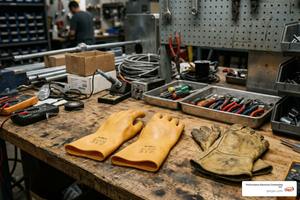
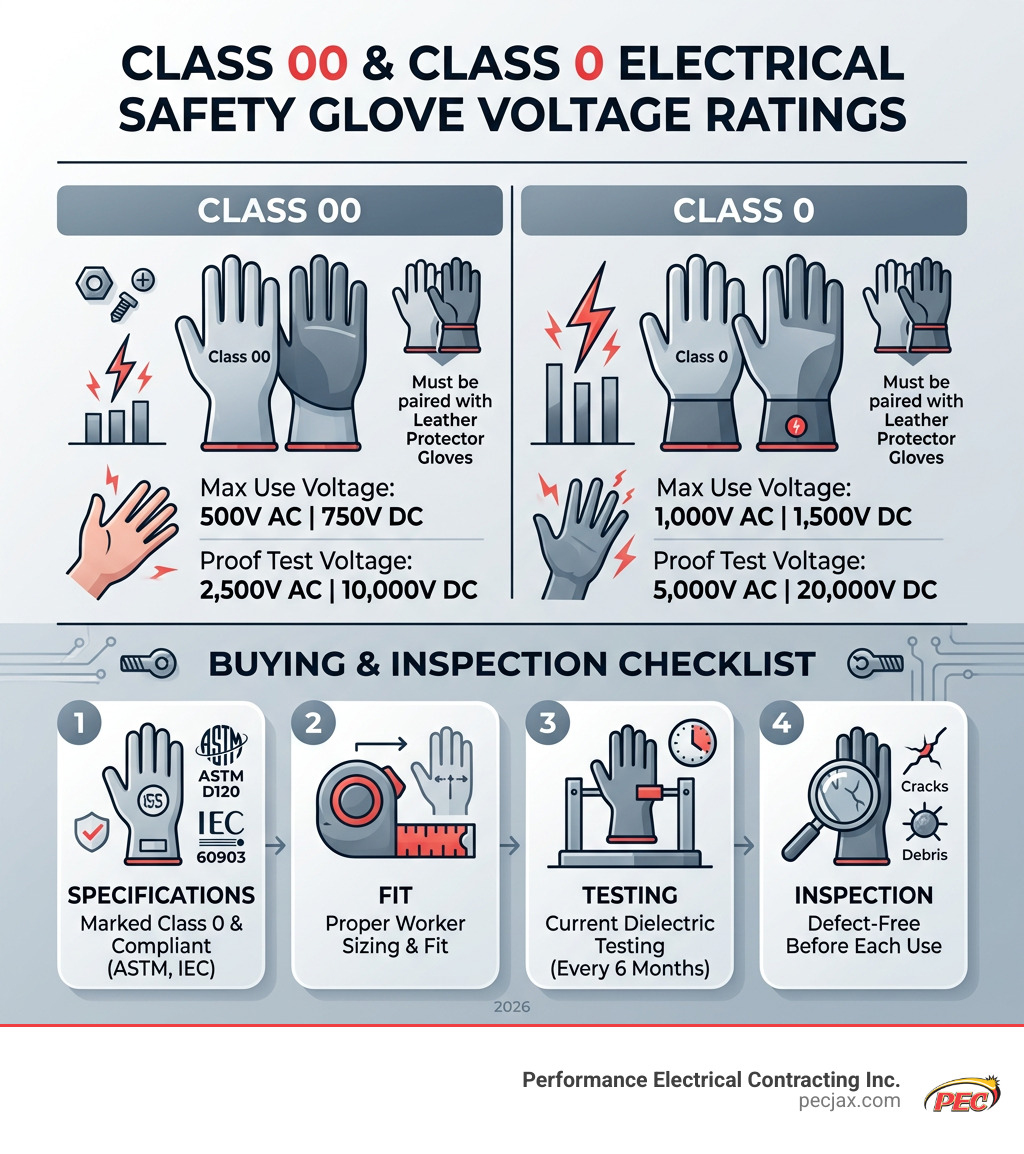
For live work on systems up to 1,000V AC, buy Class 0 rubber insulating gloves. They are rated for a maximum use voltage of 1,000V AC or 1,500V DC and must be paired with properly sized leather protector gloves to prevent cuts, punctures, and wear to the insulating rubber.
Before purchasing electrical safety gloves 1000v, confirm that the glove is:
- Marked Class 0 and compliant with ASTM D120 or IEC/EN 60903, as required for your location
- Sized to fit the worker comfortably, including any approved liner
- Current on dielectric testing, with testing required before first issue and at least every six months under OSHA requirements
- Free of cracks, holes, chemical damage, embedded debris, and other defects before each use
For property managers, this is not just a PPE purchase. The right glove kit helps qualified electrical contractors work safely on commercial panels, HVAC equipment, motor controls, and EV-related equipment while reducing risk, delays, and unplanned downtime. Gloves protect against shock hazards, but they do not replace de-energizing equipment, verifying absence of voltage, or following an arc-flash safety plan.
Understanding Electrical Safety Gloves 1000V and Voltage Classes
Whenever technicians interact with energized equipment, their hands are closest to the hazard. Regulators like OSHA, CSA, and the National Electrical Code (NEC) establish that any circuit energized above 50 volts possesses serious arcing and shock potential. Navigating these requirements means selecting personal protective equipment (PPE) tailored to the exact voltage envelope of the system.
Rubber insulating gloves fall into standardized classes defined by their maximum use voltages and dielectric proof testing limits. Proof testing subjects each glove to an elevated electrical stress level in a controlled laboratory environment to verify that no microscopic pinholes or chemical thin spots exist before the glove reaches the field. Class 0 gloves, designed for nominal systems up to 1,000V AC, undergo an AC proof test of 5,000V.
Understanding the industry standards that power commercial electrical installation helps field teams match the right gear to their daily duties. The table below outlines how voltage classes stack up across the electrical trade:
| Glove Class | Color Tag | Max AC Use Voltage | Max DC Use Voltage | AC Proof Test Voltage | Primary Field Uses |
|---|---|---|---|---|---|
| Class 00 | Beige | 500 V | 750 V | 2,500 V | Control wiring, low-voltage instrumentation |
| Class 0 | Red | 1,000 V | 1,500 V | 5,000 V | Commercial panels, HVAC systems, EV powertrains |
| Class 1 | White | 7,500 V | 11,250 V | 10,000 V | Primary switchgear, distribution sub-panels |
| Class 2 | Yellow | 17,000 V | 25,500 V | 20,000 V | Medium-voltage feeds, overhead line work |
| Class 3 | Green | 26,500 V | 39,750 V | 30,000 V | Heavy industrial switchyards, utility distribution |
| Class 4 | Orange | 36,000 V | 54,000 V | 40,000 V | Substation transformers, transmission networks |
Beyond voltage ratings, gloves are manufactured as either Type I or Type II rubber. Type I gloves use natural rubber latex, providing superior stretch, ergonomic comfort, and tactile responsiveness, but they are vulnerable to atmospheric ozone and environmental pollution. Type II gloves incorporate synthetic elastomers (such as synthetic rubber) specifically engineered to resist ozone cracking. In regions where ambient electrical discharge or intense heat causes elevated ozone levels, Type II gloves help prevent premature material degradation.
Class 00 vs Class 0 Insulating Gloves
A frequent point of confusion on commercial jobsites is whether to outfit technicians with Class 00 or Class 0 gloves. While Class 00 gloves are lighter and thinner, their maximum use voltage caps out at 500V AC (750V DC). This limitation makes them suitable only for low-voltage control circuits and basic lighting distribution.
Class 0 gloves provide the necessary protection for 480V three-phase commercial services, 600V industrial feeds, and systems scaling up to 1,000V AC or 1,500V DC. Because nominal line voltages can experience transient spikes and harmonics, working on a 480V or 600V nominal panel with Class 00 gloves leaves zero margin for error. Class 0 gloves serve as the standard choice for facilities technicians, commercial electricians, and industrial mechanics.
Standards, Certifications, and Glove Tag Colors
Regulatory bodies demand strict adherence to manufacturing and testing benchmarks. In the United States, OSHA 1910.137 and NFPA 70E require insulating gloves to meet the rigid manufacturing and dielectric standards of ASTM D120. Internationally, insulating gloves are manufactured and tested under the harmonized EN 60903 and IEC 60903 standards.
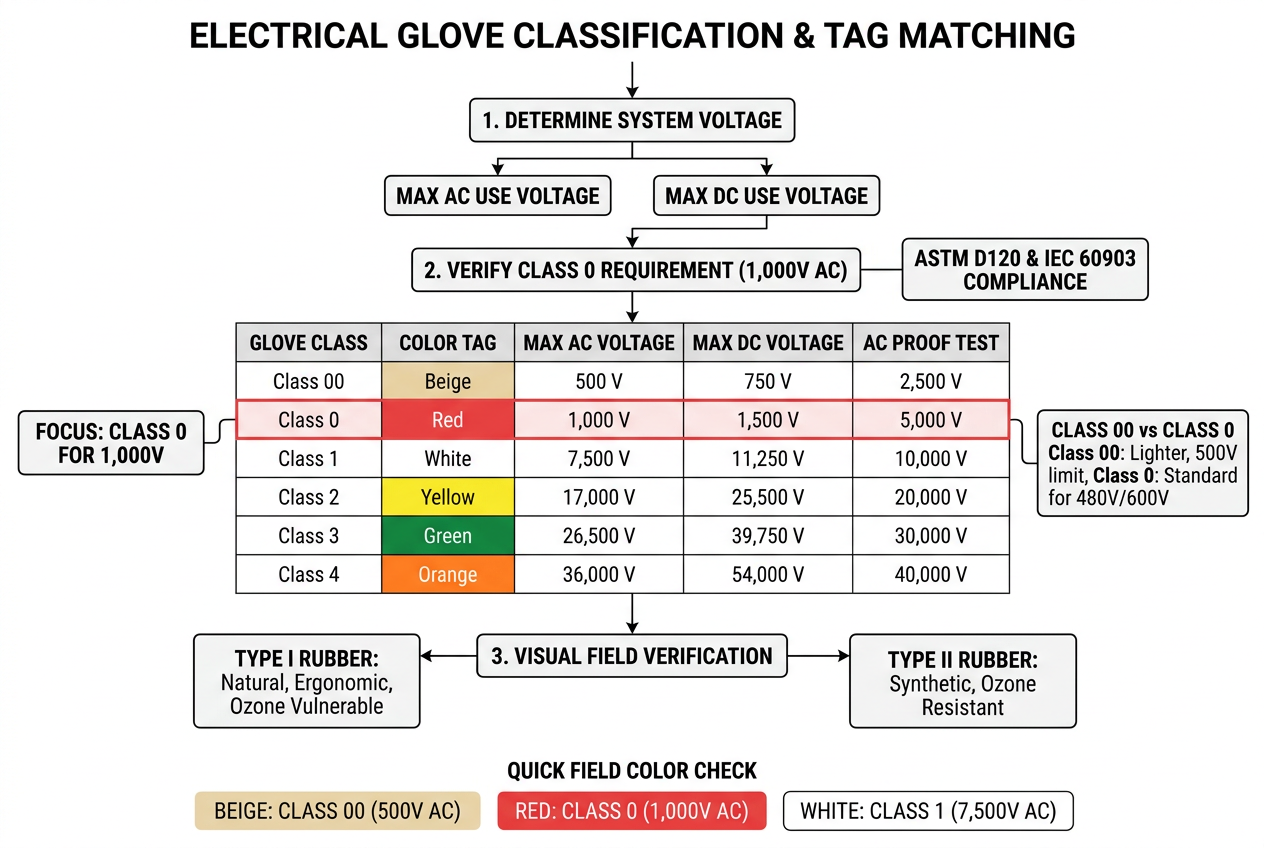
Color-coded wrist tags provide quick visual confirmation of a glove’s voltage rating on active jobsites:
- Beige: Class 00 (500V AC / 750V DC)
- Red: Class 0 (1,000V AC / 1,500V DC)
- White: Class 1 (7,500V AC / 11,250V DC)
- Yellow: Class 2 (17,000V AC / 25,500V DC)
- Green: Class 3 (26,500V AC / 39,750V DC)
- Orange: Class 4 (36,000V AC / 54,000V DC)
Proper documentation and certified PPE are essential when navigating electrical code compliance inspection rules and permits. Having certified, red-tagged Class 0 gloves on-site ensures your crew meets code requirements during testing, commissioning, and maintenance.
Key Materials and Layering for Maximum Shock Protection
High-grade 1kV safety gloves use an aqueous dipping process where anatomically contoured hand molds pass through pure liquid natural latex or synthetic compounds. This process yields a seamless membrane with uniform dielectric thickness (a minimum of 1.00 mm per ASTM D120 for Class 0). The finished glove provides reliable electrical resistance while remaining flexible enough for technicians to manipulate tiny set screws and multimeters.
Why Leather Protector Gloves Are Mandatory
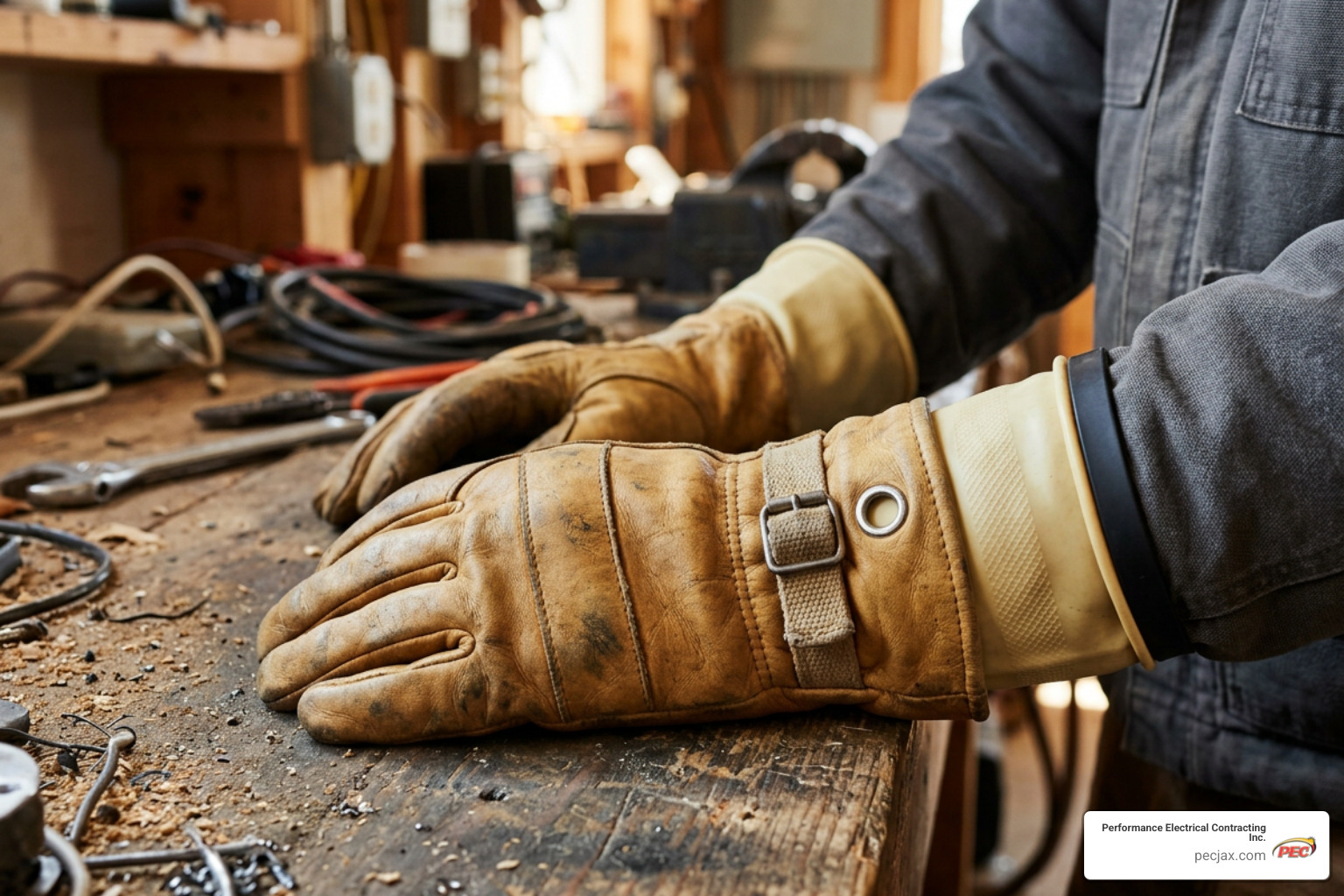
Rubber insulating gloves provide dielectric protection, but they offer little mechanical resistance. Sharp copper strands, sheet metal burrs, panel edges, or dropped hand tools can puncture unshielded rubber, compromising the dielectric barrier.
Leather protector gloves (compliant with ASTM F696) must always be worn over rubber insulating gloves. They serve several essential purposes:
- Mechanical Defense: Top-grain cowhide, goatskin, or deerskin shields the soft rubber beneath from cuts, abrasions, and punctures.
- Arc Thermal Mitigation: Leather provides a sacrificial thermal barrier during arc flash events, preventing high radiant heat from melting the rubber directly onto the technician’s skin.
- Proper Distance Standards: Industry rules mandate a minimum gap between the cuff of the leather protector and the rolled bead of the rubber glove. For Class 0 gloves, the leather protector cuff must end at least 0.5 inches (13 mm) below the rubber glove’s top edge to prevent electrical flashover across the surface.
Never use leather protectors alone as shock-insulating equipment; they protect the rubber, while the rubber protects the worker.
How to Select the Right Electrical Safety Gloves 1000V for Field Work
Gloves that fit poorly increase fatigue and compromise safety. If gloves are too tight, hand movement is restricted, blood flow is impeded, and the rubber is stretched thin, lowering dielectric performance. If gloves are too loose, technicians lose their grip on small components.
To size insulating gloves correctly:
- Wrap a flexible tailor’s tape around the widest part of your palm (just below the knuckles, excluding the thumb).
- Note the measurement in inches. A 9-inch palm measurement generally corresponds to a Size 9 glove.
- Factor in cotton knit liners. These sweat-absorbing liners improve comfort and hygiene during hot Southeast summer shifts, so you may need a half-size larger (e.g., Size 9.5 or 10) to accommodate the extra layer comfortably.
Investing in quality PPE keeps crews productive and safe, helping facility operators understand how electrical maintenance can help prevent costly downtime.
Top Industrial and Commercial Applications for 1kV Gloves
Class 0 gloves serve as the primary PPE for daily electrical work across commercial, institutional, and industrial facilities. Identifying 5 warning signs your commercial electrical system needs immediate attention often requires troubleshooting energized panels before shutting down mains. Equipping technicians with certified 1000V electrical insulating linesman gloves protects them during these critical diagnostic tasks.
Hybrid and Electric Vehicle Maintenance Applications
The rapid adoption of fleet electrification and commercial EV charging hubs has brought high-voltage DC systems directly into local service bays. Modern EV powertrains operate on battery architectures ranging from 400V to 900V DC.
Class 0 gloves (rated up to 1,500V DC) are the standard safety gear for automotive fleet technicians when:
- Pulling manual service disconnects (MSDs)
- Servicing high-voltage junction boxes and DC-to-DC converters
- Diagnosing high-power DC fast-charging infrastructure
- Verifying complete isolation of the high-voltage bus before mechanical repairs
Commercial Facility and Switchgear Operations
Within commercial facilities, technicians regularly interact with 480Y/277V distribution panels, motor control centers, and variable frequency drives (VFDs). Even basic tasks like knowing why you should upgrade old electrical outlets and switches in older commercial properties may reveal deteriorated conductors that require energized troubleshooting.
Technicians rely on Class 0 glove kits to:
- Perform three-point absence-of-voltage tests inside enclosures
- Install branch-circuit breakers in energized panel spaces where complete facility shutdowns are impractical
- Replace high-output commercial ballasts and step-down transformers
- Balance phases across active switchboards during commissioning
Maintenance, Inspection, and Storage Requirements
A top-tier dielectric glove is only as good as its maintenance. Because rubber is sensitive to ultraviolet light, extreme temperatures, mechanical trauma, and industrial chemicals, teams must follow strict care routines.
Always store rubber gloves right-side-out in dedicated heavy-duty canvas storage bags. Never fold, roll, or compress them into toolboxes. Store the canvas bag in a cool, dry, dark environment away from direct sunlight, steam pipes, chemical solvents, oils, and ozone sources like electric motors.
Inspection and Testing Rules for Electrical Safety Gloves 1000V
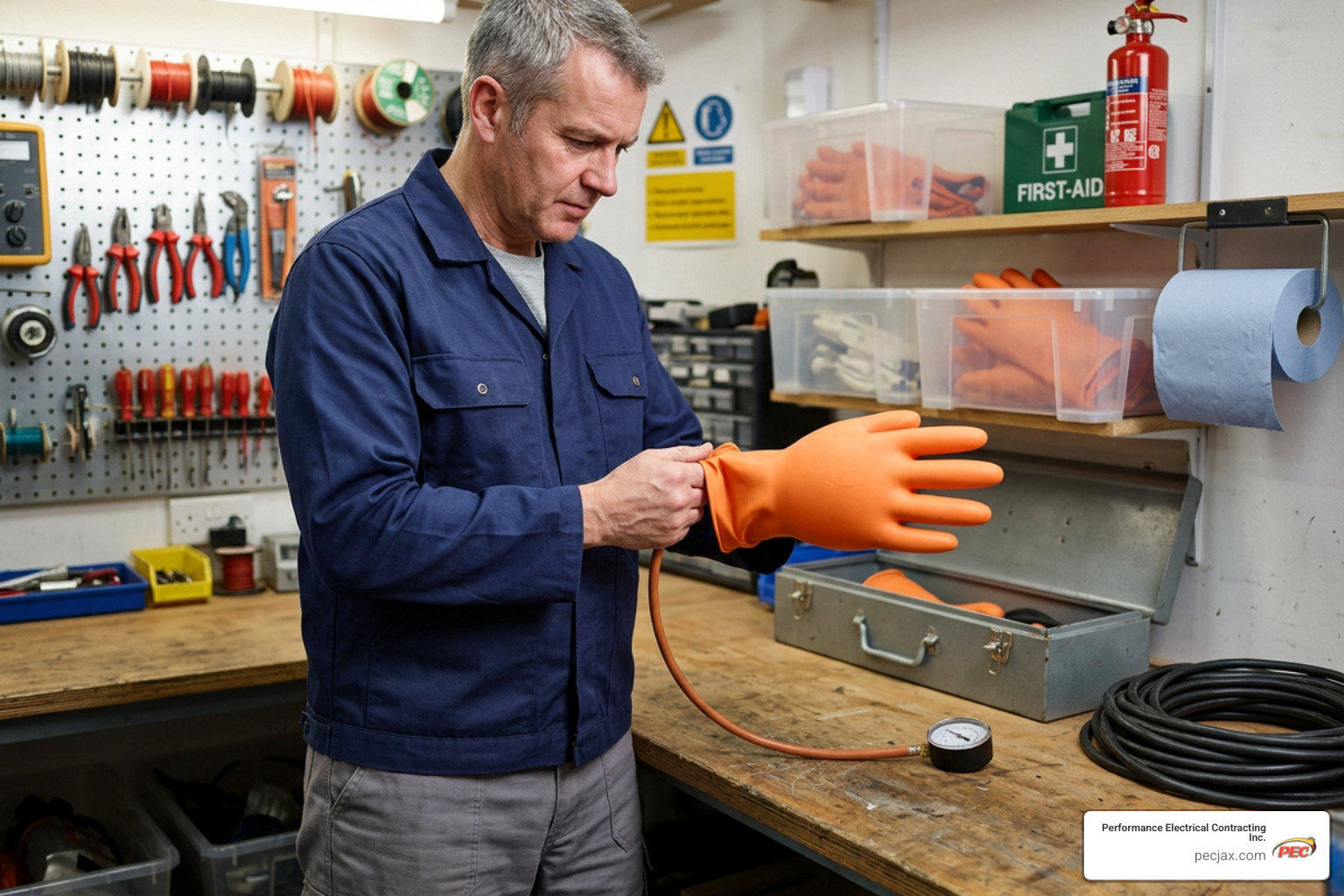
Field safety begins with a two-step inspection before every shift:
- Visual Surface Inspection: Examine the inner and outer rubber surfaces under bright lighting. Look for ozone checking (spiderweb-like cracks), UV fading, cuts, embedded copper slivers, and chemical blisters.
- Manual Air Inflation Test: Roll the cuff tightly toward the fingers to trap air inside the palm. Check the expanded rubber for pinholes, listening closely for escaping air and feeling for leaks against your cheek. Never use compressed air lines, which can overinflate the rubber or inject oil contaminants.
Beyond daily pre-use checks, OSHA Table I-5 mandates periodic laboratory dielectric testing. Rubber insulating gloves must undergo certified retesting every six months once placed into active service. If gloves remain in unopened storage, they must be retested within 12 months of their initial manufacture or previous test date before being issued to the field. Testing must occur at NAIL-accredited facilities that verify voltage withstand capabilities and generate dated calibration compliance reports.
Frequently Asked Questions About 1000V Insulated Gloves
What is the difference between AC and DC voltage ratings for Class 0 gloves?
Class 0 gloves carry a dual rating: a maximum of 1,000V AC and 1,500V DC. This difference stems from the physiological effects and dielectric stress patterns of alternating versus direct current. AC current alternates polarity, creating continuous heating and capacitive stress within the rubber, which requires a lower operating ceiling relative to steady-state DC potentials.
How often must Class 0 rubber insulating gloves be electrically tested?
Under OSHA 1910.137 standards, Class 0 gloves must undergo dielectric laboratory testing before first issue and at least every six months while in service. If gloves are kept in storage and have never been issued, they must be electrically retested if more than 12 months have passed since their previous test date.
Can Class 0 gloves be worn without leather protectors?
No. Wearing rubber insulating gloves without leather protectors exposes the thin latex membrane to cuts, punctures, abrasions, and chemical exposure. A single wire puncture can channel current directly to the skin, causing severe injury. Leather protectors must always be worn over rubber insulating gloves to maintain their dielectric integrity.
Conclusion
Protecting your team against electrical hazards requires certified equipment, thorough training, and consistent safety practices. Selecting properly sized Class 0 electrical safety gloves paired with rugged leather protectors ensures that everyday maintenance, panel upgrades, and EV troubleshooting proceed safely and without incident.
At Performance Electrical Contracting Inc., safety is central to how we deliver commercial, industrial, multifamily, and infrastructure projects across Jacksonville and the Southeast. Whether you need planned facility maintenance, complex switchgear upgrades, or comprehensive commercial installations, our experienced team provides on-time, code-compliant results. Contact us today to learn more about our complete electrical safety solutions and keep your systems operating safely.