Why NFPA 70 Standards Matter for Facility Safety
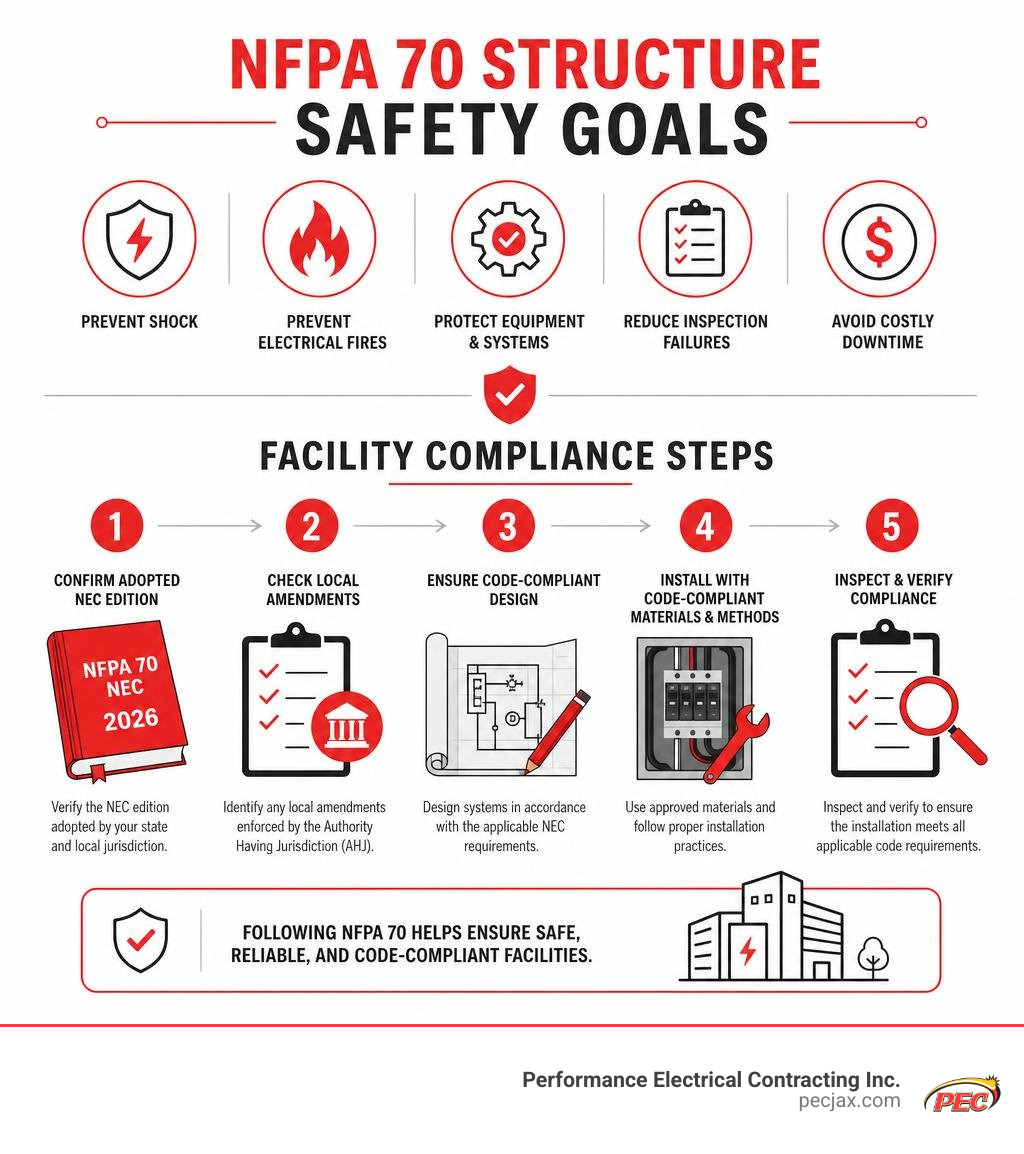
NFPA 70 standards, commonly called the National Electrical Code (NEC), set the baseline rules for safe electrical design, installation, and inspection. For facility managers, they help prevent shock, electrical fires, equipment damage, and costly inspection failures.
Before planning an upgrade, renovation, solar installation, battery system, or EV charging project, confirm three things:
- Which NEC edition your state and local jurisdiction has adopted.
- Any local amendments enforced by the Authority Having Jurisdiction (AHJ).
- That the design, materials, installation, and inspection process meet the applicable code.
The NEC has guided electrical safety since 1897 and is updated every three years. The 2026 NEC is the current edition, but the edition legally required for your building may be older. Local adoption and enforcement determine what applies on site.
This guide explains the NEC in plain language, including core protection rules, grounding, conductor ratings, new energy technology requirements, and the difference between installation rules in NFPA 70 and workplace practices in NFPA 70E.
Understanding the Scope and Structure of NFPA 70 Standards
At its core, NFPA 70 is not a federal statute; it is a model safety standard developed by the National Fire Protection Association (NFPA) and approved by the American National Standards Institute (ANSI). Despite lacking direct federal authority, it serves as the benchmark for electrical installation safety across all 50 U.S. states.
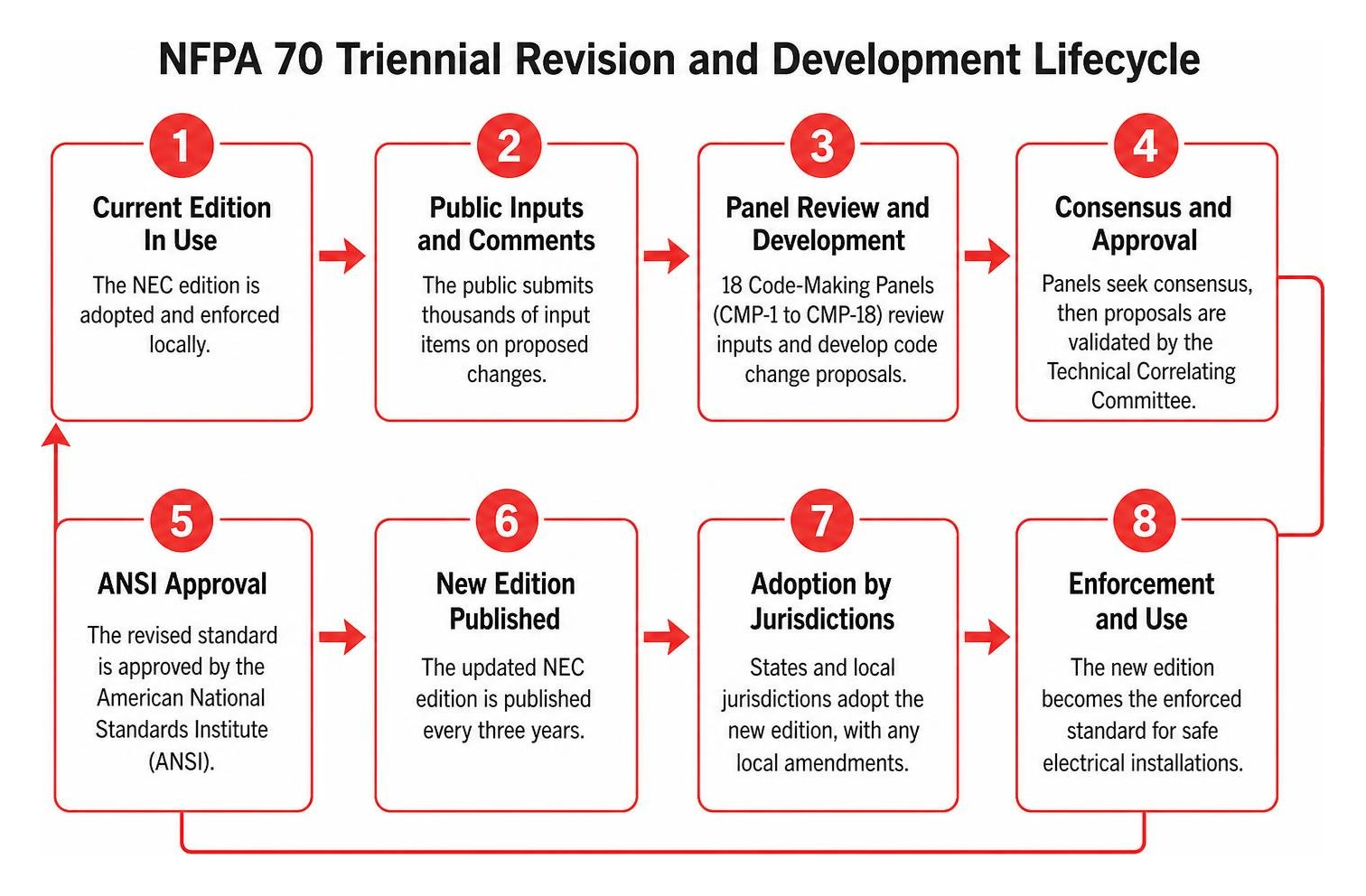
The standard does not write itself behind closed doors. The NFPA 70 (NEC) Code Development process is a consensus-driven effort maintained by 18 specialized Code-Making Panels (CMP-1 through CMP-18) overseen by a Technical Correlating Committee. These panels consist of electrical engineers, installation contractors, testing lab representatives, union delegates, fire marshals, and building inspectors.
Every three years, the panels review thousands of public inputs and comments to publish a revised edition. As of August 2026, the active edition is the 2026 NEC, representing 46 distinct editions published over its 125-plus-year lifespan.
Core Objectives and the Role of the National Electrical Code
The primary objective of the NEC, formally stated in Article 90.1, is the practical safeguarding of persons and property from hazards arising from the use of electricity. Electrical failures remain one of the leading causes of commercial property loss and structural fires. When we examine the industry standards that power commercial electrical installation, NFPA 70 stands as the foundation because it eliminates the guesswork behind conductor sizing, short-circuit protection, physical cable routing, and thermal safety.
Crucially, the NEC is an installation standard, not a design specification manual or an instruction book for untrained individuals. It establishes the bare minimum requirements necessary for an electrical system to operate safely, free from electrocution and thermal ignition hazards, throughout its operational life.
Chapter Breakdown from Wiring Design to Special Conditions
The National Electrical Code spans around 1,000 pages of technical requirements organized into nine core chapters, followed by Informative Annexes A through K:
- Chapter 1: General (Articles 100–110) — Covers essential definitions, electrical equipment examination, installation requirements, and dedicated working space clearances around switchboards and panelboards.
- Chapter 2: Wiring and Protection (Articles 200–250) — Details branch circuits, feeders, service entrance equipment, overcurrent protective devices, and grounding/bonding rules.
- Chapter 3: Wiring Methods and Materials (Articles 300–398) — Governs raceways, conduit types (EMT, PVC, RMC), cable assemblies, junction box sizing, and physical conductor protections.
- Chapter 4: Equipment for General Use (Articles 400–490) — Regulates everyday fixtures, flexible cords, panelboards, switchgear, electric motors, air-conditioning equipment, and transformers.
- Chapter 5: Special Occupancies (Articles 500–590) — Establishes stringent requirements for hazardous (classified) locations containing flammable vapors or dusts, health care facilities, commercial garages, and temporary wiring.
- Chapter 6: Special Equipment (Articles 600–695) — Governs electric signs, elevators, electric vehicle supply equipment, swimming pools, and solar photovoltaic (PV) arrays.
- Chapter 7: Special Conditions (Articles 700–760) — Regulates emergency power systems, standby systems, energy storage installations, and fire alarm circuits.
- Chapter 8: Communications Systems (Articles 800–840) — Dedicated to communications circuits, network cabling, radio and television equipment, and optical fiber cables.
- Chapter 9: Tables — Contains mandatory mathematical tables for conductor dimensions, conduit fill percentages, and raceway properties.
- Informative Annexes (A through K) — Provides non-mandatory engineering calculations, conduit fill formulas, reference standards, and model administration rules.
NFPA 70 vs. NFPA 70E: Installation vs. Workplace Safety
A common point of confusion among building owners and plant engineers is the distinction between NFPA 70 and NFPA 70E. While their numbers sound almost identical, their regulatory mandates, enforcement mechanisms, and everyday applications serve completely different purposes.
| Feature | NFPA 70 (National Electrical Code) | NFPA 70E (Electrical Safety in the Workplace) |
|---|---|---|
| Primary Focus | Safe installation of wiring and electrical hardware | Safe work practices for maintenance personnel |
| Target Audience | Electrical engineers, contractors, installers, AHJs | Facility managers, safety directors, plant electricians |
| Core Goal | Prevent electrical fires, faults, and physical structural hazards | Eliminate workplace arc-flash, blast, and shock injuries |
| Legal Status | Adopted directly into municipal and state building codes | Referenced by OSHA under General Duty Clause & Subpart S |
| Trigger Point | New construction, facility additions, tenant buildouts | Daily maintenance, servicing, inspections, panel troubleshooting |
| Key Mandate | Clearances, wire sizes, overcurrent devices, grounding | PPE categories, boundary lines, de-energized conditions |
Applying NFPA 70 Standards to Facility Design and Construction
NFPA 70 governs the physical infrastructure installed behind your facility’s walls, inside utility rooms, and above drop ceilings. When planning a commercial renovation, the NEC dictates exact requirements: how many branch circuits must serve a mechanical room, the minimum depth of working space in front of an 800-amp switchboard (Section 110.26), and how conduit must be anchored to concrete slabs.
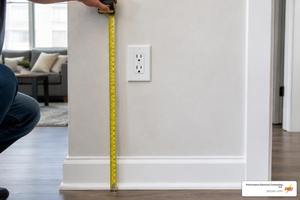
It also covers architectural specifics. For example, maintaining accessibility and safety when locating devices requires knowing the standard light switch height requirements explained by code. Adhering to NFPA 70 ensures that once the building official issues the certificate of occupancy, the building’s permanent wiring can operate without overheating or sparking.
Navigating Operational Safety and OSHA Alignment with NFPA 70E
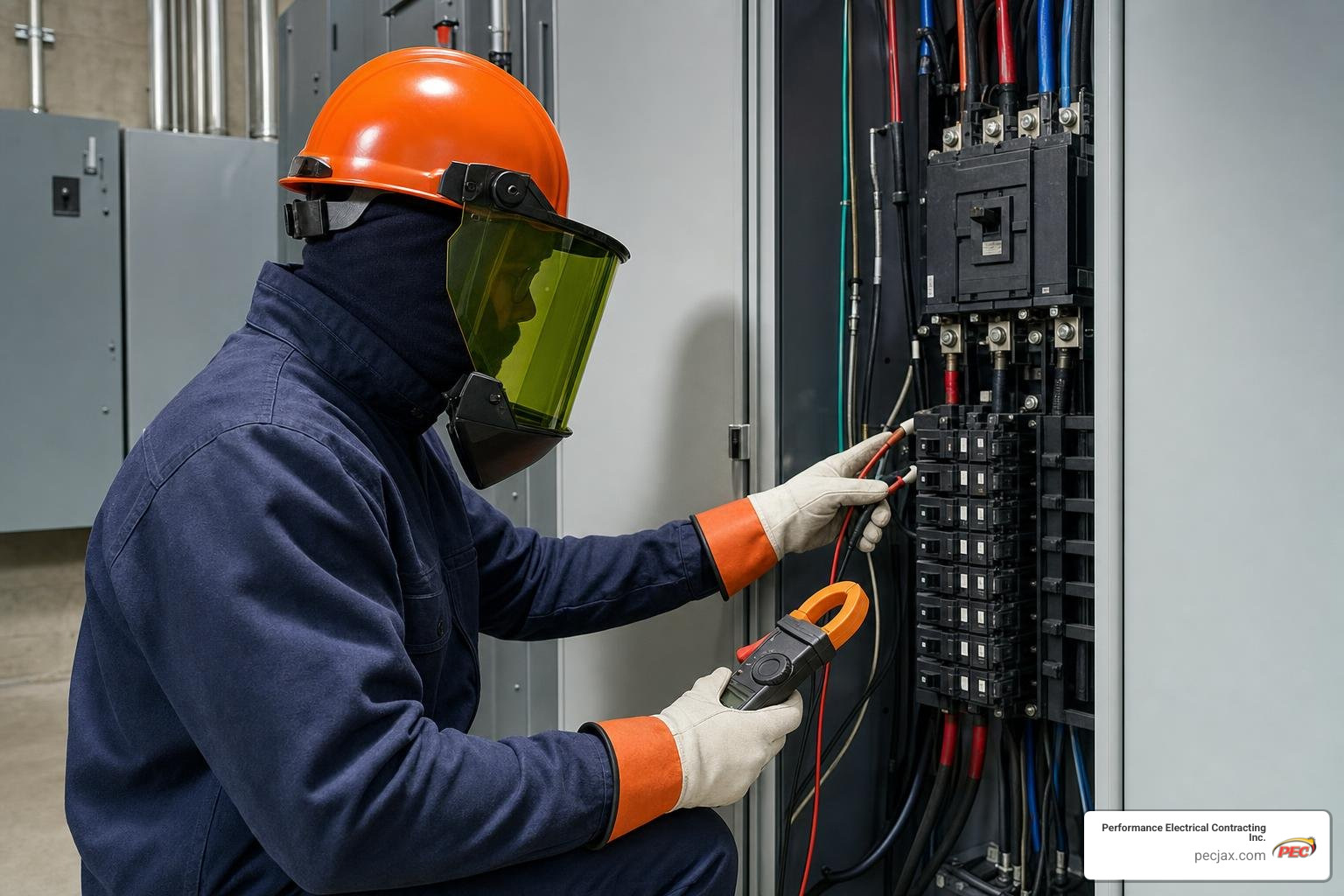
Once your electrical system is energized and operational, the focus shifts to personnel safety. This is where NFPA 70E comes into play. Developed at OSHA’s request, NFPA 70E provides actionable work practices that satisfy OSHA Subpart S (29 CFR 1910) and Subpart K (construction).
Under NFPA 70E, working on energized equipment is strictly restricted to situations where de-energizing introduces additional hazards or is completely infeasible. If justified live troubleshooting is required, NFPA 70E mandates:
- Formal, documented Energized Electrical Work Permits.
- Shock and arc-flash risk assessments to define boundary perimeters.
- Verified personal protective equipment (PPE) based on calculated incident energy levels.
- A dedicated second qualified safety observer during justified live work tasks.
While NFPA 70 guarantees your electrical room will not catch fire under nominal load, NFPA 70E makes sure your in-house technicians return home safely after performing maintenance.
Key Code Mandates: Protection, Grounding, and Temperature Ratings
Meeting NFPA 70 requires precise attention to protective devices, fault-clearing paths, and conductor heat dissipation. Misinterpreting these core mandates can lead to tripped breakers, damaged equipment, or catastrophic arc faults.

GFCI, AFCI, and Equipment Protection Protocols
The NEC relies on specialized protective devices to shield both humans and property from distinct failure modes:
- Ground-Fault Circuit-Interrupters (GFCI): Designed specifically for personnel protection, a Class A GFCI continuously monitors the balance of current between the ungrounded (hot) and grounded (neutral) conductors. If current leaks to ground anywhere between 4 to 6 milliamperes (mA), the device trips within milliseconds. Section 210.8 mandates GFCI protection across all commercial kitchens, bathrooms, outdoor locations, rooftops, and near wet sinks.
- Arc-Fault Circuit-Interrupters (AFCI): While GFCIs protect humans from shock paths, AFCIs protect buildings from fires. An AFCI detects unintended, erratic electrical arcing across damaged insulation or loose terminal connections that would not pull enough current to trip a standard thermal-magnetic breaker.
- Short-Circuit and Overcurrent Protection (Article 240): Circuit breakers and fuses must be rated to interrupt prospective fault currents (Short-Circuit Current Rating / SCCR). If an available fault current from the utility transformer reaches 42,000 amps, a breaker rated for only 10,000 Interrupting Capacity (AIC) will explode during a bolted fault.
Grounding, Bonding, and Ampacity Derating Rules
Grounding and bonding under Article 250 are critical to power quality and life safety. Grounding connects the electrical system to the earth (via ground rods, concrete-encased electrodes, or ground rings) to stabilize voltage during lightning strikes and line surges. Bonding joins all non-current-carrying metal parts together (conduit, equipment enclosures, structural steel) to create a low-impedance electrical path back to the electrical source. This low-impedance path allows enough fault current to flow instantly, ensuring the circuit breaker trips immediately during a ground fault.
Conductor sizing requires careful attention to thermal dynamics. Wire ampacity is governed by Article 310 and depends on insulation temperature ratings ($60^circtext{C}$, $75^circtext{C}$, or $90^circtext{C}$) and environmental conditions:
- Conduit Fill Derating: When more than three current-carrying conductors share a single raceway, cumulative heat cannot easily escape. NEC Table 310.15(C)(1) requires derating the conductor’s allowable ampacity (for example, applying an 80% adjustment factor for 4 to 6 conductors).
- Ambient Temperature Adjustments: Conductors operating in mechanical rooms or outdoors in hot climates must be derated if the ambient temperature exceeds $30^circtext{C}$ ($86^circtext{F}$).
- Rooftop Solar Adjustments: Conductor raceways exposed to direct sunlight on commercial rooftops experience significant solar heating, requiring specific temperature adders to prevent insulation breakdown.
Modern Technology Integration in the 2023, 2026, and 2029 Code Cycles
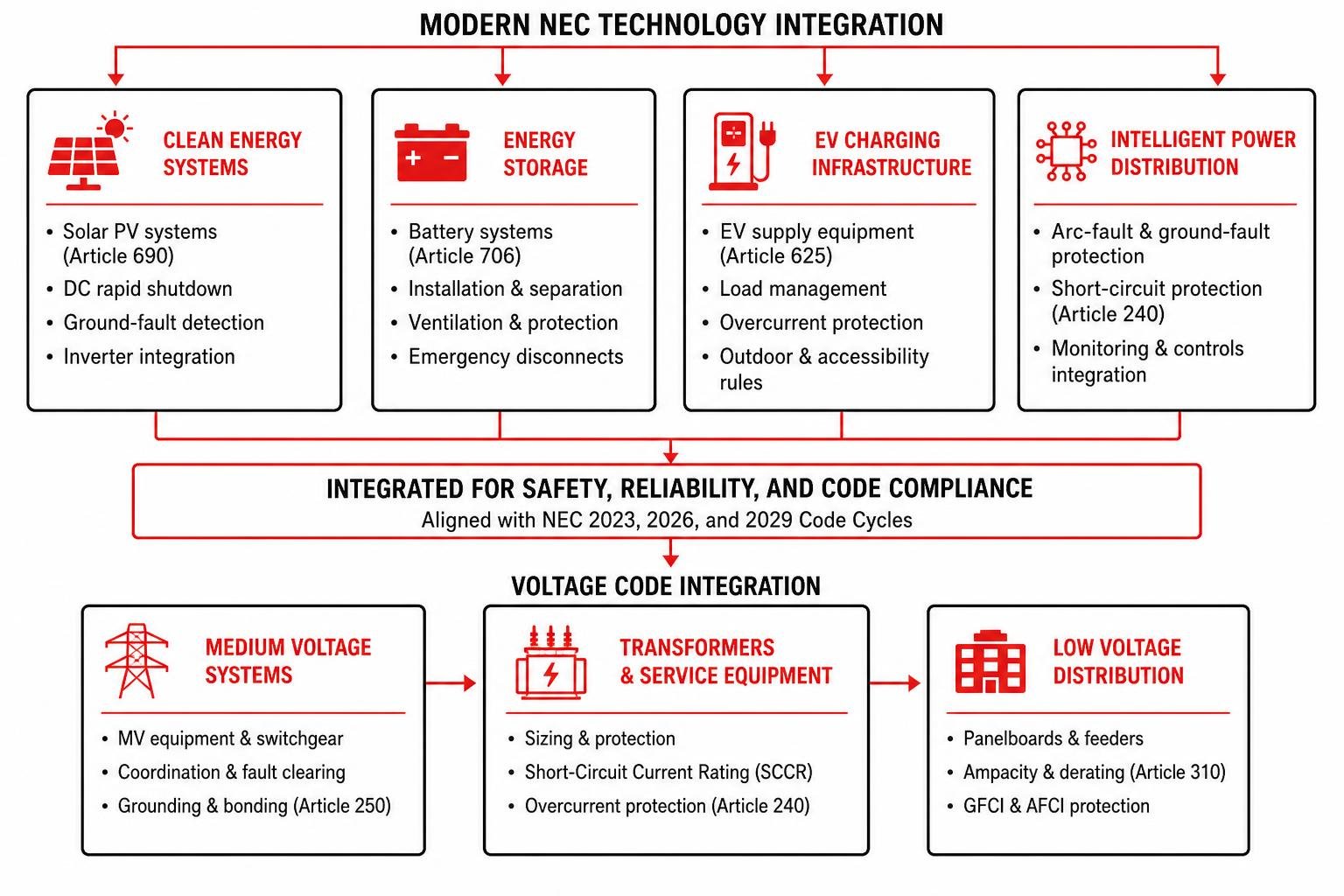
The electrical industry is changing rapidly, driven by electrification, renewable generation, microgrids, and intelligent power distribution. In response, the NEC is undergoing a major multi-cycle reorganization that began in the 2023 edition, expanded in the NFPA 70, National Electrical Code (NEC) Handbook (2026), and will conclude in the 2029 code cycle.
Clean Energy Systems, Storage, and EV Infrastructure Under NFPA 70 Standards
Commercial facilities are no longer just passive consumers of grid power; they are active power producers and storage hubs:
- Solar Photovoltaic (PV) Systems (Article 690): The code establishes strict safety rules for DC array rapid shutdown, ground-fault detection, and inverter integration, preventing dangerous DC arcs and protecting first responders on facility rooftops.
- Energy Storage Systems (Article 706): In earlier editions, battery banks were governed simply under standby battery rules (Article 480). Article 706 explicitly regulates high-density commercial Energy Storage Systems (ESS), mandating detailed commissioning, emergency ventilation, and physical clearances to mitigate lithium-ion thermal runaway risks.
- Electric Vehicle Power Transfer (Article 625): The NEC has moved well beyond basic Level 2 charging stations. Article 625 now provides comprehensive rules for bidirectional charging and Electric Vehicle Power Export Equipment (EVPE), allowing electric vehicle fleets to act as backup power generation sources for commercial facilities during utility outages.
Reorganization of High-Voltage and Class 4 Fault-Managed Circuits
To simplify code navigation, technical panels restructured the NEC’s voltage boundaries. Historical voltage divisions (such as the traditional 600V threshold) have been modernized to establish clean cutoff points at 1,000 Volts AC and 1,500 Volts DC across all wiring and equipment articles.
Additionally, Article 726 regulates Class 4 Fault-Managed Power Systems (FMPS). Unlike traditional power-limited circuits (Class 2 and Class 3), Class 4 systems deliver hundreds of watts over long-distance, small-gauge twisted-pair cables. They monitor the circuit for human touch, short circuits, or ground faults hundreds of times per second, cutting power instantly before an electric shock or fire can occur. This technology is quickly becoming the standard for powering intelligent LED lighting networks, 5G transmitters, and IoT infrastructure in modern facilities.
Adoption, Enforcement, and Legal Compliance Across Jurisdictions
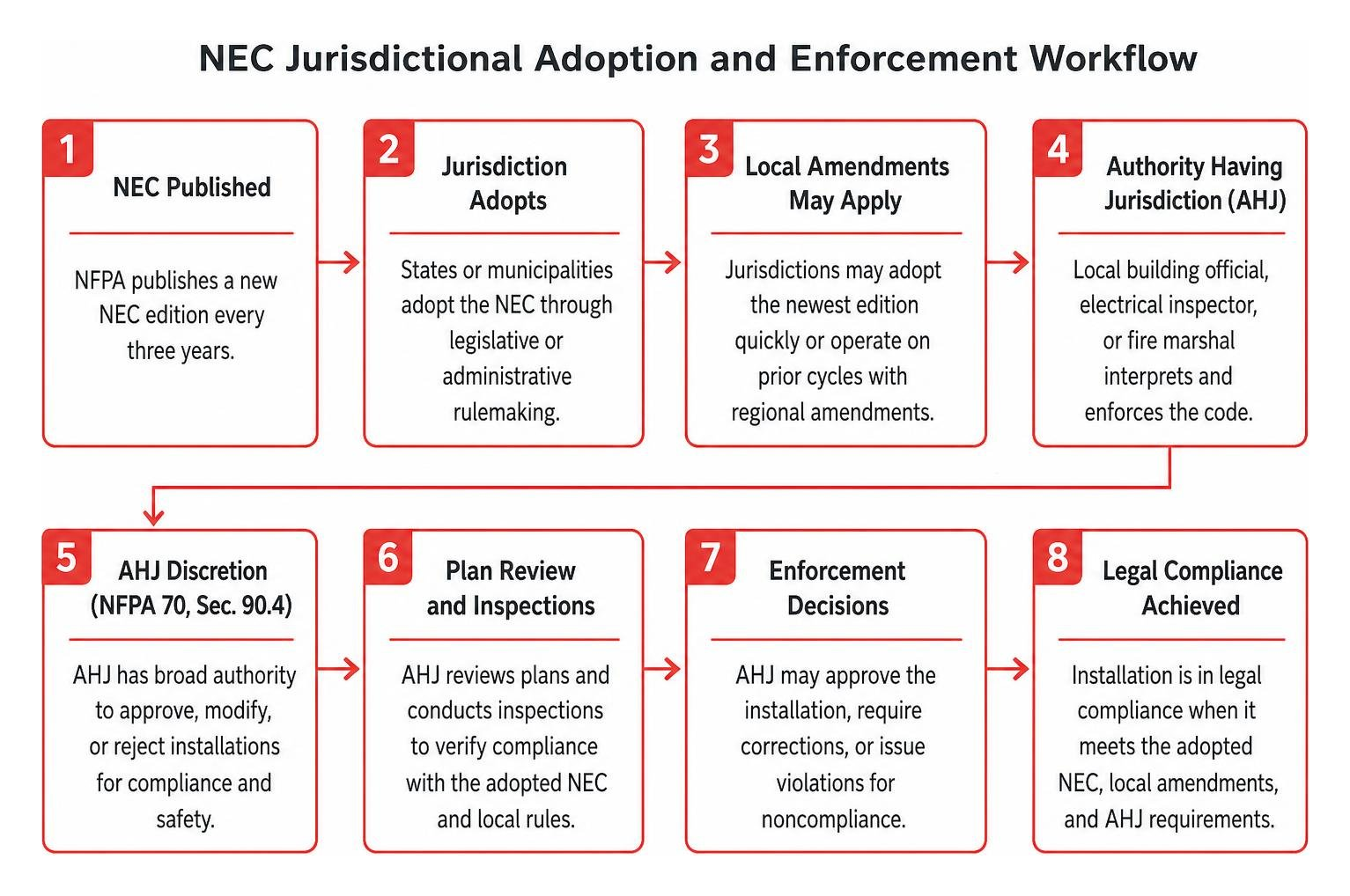
One of the most important lessons for any facility manager is that the NEC is not self-enforcing. Publishing a new code edition every three years does not instantly make it statutory law in your municipality.
Authority Having Jurisdiction (AHJ) Powers and Inspection Protocols
States and municipalities adopt the NEC through legislative or administrative rulemaking, often modifying the model code with regional amendments. For instance, some states adopt the newest edition within months, while others operate on prior cycles.
The individual responsible for interpreting and enforcing these rules on your project is the Authority Having Jurisdiction (AHJ)—typically the local municipal building official, electrical inspector, or fire marshal. The AHJ holds broad discretionary power under Section 90.4 to:
- Approve equipment and wiring methods.
- Grant variances or waivers for practical difficulties.
- Reject installations that do not comply with the adopted code, even if designed by a licensed professional engineer.
- Require field evaluation testing for non-listed or custom-built switchgear assemblies.
When coordinating renovations, you can save significant time and money by navigating electrical code compliance inspection rules and permits proactively with local officials before construction begins.
Public Access, NRTL Listing, and Model Code Adoptions
Under Section 110.2 and 110.3, the NEC requires all electrical equipment to be approved. In practical terms, this means materials must be listed and labeled by an OSHA-approved Nationally Recognized Testing Laboratory (NRTL), such as Underwriters Laboratories (UL), Intertek (ETL), or CSA Group. The AHJ will verify that equipment is installed in strict accordance with any instructions included in its commercial listing.
Because safety codes serve the public interest, many wonder about access costs. While printed codebooks and digital subscriptions carry licensing fees that fund the NFPA’s independent consensus panels, the NFPA provides free online read-only access to all safety standards through its website. Facility managers can register for a free account to review any edition of the NEC directly from their web browser.
Frequently Asked Questions About NFPA 70
What is the difference between NFPA 70 and local electrical codes?
NFPA 70 is a model code written by national technical committees. A local electrical code is the enforceable law enacted by your state, county, or municipal government. While most local codes adopt NFPA 70 wholesale, jurisdictions frequently add localized amendments, delete specific articles, or alter administrative permitting requirements. The locally adopted version is always the legal standard enforced on your job site.
How often are NFPA 70 editions updated and enforced?
The NFPA updates and publishes the National Electrical Code on a strict three-year cycle (such as the 2020, 2023, and 2026 editions). However, legal enforcement depends entirely on how quickly your state or municipality adopts each new edition. It is common for a local jurisdiction to enforce the 2020 or 2023 edition while the 2026 code is already published.
Can facility managers access the National Electrical Code for free online?
Yes. The NFPA makes all of its codes and standards available for free, read-only public review on its official website. After creating a free account, you can select NFPA 70, choose your jurisdiction’s adopted edition year, and search through chapters and articles using the built-in digital viewer.
Maintaining Safe, Compliant Facilities
Managing commercial electrical infrastructure requires vigilance, technical understanding, and reliable professional partners. Overlooking simple code mandates—such as dedicated switchboard clearances, continuous grounding paths, or ampacity derating—can lead to project delays, failed municipal inspections, equipment downtime, or serious workplace hazards.
As a facility manager, the best approach is to conduct regular electrical system audits and partner with pre-qualified electrical contractors who understand local code amendments inside and out. To keep your commercial or multifamily properties fully compliant and operating smoothly, review our guide on common electrical code violations in Florida and how to avoid them. Our team at Performance Electrical Contracting Inc. is always here to help you navigate code updates, design safe power distributions, and deliver projects on time and within budget.